
A cable that looks big enough in the catalogue can overheat on site once real temperature and grouping are applied.
Cable derating factors reduce the catalogue current rating of a cable to match real installation conditions. Ignoring them is one of the most common causes of overheated cables and nuisance tripping.
What Are Cable Derating Factors?
Cable derating factors are multipliers below 1.0 that reduce the tabulated current rating of a cable when site conditions are worse than the standard reference conditions. They are a core part of cable sizing and ampacity calculations.
Catalogue ratings assume ideal conditions, such as 30 °C air, a single circuit and standard soil. Real plants have hot roofs, crowded cable trays and dry soil, all of which stop heat escaping.
Heat is the real limit. XLPE insulation is typically rated for a 90 °C conductor temperature and PVC for 70 °C, and any condition that traps heat pushes the conductor toward those limits.
Standards such as IEC 60364 5 52, BS 7671 and AS/NZS 3008 publish tables of correction factors. In India, designers usually follow IEC values along with the cable maker catalogue.
5 Crucial Cable Derating Factors to Check
Not every factor applies to every cable. A cable on a tray needs air temperature and grouping, while a buried cable needs ground temperature, soil resistivity, depth and grouping.
Other conditions such as direct sunlight, thermal insulation and harmonic currents can also need correction. ELEK lists nine factors in total for Australian practice.
Typical IEC Correction Values
| Condition | Value | XLPE Factor | PVC Factor |
|---|---|---|---|
| Ambient air | 30 °C | 1.00 | 1.00 |
| Ambient air | 40 °C | 0.91 | 0.87 |
| Ambient air | 50 °C | 0.82 | 0.71 |
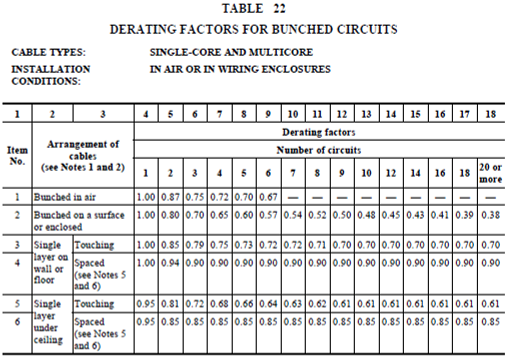
| Bunched circuits | 2 circuits | 0.80 | 0.80 |
| Bunched circuits | 3 circuits | 0.70 | 0.70 |
| Bunched circuits | 6 circuits | 0.57 | 0.57 |
These values come from IEC 60364 5 52 tables B.52.14 and B.52.17. PVC loses rating faster with heat because its maximum temperature is lower.
In hot Indian summers, roof and outdoor trays often see 45 to 50 °C. That alone can cut ampacity by close to 20 percent for XLPE and nearly 30 percent for PVC.
Cable Derating Formula With a Worked Example
Iz = derated current capacity
It = tabulated current rating
Ca = ambient temperature factor
Cg = grouping factor
Cs, Cd = soil and depth factors for buried cable
Worked example, XLPE cable on tray:
It = 150 A
Ambient 40 °C, Ca = 0.91
3 circuits bunched, Cg = 0.70
Iz = 150 × 0.91 × 0.70
Iz = 95.6 A
The cable drops from 150 A to about 96 A just from heat and grouping. If the load is 110 A, you must choose a bigger size or spread the circuits apart.
After derating, also check voltage drop and short circuit withstand. The final size is the largest one needed by any of these checks.
Buried Cables and Soil Conditions
Buried cables depend on the soil to remove heat. IEC uses 2.5 K.m/W as its reference soil resistivity, and wetter soil at 1.0 K.m/W gives a factor of 1.18, which actually increases the rating.
Dry, sandy or backfilled soil can be worse than the reference. Ask for a site soil survey on large projects instead of guessing.
Depth also matters because deeper cables are further from the cool surface. Group spacing in trenches has its own factor tables separate from tray grouping.
Where Derating Is Most Often Missed
Motor circuits deserve extra care, as explained in cable sizing for motor feeders. Starting current and ambient heat together can push small cables past their limit.
Crowded trays also affect fill limits. Our guide on cable tray fill calculation pairs well with grouping derating.
Harmonic currents from drives heat the neutral conductor as well, as shown in THD calculation. Large harmonic loads may need a reduction factor or a bigger neutral.
How to Apply Cable Derating Factors on a Project
First fix the installation method, because the tabulated rating depends on it. Then list every condition along the route and pick the worst section, since the cable is only as good as its hottest point.
Multiply all relevant factors and apply them to the tabulated rating. Then confirm that the derated rating is above the design current and coordinated with the MCCB rating.
Record the factors used in the cable schedule, along with the earth conductor size. This makes future checks easy when new circuits are added to the same tray.
Cable Derating Calculator
Enter 1.00 for any factor that does not apply. Use the cable maker tables when they differ from general IEC values.
- Cables stay below their temperature limit.
- Longer insulation life.
- Fewer nuisance trips and hot spots.
- Compliance with wiring standards.
- Overheated insulation and early failure.
- Fire risk in crowded trays.
- Unexpected voltage drop.
- Costly rework after commissioning.
Cable Sizing Criteria PDF
Derating Factor Calculation Video
Cable Derating Factors FAQ
Related Articles
- Cable Sizing and Ampacity Explained
- Cable Size for Load Current
- Voltage Drop Calculation
- Cable Tray Fill Calculation
- Short Circuit Current Calculation
External References
- Cable Current Rating Derating Factors, ELEK Software
- IEC 60364 Correction Factors, ECalPro
- General Method for Cable Sizing, Electrical Installation Guide
- Electrical Cable Sizing Criteria
- Ampacity, Wikipedia
What We Learn Today
- Derating reduces catalogue ratings to match real heat and grouping conditions.
- All relevant factors are multiplied and applied to the tabulated rating.
- The hottest, most crowded section of the route decides the cable size.