
Four different letters on a panel schedule, and each one protects against a completely different failure, not interchangeable versions of the same device.
Mixing up which device handles overload current and which one watches for earth leakage is exactly how a panel ends up under protected or absurdly over specified.
An MCB and an MCCB both watch current draw. An ELCB and an RCCB both watch for leakage to earth, but they sense it in completely different ways.
This guide lines up all four side by side, then hands over a tool that recommends the right device for a given load and earth leakage requirement.
MCB vs MCCB vs ELCB vs RCCB comes down to what each device is built to detect: MCB and MCCB trip on overload and short circuit current, sized for domestic and industrial loads respectively, while ELCB and RCCB trip on earth leakage current, with RCCB now the modern standard and ELCB considered a largely outdated technology.
A panel schedule that lists all four devices side by side can look confusing at first glance, since every one of them is broadly described as a circuit breaker.
The confusion clears up once the actual failure mode each device is watching for is separated out from the rest.
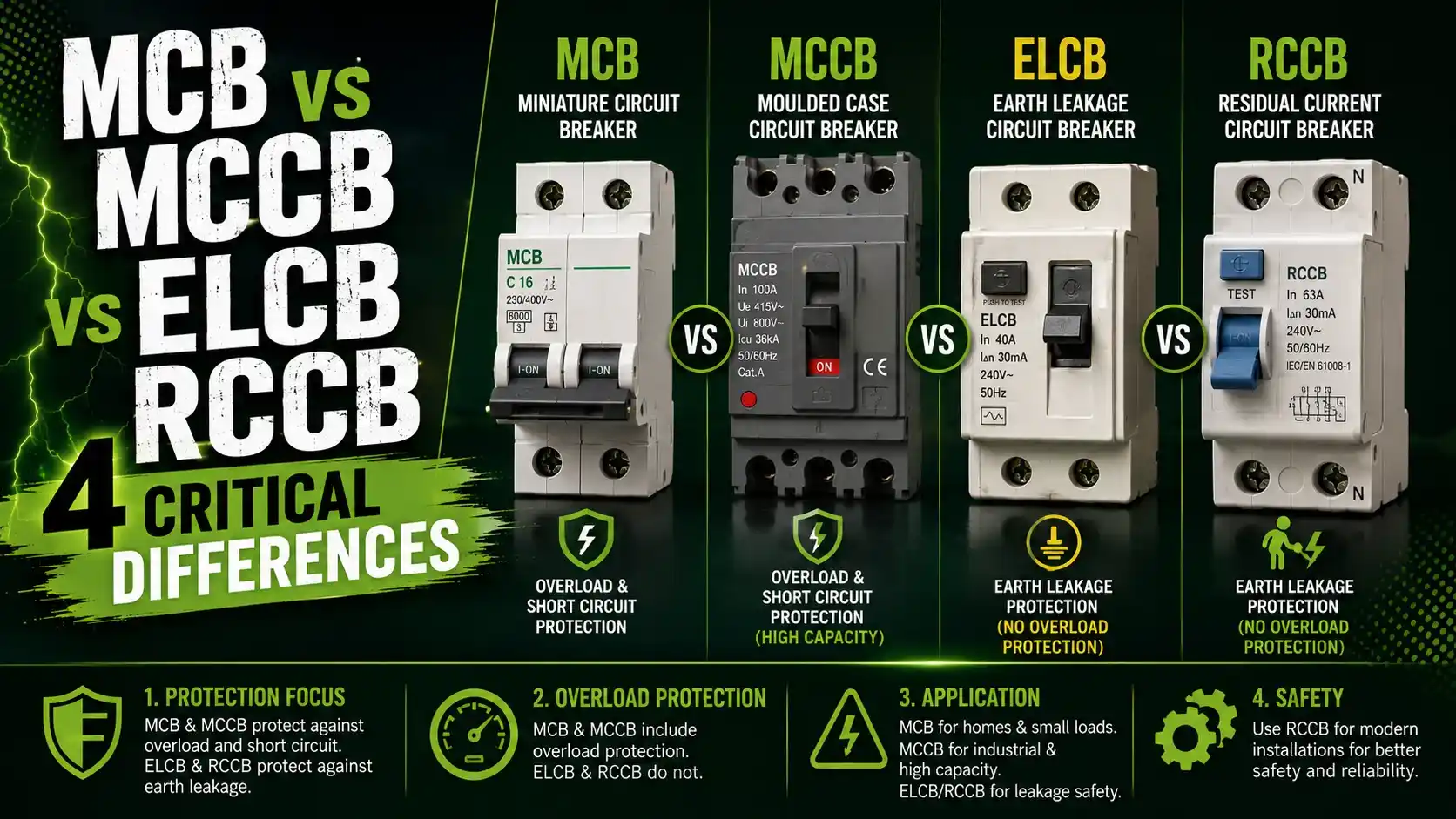
This article walks through what each device senses, the current ratings each one is built for, and a calculator that recommends the right device combination for a given load.
What an MCB Actually Protects Against
A Miniature Circuit Breaker, MCB, protects a circuit against overload current and short circuit current, the two failure modes that show up as excess current draw.
Inside an MCB, a bimetallic strip handles the slow overload case, bending as it heats up until it releases the trip mechanism, while a magnetic coil handles the fast short circuit case, tripping almost instantly once current spikes far above the rated value.
MCBs are sized for domestic and light commercial loads, typically 6A through 125A, with breaking capacity up to about 10kA.
What an MCCB Adds for Industrial Loads
A Molded Case Circuit Breaker, MCCB, protects against the same two failure modes as an MCB, overload and short circuit, just scaled up for industrial current levels.
MCCBs cover ratings from about 16A up to 1600A and beyond, with breaking capacity ranging from 10kA up to roughly 85kA depending on the frame size selected.
Most MCCBs also carry an adjustable trip setting, letting an engineer tune the overload and short circuit thresholds to match the exact load on that circuit, something a fixed rating MCB cannot offer.
How Overload Sensing Differs From Earth Leakage Sensing
An MCB or MCCB has no idea that current is leaking to earth as long as the total draw stays under its rated value, which is exactly why a leakage specific device is needed alongside it, not instead of it.
How an RCCB Detects Earth Leakage
A Residual Current Circuit Breaker, RCCB, continuously compares the current flowing out through the live conductor against the current returning through the neutral conductor.
Under normal conditions those two values match exactly. The moment current starts leaking to earth through a fault, a damaged cable, or a person touching a live part, the two values stop matching, and that difference is what trips the RCCB.
Sensitivity as low as 10mA is available, with 30mA, 100mA, and 300mA the common standard thresholds, and the response time is measured in milliseconds, fast enough to prevent a dangerous shock.
Why ELCB Is Considered Legacy Technology
An Earth Leakage Circuit Breaker, ELCB, works on a different principle. It senses the voltage that appears on the earth conductor once leaked current raises its potential above a safe reference, typically around 50V.
That voltage based sensing only works reliably if the earth connection itself is strong and low resistance. A poor or corroded earth connection can leave an ELCB unable to detect a genuine leakage fault at all.
Current differential sensing does not depend on earth connection quality the same way, which is why RCCB has replaced ELCB as the modern standard, and is now mandated in high risk wet areas like bathrooms and outdoor sockets.
Four Devices, Four Distinct Jobs
MCB
Overload and short circuit protection for domestic and light commercial circuits, 6A to 125A.
MCCB
Overload and short circuit protection scaled for industrial panels, 16A up to 1600A and beyond.
ELCB
Legacy earth leakage device, senses voltage on the earth conductor, phased out in most new installs.
RCCB
Modern earth leakage device, senses current differential, now the mandated standard for shock protection.
Ratings and Sensing Compared
| Device | Protects Against | Typical Rating | Sensing Method |
|---|---|---|---|
| MCB | Overload, short circuit | 6A to 125A | Bimetallic strip and magnetic coil |
| MCCB | Overload, short circuit | 16A to 1600A+ | Thermal and magnetic, adjustable trip |
| ELCB | Earth leakage | Up to 100A | Voltage on earth conductor, needs 50V+ threshold |
| RCCB | Earth leakage | 16A to 100A | Live to neutral current differential, 30 to 300mA |
Which Protection Device Do You Need?
Enter a load current and installation type below to see which overload device fits, and whether an earth leakage device should be paired alongside it.
Two Recommendations Worked Through
A 32A domestic circuit that also needs shock protection gets a straightforward pairing: an MCB rated for the load current, sitting alongside an RCCB for earth leakage.
A 400A industrial feeder with the same leakage requirement scales up on both sides: an MCCB handles the overload and short circuit duty, paired with an RCCB or RCBO for the leakage side, since 400A sits far beyond any standard MCB rating.
MCB, MCCB, ELCB, RCCB Selection Do's and Don'ts
✓ Do
- Pair an overload device, MCB or MCCB, with a leakage device, RCCB, rather than treating either as a substitute for the other
- Choose an MCCB once industrial load current pushes past standard MCB ratings
- Specify RCCB over ELCB for any new installation, especially wet or high risk areas
- Check earth connection quality carefully if an existing ELCB must stay in service
✗ Don't
- Assume an MCB or MCCB provides any earth leakage protection on its own
- Rely on an ELCB where the earth connection is weak, corroded, or unverified
- Undersize an MCCB frame just to save panel space on an industrial feeder
- Mix up RCCB sensitivity thresholds, a 300mA device will not catch a 30mA leakage fault
Resources on Circuit Protection Devices
MCB vs MCCB vs ELCB vs RCCB Questions Engineers Ask
External References
- Panasonic: Difference Between MCB, MCCB, RCCB and ELCB
- CNC Electric: Differences Between MCB, MCCB, RCCB and ELCB
What We Learn Today
- MCB and MCCB protect against overload and short circuit current, scaled for domestic and industrial loads respectively.
- ELCB and RCCB both protect against earth leakage, but sense it differently: ELCB uses earth voltage, RCCB uses current differential.
- RCCB has replaced ELCB as the modern standard because it does not depend on earth connection quality.
- A safe panel pairs an overload device with a leakage device, since neither type covers the other's failure mode.