
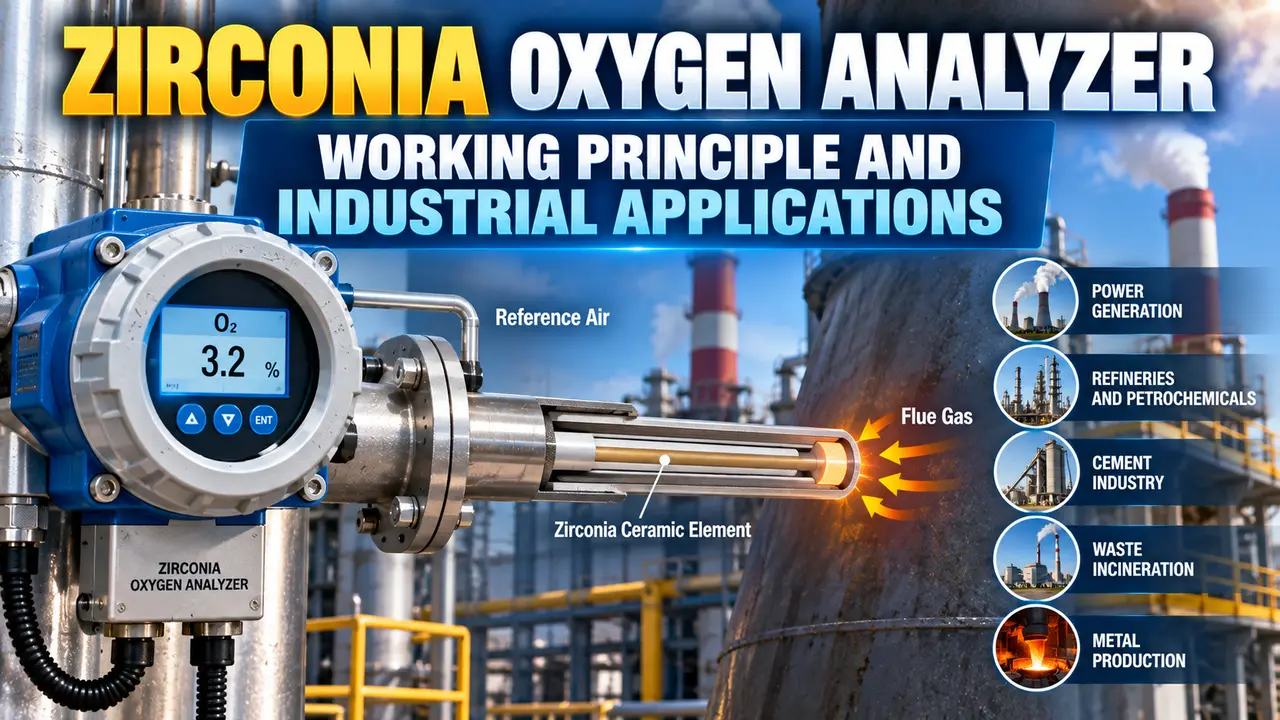
A zirconia oxygen analyzer measures flue gas oxygen concentration using a heated zirconium dioxide ceramic cell that conducts oxygen ions at temperatures between 600 and 850 degrees C.
It is the most widely used online oxygen measurement technology in combustion control, replacing manual flue gas sampling with a continuous, real-time signal that allows the air-to-fuel ratio to be optimised automatically.
The zirconia cell output follows a logarithmic relationship with oxygen concentration. At 2% flue gas oxygen at 650 degrees C, the output is approximately 47 mV.
At 5% oxygen it falls to approximately 28 mV.
The transmitter applies the Nernst equation to convert millivolts to a percentage oxygen reading.
We will cover how the zirconia cell generates a voltage proportional to the oxygen concentration difference between two sides of the ceramic, how the Nernst equation converts this voltage to a percentage reading, the difference between in-situ and extractive analyzer types, calibration procedure, and the main applications in combustion control and process gas monitoring.
Zirconia Oxygen Analyzer Working Principle
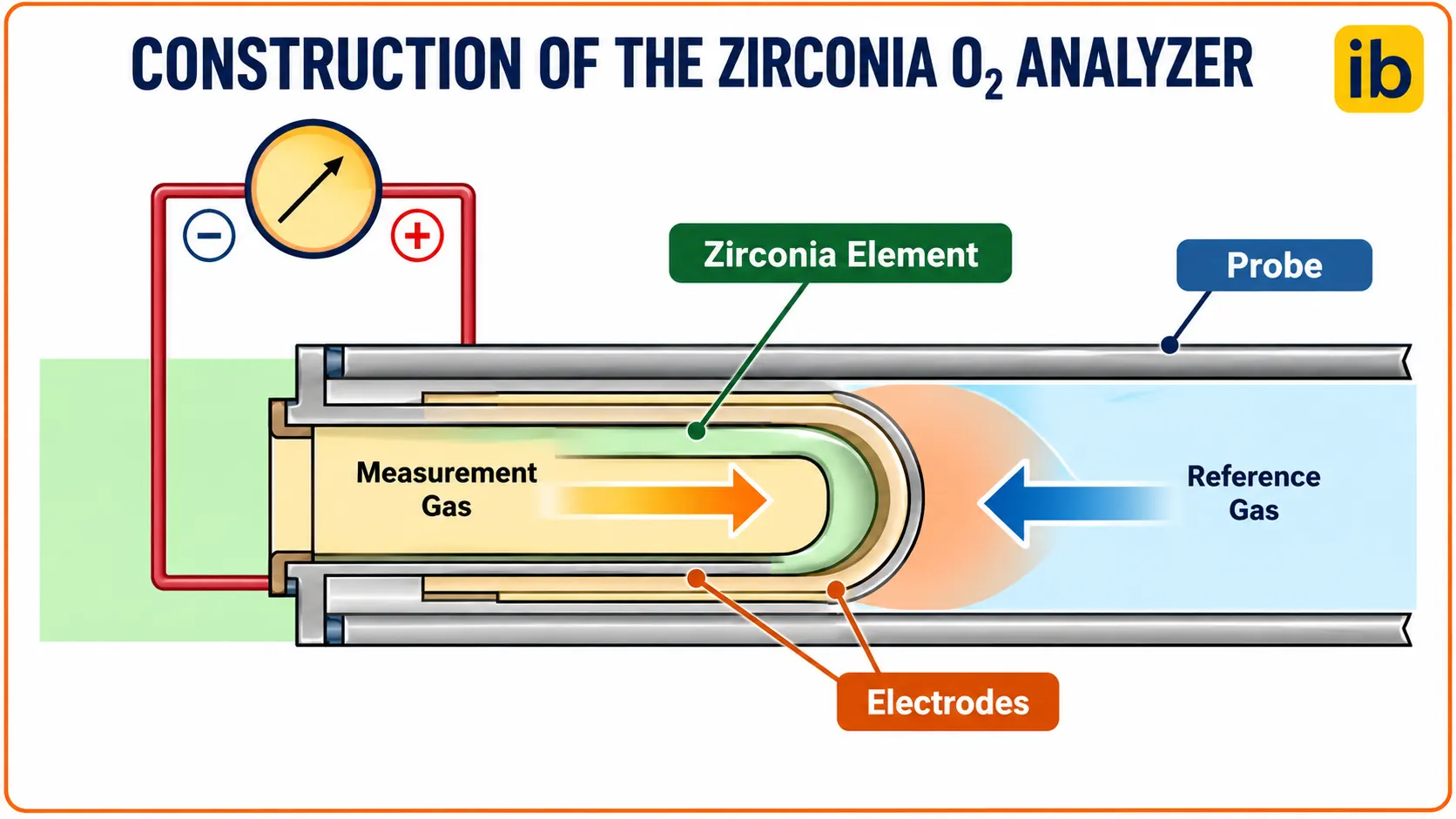
The zirconia oxygen analyzer uses a solid electrolyte cell made from zirconium dioxide (ZrO2) stabilised with yttrium oxide.
Above 600 degrees C, the crystal lattice allows oxygen ions to migrate from a region of high to low oxygen partial pressure.
The cell has two platinum electrodes, one on each face of the ceramic. One side is exposed to the flue gas. The other is exposed to reference air at 20.9% oxygen.
When the oxygen concentration on the measurement side differs from the reference side, ions migrate through the ceramic and generate a potential difference between the two electrodes.
This voltage is described by the Nernst equation:
EMF (mV) = 0.0496 x T x log (P_ref / P_sample)
Where T is the cell temperature in Kelvin, P_ref is the reference side oxygen partial pressure (20.9% for air), and P_sample is the measurement side oxygen partial pressure.
The cell temperature is controlled by an internal heater to a setpoint (typically 650 to 750 degrees C) so that T is known accurately.
Nernst Equation: Worked Examples
Understanding the Nernst equation helps explain why the zirconia analyzer output is logarithmic and why calibration is important at both the high and low end of the measurement range.
Reference oxygen: 20.9% (air)
Sample oxygen: 2.0%
P_ref / P_sample: 20.9 / 2.0 = 10.45
log (10.45): 1.019
EMF: 0.0496 x 923 x 1.019 = 46.7 mV
Interpretation: 46.7 mV at 923 K corresponds to 2.0% O2. The DCS receives a 4-20 mA signal scaled by the transmitter to this reading.
Reference oxygen: 20.9% (air)
Sample oxygen: 5.0%
P_ref / P_sample: 20.9 / 5.0 = 4.18
log (4.18): 0.621
EMF: 0.0496 x 923 x 0.621 = 28.4 mV
Interpretation: 28.4 mV at 923 K corresponds to 5.0% O2. A furnace targeting 3% excess O2 would use a setpoint between these two values.
In-Situ vs Extractive Zirconia Analyzers
The zirconia cell is mounted on a probe inserted directly into the flue gas duct through a flanged nozzle. No sample conditioning system is required.
Fast response (typically 5 to 15 seconds). No sample pump, no sample line, no moisture separator. The most common type in boiler, furnace, and fired heater service.
A sample is withdrawn from the duct through a probe, conditioned (cooled, dried, filtered) by a sample conditioning system, and then passed through the zirconia cell in an analyser cabinet.
Slower response due to sample transport time. Used where the gas must be conditioned (very wet or corrosive), or where multiple gas components are measured in the same cabinet.
In-Situ Probe Construction and Installation
Calibration Procedure for a Zirconia Oxygen Analyzer
Zirconia analyzers use two-point calibration: a zero gas (0 or 2% O2 in nitrogen) and a span gas (8% or 21% O2). Both gases connect to the sample port of the probe.
Industrial Applications of Zirconia Oxygen Analyzers
Zirconia Analyzer vs Other Oxygen Measurement Technologies
| Technology | Measurement Principle | Typical Range | Best Application |
|---|---|---|---|
| Zirconia (in-situ) | Nernst electrochemical cell, solid electrolyte O2 ion conduction at 650 to 750 degrees C | 0.1% to 25% O2 | High-temperature flue gas, combustion control, direct duct installation |
| Paramagnetic | Oxygen is strongly paramagnetic; dumbbell suspended in magnetic field deflects proportional to O2 content | 0 to 100% O2 | High-accuracy laboratory and process O2, clean dry gas only, no high temperature |
| Electrochemical cell (galvanic) | Oxygen reacts at a cathode in an electrolyte, generating a current proportional to O2 concentration | 0 to 25% O2 | Portable safety monitors, ambient air O2 measurement, lower-cost fixed installations |
| Optical (tunable diode laser) | Laser beam crosses the gas path; O2 absorption at a specific wavelength is measured | 0 to 25% O2 | Cross-stack measurement in large ducts, non-contact, no sample conditioning |
| Fluorescence quenching | O2 quenches the fluorescence of a dye excited by UV light; quenching rate proportional to O2 | 0 to 100 ppm to 25% | Dissolved oxygen in water, low-concentration O2 in liquids |
Watch: How to Calibrate a Zirconia Oxygen Analyzer
Zirconia Oxygen Analyzer Questions Engineers Ask
Related Articles on This Site
- Gas Analyzers Explained: Types and Working Principles
- Signal Conditioning in Instrumentation Explained
- Why 4-20 mA Is the Best Signal for Industrial Automation
- HART Protocol: How It Works and Why It Is Used
- Hazardous Area Classification: Zone 0, 1 and 2 Explained
External References
- Zirconia Oxygen Analysis: Theory and Cell Construction | Industrial Physics
- Zirconia Oxygen Analyzers in Industrial Applications | Automation Forum
What We Learn Today
- The zirconia analyzer uses a ZrO2 cell heated to 650 to 750 degrees C. Oxygen ions migrate from the reference side (20.9% O2) to the flue gas side, generating a voltage per the Nernst equation (EMF = 0.0496 x T x log P_ref/P_sample). The transmitter converts this to a percentage O2 reading.
- In-situ probes insert directly into the flue gas duct with no sample conditioning system, giving fast response (5 to 15 seconds). The probe filter, cell heater, reference air supply, and cell impedance are the four key maintenance checks for in-situ probes.
- Zirconia analyzers serve combustion control, fired heater air-fuel trimming, cement and glass kilns, gas purity monitoring, and CEMS O2 correction. Cell impedance is the main aging indicator. Calibration uses zero gas (0 to 2% O2) and span gas (8% or 20.9% O2) at the sample port.