
No single vacuum gauge covers the full pressure range from atmospheric down to ultra-high vacuum. Each technology works within a specific pressure range and uses a different physical principle to infer pressure.
Pirani, Penning and capacitance manometer gauges together cover the range from roughing vacuum down to high vacuum, and each has distinct accuracy, gas-type sensitivity, and application characteristics.
Choosing the wrong vacuum gauge gives either no reading or a wildly inaccurate one. Understanding each gauge type and its pressure range is essential before specifying a vacuum system.
We will cover the working principle of each type, the pressure range each covers, how gas type affects the reading, and a comparison table to help you select the right gauge for your application.
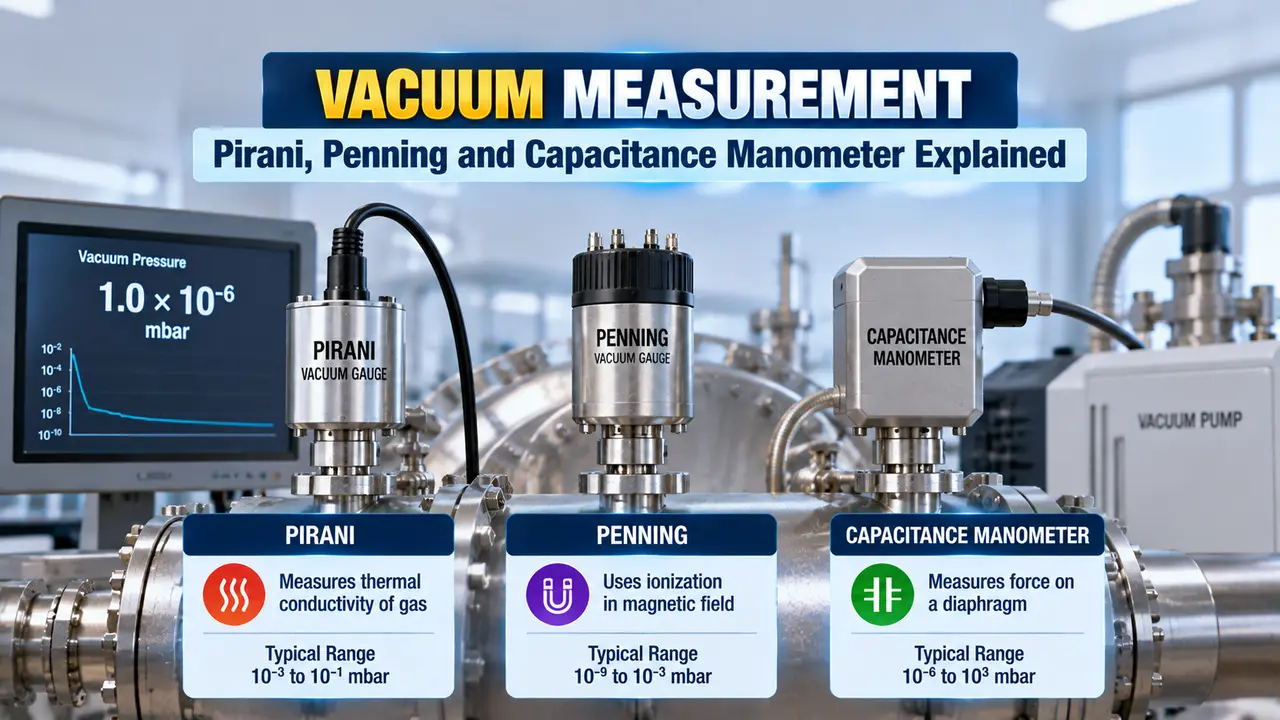
Vacuum Measurement: Three Gauge Types and Their Pressure Ranges
Thermal conductivity gauge. Measures heat loss from a heated filament to surrounding gas molecules. Works from 1 atm down to 10-3 mbar (1000 Pa to 0.1 Pa).
Gas-type dependent. Used for roughing and medium vacuum monitoring.
Cold cathode ionisation gauge. Measures ion current produced by electron bombardment of gas molecules. Works from 10-2 to 10-7 mbar.
Gas-type dependent. Used for high vacuum monitoring and interlock systems.
Mechanical diaphragm gauge. Measures physical deflection of a thin metal diaphragm against a reference vacuum. Works from atmosphere down to 10-4 mbar.
Gas-type independent. The most accurate of the three types.
Pirani Gauge Working Principle
The Pirani gauge uses the thermal conductivity of a gas to measure its pressure.
A thin filament (usually platinum or tungsten) is heated by electrical current inside a tube connected to the vacuum system.
Gas molecules collide with the hot filament and carry heat away. At higher pressures, more heat is removed and the filament cools.
At lower pressures, fewer molecules carry heat away and the filament stays hotter.
The gauge circuit measures the filament resistance change. Since resistance changes with temperature, this gives a direct indication of gas molecule density, which is proportional to pressure.
Penning Gauge Working Principle
The Penning gauge is a cold cathode ionisation gauge. It measures pressure by counting ions produced when electrons collide with gas molecules inside a strong magnetic field.
A high voltage (2 to 4 kV) is applied between an anode ring and a cathode plate. A permanent magnet creates a field perpendicular to the electric field.
Electrons from the cathode spiral in long helical paths along the magnetic field lines, greatly increasing the chance of ionising a gas molecule.
The ion current from these collisions is measured by the gauge circuit. Higher current means more gas molecules and higher pressure.
The relationship follows approximately I = k x P, where k is a gauge-specific constant.
Capacitance Manometer Working Principle
The capacitance manometer measures the physical deflection of a thin metal diaphragm. The diaphragm separates the process vacuum from a sealed reference chamber held below 10-6 mbar.
As process pressure increases, the diaphragm deflects toward the reference side. Capacitance plates detect this deflection as a change in capacitance. The gauge electronics convert this change to a pressure reading.
Pirani vs Penning vs Capacitance Manometer: Full Comparison
| Parameter | Pirani Gauge | Penning Gauge | Capacitance Manometer |
|---|---|---|---|
| Measurement principle | Thermal conductivity of gas | Ion current from electron bombardment | Mechanical diaphragm deflection |
| Pressure range (mbar) | 1000 to 10-3 | 10-2 to 10-7 | Atmosphere to 10-4 (head dependent) |
| Typical accuracy | 10 to 15% of reading | 20 to 50% of reading | 0.1 to 0.5% of full scale |
| Gas type dependent? | Yes: correction factor needed for non-N2 gases | Yes: correction factor needed for non-N2 gases | No: gas-type independent |
| Hot filament? | Yes: platinum or tungsten wire | No: cold cathode, no hot filament | No: purely mechanical |
| Contamination risk | Filament oxidation in reactive gases | Electrode coating causes low readings | Diaphragm coating causes stiction or zero shift |
| Used for calibration? | No | No | Yes, primary reference standard |
| Typical applications | Roughing pump monitoring, vacuum ovens | High vacuum interlocks, deposition systems | Semiconductor processes, freeze drying, calibration |
Watch: Pirani Gauge for Measuring Vacuum
Vacuum Measurement Questions Engineers Ask
Related Articles on This Site
- Basics of Pressure Measurement Explained
- How to Calculate Vacuum Pressure
- Gauge Pressure Transmitter Working Principle
- Pressure Gauge and Pressure Transmitter: Key Differences
- Pressure Transmitter Installation Best Practices
External References
- Pressure Measurement Technical Notes | Kurt J. Lesker Company
- Vacuum Gauge Selection Best Practices | AIChE CEP
What We Learn Today
- The Pirani gauge uses thermal conductivity of gas to measure pressure from 1000 to 0.001 mbar. It is gas-type dependent and achieves 10 to 15% accuracy. Used for roughing vacuum monitoring.
- The Penning gauge uses cold cathode ionisation to measure 0.01 to 0.0000001 mbar. It is gas-type dependent and achieves 20 to 50% accuracy. Used for high vacuum interlocks and deposition systems.
- The capacitance manometer measures diaphragm deflection and is gas-type independent. It achieves 0.1 to 0.5% accuracy and is the primary calibration reference for other vacuum gauges.