Water in soil changes both its conductivity and its dielectric constant, and every probe in a garden kit or a farm IoT node reads one of these two effects. Pick the right type, calibrate it in your own soil and the readings become a reliable guide for irrigation.
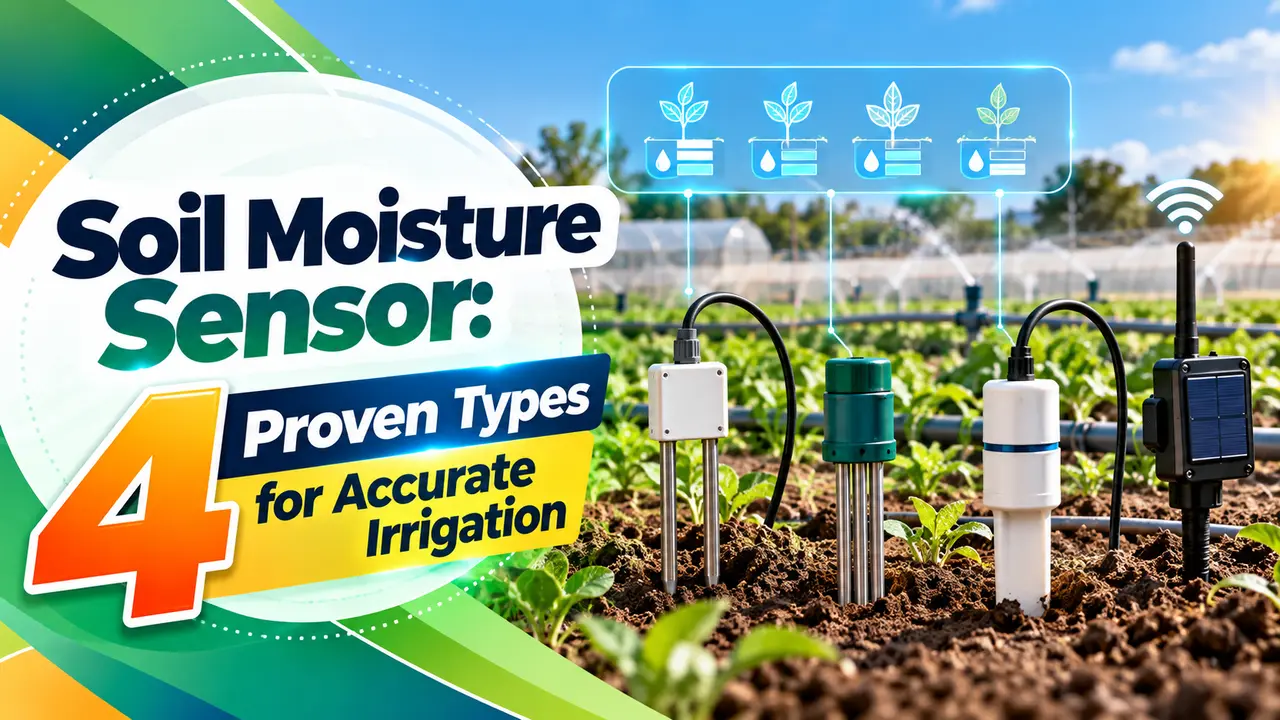
A soil moisture sensor turns the water held in soil into a voltage that a microcontroller or logger can read. This guide explains resistive, capacitive, FDR and TDR probes, calibration and practical irrigation use in India.
What Is a Soil Moisture Sensor?
A soil moisture sensor is a probe that measures how much water the soil holds and converts it into an electrical signal, usually an analog voltage, a frequency or a digital value. Hobby modules connect to an ADC input of a board, while industrial probes report volumetric water content directly.
Two effects make this possible: wet soil conducts better than dry soil, and it has a much higher dielectric constant because water molecules are strongly polar.
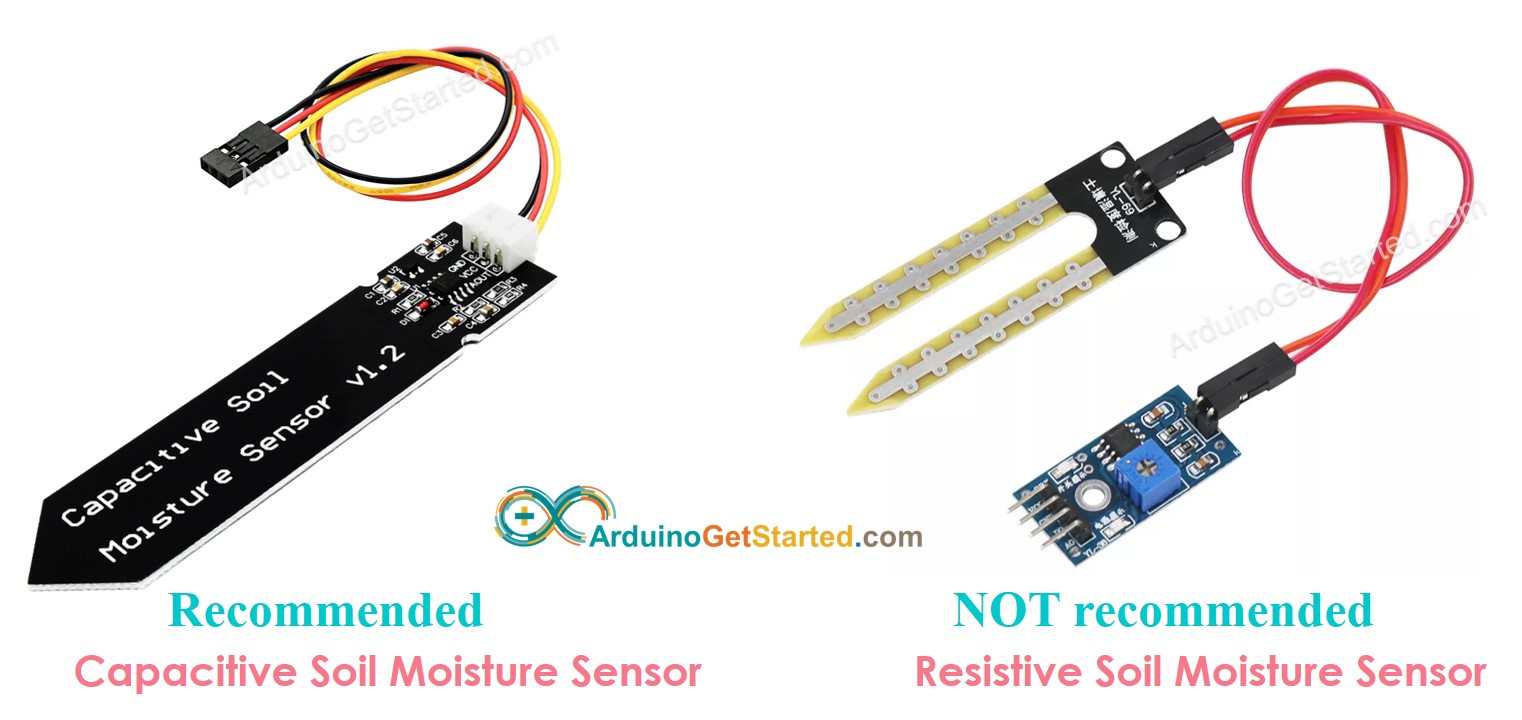
Resistive probes read conductivity through two bare metal prongs. Capacitive probes read the dielectric effect through a coated copper plate that acts as one side of a capacitor, with the surrounding soil as the dielectric.
Volumetric and Gravimetric Water Content
Soil scientists express moisture in two ways. Gravimetric water content, or GWC, is the mass of water divided by the mass of dry soil, while volumetric water content, or VWC, is the volume of water divided by the total soil volume.
Field probes and irrigation schedules almost always use VWC in percent.
How a Soil Moisture Sensor Detects Water
Relative permittivity, also called the dielectric constant, decides how much charge a capacitor stores for a given voltage. The idea is covered in what is capacitance, and it is the same principle used in capacitance level measurement of tanks.
Because water is about 80 and dry minerals only 3 to 5, even a small rise in water content raises the bulk permittivity of soil sharply. The probe capacitance rises with it, and the electronics convert that change into a voltage or a frequency.
Resistive probes work differently. Dissolved salts make soil water conductive, so the resistance between the prongs falls as moisture rises, and a voltage divider turns that resistance into a voltage.
Pure distilled water barely conducts, so a resistive probe dipped in it shows almost no change. Soil water reads well only because it carries dissolved salts and minerals.
4 Soil Moisture Sensor Types Compared
Two bare prongs and an LM393 comparator board measure soil conductivity.
A coated PCB plate with a 555 or TLC555 oscillator senses permittivity.
Frequency domain reflectometry measures the resonant frequency of a probe circuit.
Time domain reflectometry times a pulse travelling along steel rods.
| Type | Measures | Typical Output | Life in Soil |
|---|---|---|---|
| Resistive | Conductivity | Analog plus digital | Days to weeks |
| Capacitive | Permittivity | Analog voltage | Months to years |
| FDR | Permittivity | VWC, SDI 12, Modbus | Years |
| TDR | Pulse travel time | VWC, digital | Years |
Resistive Probe: Simple but Short Lived
The common resistive module has a fork shaped probe and a small board carrying an LM393 comparator. The analog pin gives the divider voltage and the digital pin switches when moisture crosses a level set by the onboard trimmer.
A direct current flows through the prongs whenever the module is powered. Electrolysis then eats the positive prong, deposits form on the metal and readings drift upward within days or weeks.
A study by researchers at IIT Delhi, published on arXiv as a comparative analysis of low cost resistive and capacitive sensors, saw this clearly. Their exposed resistive probes corroded and stopped working after roughly 5 to 6 short measurement sessions.
The same study, using clay soil from the IIT Delhi campus, found the resistive soil moisture sensor gave a tighter calibration fit, with R squared near 0.92 to 0.93 against gravimetric water content. Its readings were still less consistent on dry soil, so the authors suggested resistive probes only for instant spot checks.
If you must use a resistive probe, power it from a digital pin only for the moment of reading, then switch it off. Less current time means much slower electrolysis of the prongs.
Capacitive Soil Moisture Sensor Working
The popular capacitive soil moisture sensor, sold as v1.2 or v2.0, carries a 555 timer oscillator and a coated copper trace along the probe blade. The trace and the ground plane form a capacitor whose value rises with soil water.
The oscillator square wave passes through a resistor into this capacitor, which acts as a low pass filter. A diode and a smoothing capacitor then convert the remaining ripple into a DC level, so more water gives a lower output voltage.
DFRobot lists its SEN0193 module with a 3.3 to 5.5 V supply and an analog output of 0 to 3.0 V. The same capacitive idea is used in capacitive humidity sensors, where a polymer film replaces the soil as the dielectric.
The IIT Delhi authors note that the polymer coating of the capacitive probe resists electrolysis and oxidation, which makes it better for long duration monitoring. Its calibration fit in their clay was weaker, with R squared about 0.73 to 0.78, so a proper calibration in your own soil matters even more.
Converting ADC Counts to Percent Moisture
A capacitive module read by a 10 bit analog to digital converter gives a count from 0 to 1023. You record the count in dry soil and in saturated soil, then map any reading linearly between these two points.
Higher count means drier soil for most capacitive modules
Example:
Dry count = 520, Wet count = 260, Reading = 350
Span = 520 minus 260 = 260 counts
(520 minus 350) ÷ 260 = 170 ÷ 260 = 0.654
Moisture = 65.4 percent of calibrated span
Soil Moisture Sensor Calculator
Second Worked Example: Real Volumetric Water Content
To get true VWC, take soil samples at several moisture levels, weigh them wet, oven dry them at 105 °C and weigh again. Suppose a sample shows 0.25 g of water per g of dry soil and the bulk density of the field soil is 1.3 g per cubic centimetre.
Then VWC = GWC × bulk density ÷ water density = 0.25 × 1.3 ÷ 1.0 = 0.325, or 32.5 percent. Repeat this for five or six samples, plot sensor counts against VWC and fit a straight line, exactly as the IIT Delhi team did with six containers of clay.
Calibrating Your Probe Step by Step
Insert the probe to the same depth every time. Good sensor linearity is rare in cheap probes, so more middle points give a better curve.
Never calibrate a capacitive probe only in air and a glass of water. Air and tap water give the widest span, but your soil never reaches either extreme, so percent values will look compressed.
Industrial FDR and TDR Probes
Professional probes from makers such as METER Group and Campbell Scientific use sealed housings and output VWC over SDI 12, Modbus or analog channels.
A METER Group application note comparing its ECH2O dielectric probes with TDR states that measurements below 10 MHz are highly susceptible to salinity and temperature. Good probes therefore excite the soil at higher frequencies, where the water dielectric effect dominates.
The same note says high salinity diminishes the TDR reflection waveform, and that most errors in practice come from poor installation rather than the technique itself. This is the same lesson that conductivity sensor users learn in process plants.
TDR finds water content from the travel time of a fast pulse along metal rods. The pulse slows down in wet soil because the speed of an electromagnetic wave falls as permittivity rises.
Building a Farm IoT Node in India
The IIT Delhi study used a NodeMCU board with the ESP8266 chip and logged readings to ThingSpeak, a common setup for student projects. A microcontroller such as the ESP32 adds deep sleep, which helps a solar or battery node last a full crop season.
For fields far from Wi Fi, a LoRaWAN network can cover several kilometres in open farmland. Data can then travel to a server over MQTT for drip irrigation control on sugarcane, grapes or vegetables.
Push each probe in without leaving an air gap along the sensing face, and keep the electronics shaded and above flood level. In hard clay, make a pilot hole first and pack the soil back firmly.
- Saves water by irrigating only when needed.
- Low cost modules suit students and small farms.
- Capacitive probes resist corrosion for long use.
- Easy to connect to ESP32 and Arduino boards.
- Raw values change with soil type and depth.
- Resistive prongs corrode quickly in DC use.
- Salinity and temperature affect cheap probes.
- True VWC needs a calibration with oven dried samples.
Where Soil Moisture Probes Are Used
Troubleshooting Wrong Moisture Readings
- Weekly upward drift: look for corroded resistive prongs.
- Jumps with supply: check regulator and timer chip.
- No change wet or dry: look for an air gap.
- Stuck at maximum: check signal wire and connector.
- Erratic after rain: look for water in the electronics.
- Daily cycle: check temperature effect on the probe.
METER Group Application Note on Dielectric Probes
Capacitive Probe Teardown Video
Soil Moisture Sensor FAQ
It measures how much water the soil holds, either through conductivity or through the dielectric constant of the soil. The result appears as a voltage, a frequency or a digital value.
Hobby modules give a raw count that needs calibration. Professional probes report volumetric water content in percent after factory calibration for common mineral soils.
For any installation longer than a few days, the capacitive probe is the better choice. Its coated plate does not corrode the way bare resistive prongs do under direct current.
The IIT Delhi study found resistive probes stopped working after about five or six sessions. Resistive modules still suit quick spot checks and classroom demonstrations where low cost matters most.
In most capacitive modules, wetter soil raises the probe capacitance and filters more of the oscillator signal. The rectified output voltage therefore drops as moisture rises.
This is normal behaviour for the module and not a fault in your board. Your conversion formula simply subtracts the present reading from the dry count, as shown in the calculator above.
Record the steady count in your own soil when fully dry and again when saturated and drained. Add a few middle points with weighed water if you want a better curve.
Insert the probe to the same depth each time, because depth changes the reading. Store the dry and wet counts in firmware and repeat the check every season or after replacing the probe.
A hobby probe gives true values only after you calibrate it against oven dried samples of your soil. Fit a straight line between the counts and the measured water content.
Professional FDR and TDR probes come with factory calibration for mineral soils. They are still checked in very sandy, clay rich or saline soil for better accuracy.
Place it in the active root zone of the crop, which is shallow for vegetables and deeper for trees and sugarcane. Many growers use one probe at root depth and one below it.
The deeper probe shows whether irrigation water is draining past the roots. That second reading helps you shorten drip cycles and save both water and power.
Yes, dissolved salts raise conductivity and can disturb low frequency dielectric probes. METER Group notes that measurements below 10 megahertz are highly sensitive to salinity and temperature.
Resistive probes are affected most strongly by fertiliser dissolved in the soil water. Recheck the calibration after heavy fertigation or whenever you switch to saline borewell water for irrigation.
Related Articles
- Capacitive Humidity Sensor Working
- Capacitance Level Measurement
- ADC Working Principle Explained
- LoRaWAN Industrial IoT Guide
- Conductivity Sensor Working
External References
- ECH2O Dielectric Probes vs Time Domain Reflectometers, METER Group
- Comparative Analysis and Calibration of Low Cost Resistive and Capacitive Soil Moisture Sensor, arXiv
- Soil Moisture Sensor, Wikipedia
What We Learn Today
- A soil moisture sensor reads either soil conductivity with bare prongs or soil permittivity with a coated plate, since water has a dielectric constant near 80.
- Capacitive probes resist corrosion and suit long term IoT use, while bare resistive prongs corroded within about five or six sessions in an IIT Delhi study.
- Calibrate in your own soil at dry and saturated points, then map ADC counts linearly, so 520, 260 and 350 counts give 65.4 percent.