
MQTT wasn't built for factories. It was built in 1999 to move oil pipeline telemetry over a satellite link that dropped out constantly.
That same design, light, resilient, built for bad connections, turned out to be exactly what modern industrial IoT needed decades later.
MQTT protocol for industrial IoT works on a publish/subscribe model, where devices send data to a central broker instead of connecting directly to each other.
A sensor doesn't need to know who's listening. It just publishes to a topic, and the broker handles the rest.
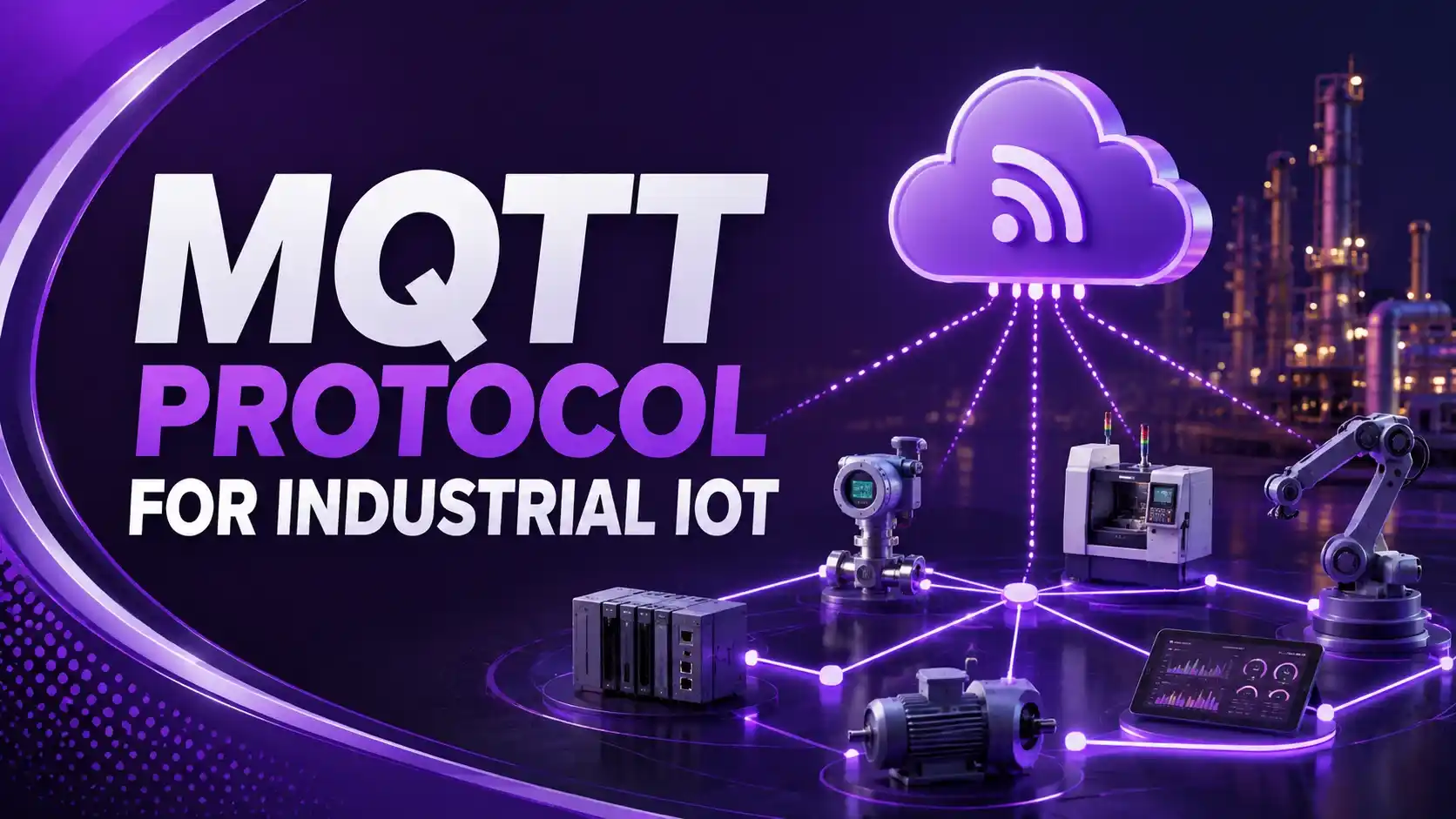
That decoupling is what makes MQTT scale from a handful of devices to a plant with tens of thousands of tags, without rewriting a single connection.
The 6 Core Concepts of MQTT for Industrial IoT
These six ideas cover almost everything an engineer needs to read an MQTT architecture diagram.
Publish/Subscribe Model
Devices publish data to a topic instead of connecting directly to each other, fully decoupling sender from receiver.
The Broker
A central server that receives every published message and routes it only to clients subscribed to that topic.
Topics
Hierarchical strings like Plant/Line1/Temp that organize data and let subscribers filter with wildcards.
Quality of Service (QoS)
Three delivery guarantee levels, letting engineers trade bandwidth for reliability per message.
Last Will and Testament (LWT)
A message the broker sends automatically if a client disconnects ungracefully, signaling a device is offline.
Sparkplug B
A specification built on MQTT that standardizes topic structure and payloads for true multi-vendor interoperability.
MQTT QoS Levels Compared
Every published message picks one of three delivery guarantees.
QoS 0
At most once. Fire and forget, no acknowledgment. Fastest, but a message can be lost.
QoS 1
At least once. Broker acknowledges receipt, but duplicates are possible if acks are lost.
QoS 2
Exactly once. A four-part handshake guarantees no loss and no duplication, at the cost of overhead.
How a Publish/Subscribe Message Actually Flows
Sensor publishes to Plant/Line1/Temp
Receives message, checks active subscriptions
SCADA/historian receives the forwarded message
Sparkplug B Topic Namespace Explained
Plain MQTT never defines how a topic should be named. Sparkplug B fixes that with one strict structure every compliant client must follow.
A topic like spBv1.0/FactoryA/DDATA/Line3/Machine7 tells a monitoring tool everything it needs before even reading the payload: the site, the message purpose, the line, and the exact machine.
Group ID: FactoryA
Message Type: DDATA (device data update)
Edge Node ID: Line3
Device ID: Machine7
Sparkplug B Message Types
These are the nine defined message types that manage state and data across the topic namespace.
| Message Type | Purpose |
|---|---|
| NBIRTH | Edge node birth certificate, announces node and its metrics |
| NDEATH | Edge node death certificate, sent as the node's LWT |
| DBIRTH | Device birth certificate, announces a device and its metrics |
| DDEATH | Device death certificate, device has left the network |
| NDATA | Updated metric values for the edge node itself |
| DDATA | Updated metric values for a device (report by exception) |
| NCMD / DCMD | Commands sent to a node or device from a host application |
| STATE | Primary host application availability, published at QoS 1 |
Report by Exception: Why Sparkplug Saves Bandwidth
Polling protocols ask for every value, every cycle, whether it changed or not. Sparkplug flips that model.
An edge node only publishes a DDATA message when a metric's value actually changes since the last BIRTH or DATA message. Nothing changes, nothing gets sent.
On a network carrying thousands of tags, this alone can cut bandwidth use dramatically compared to a traditional scan-based polling architecture.
Plain MQTT vs Sparkplug B
Sparkplug doesn't replace MQTT. It's a specification layered on top of it.
| Aspect | Plain MQTT | Sparkplug B |
|---|---|---|
| Topic structure | Free form, developer defined | Fixed: spBv1.0/group/type/node/device |
| Payload format | Any format, often JSON | Standardized Protobuf-based payload |
| Device state awareness | Not built in | Built in via BIRTH/DEATH certificates |
| Multi-vendor interoperability | Requires custom mapping | Plug and play by design |
Where MQTT Is Used in Industrial IoT
Smart Manufacturing
Machine-to-cloud telemetry across production lines and cells.
Energy and Utilities
Grid monitoring, renewable farm diagnostics, and demand response.
Oil and Gas
Remote wellhead and pipeline telemetry over unreliable links.
Building Automation
HVAC, lighting, and security systems reporting to a unified namespace.
Connected Vehicles
Assembly line data and connected vehicle telemetry integration.
Unified Namespace Architectures
Central event-driven data backbone connecting OT and IT systems.
Do's and Don'ts of Industrial MQTT Deployment
✓ Do
- Use QoS 1 for most industrial data, reserving QoS 2 for critical commands
- Always set a Last Will and Testament for every client connection
- Use TLS with device-specific certificates instead of shared credentials
- Adopt Sparkplug B when connecting equipment from multiple vendors
✗ Don't
- Publish every tag at full rate when change-of-value filtering would work
- Mix Sparkplug and non-Sparkplug clients on the same topic namespace
- Assume every cloud MQTT service supports Sparkplug's required features
- Retain data or birth messages on a Sparkplug B namespace, it's not permitted
Live Sparkplug B Topic Builder
Enter a group, message type, edge node, and device to see the resulting Sparkplug B topic string.
Reference Materials on MQTT and Sparkplug B
FAQs on MQTT Protocol for Industrial IoT
External References
- MQTT Essentials, All Core Concepts and Basics Explained, HiveMQ
- Sparkplug Specification, Version 2.2, Eclipse Foundation
- Demystifying MQTT and Sparkplug, Cirrus Link
- Mastering MQTT, Your Ultimate Tutorial, EMQ
- Industrial-Strength MQTT/Sparkplug B, Opto 22
What we learn today
- MQTT protocol for industrial IoT uses a publish/subscribe model, decoupling devices through a central broker instead of direct connections.
- Three QoS levels, at most once, at least once, and exactly once, let engineers trade bandwidth against delivery guarantees per message.
- Last Will and Testament automatically notifies the system when a device disconnects ungracefully.
- Sparkplug B standardizes topic namespace and payload format, using BIRTH and DEATH certificates for real device state awareness.
- Sparkplug topics follow a fixed structure, spBv1.0/group_id/message_type/edge_node_id/device_id, that plain MQTT never defines on its own.