
A thin polymer film soaks up water vapour and changes its capacitance, and that tiny change tells a controller how humid the air is.
Humidity affects comfort, product quality, corrosion and instrument air. Electronic sensors turn moisture in the air into a signal that HVAC controllers, dryers and data loggers can use.
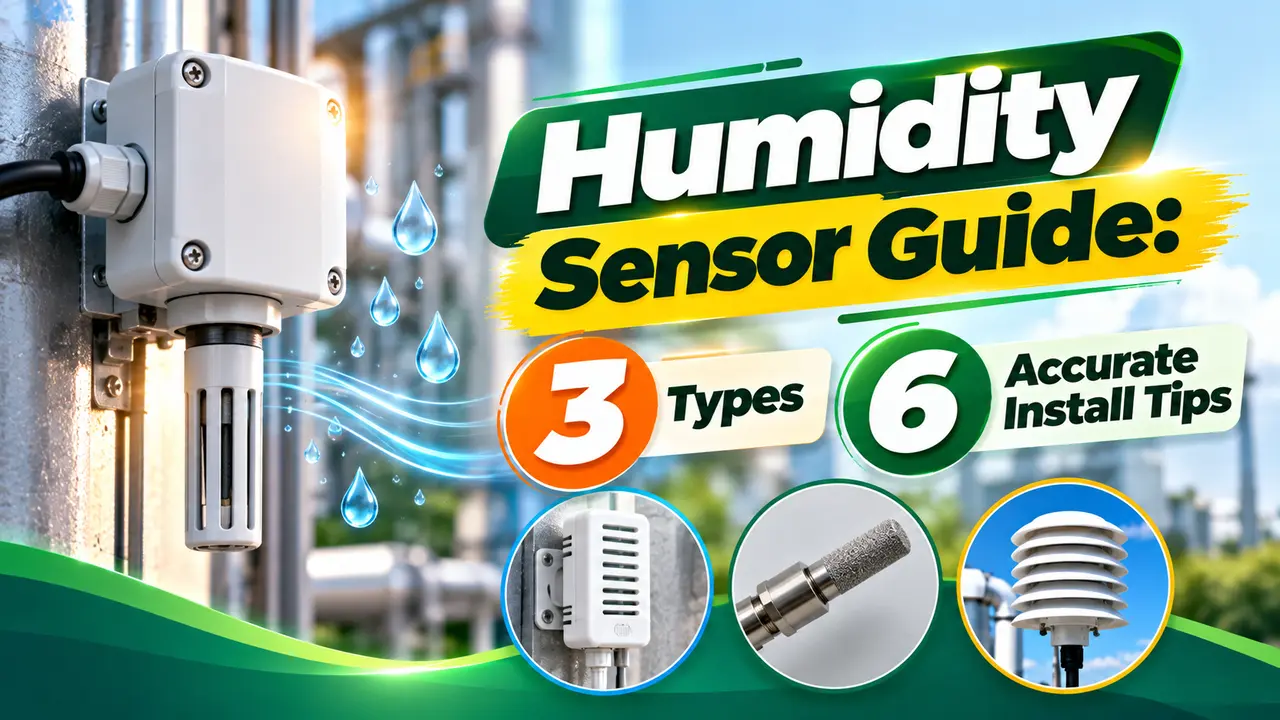
What Is a Humidity Sensor?
A humidity sensor is a device that measures the water vapour content of air or gas and gives an electrical output, most often as relative humidity in percent. The most common design is capacitive, working like a small capacitor whose dielectric absorbs moisture.
Relative humidity is the ratio of actual vapour pressure to saturation vapour pressure at the same temperature. Because saturation pressure rises with temperature, RH always needs a temperature reading beside it.
Process Sensing Technologies explains that water vapour has a dielectric constant of about 80, while the sensing polymer sits between 2 and 15. As the polymer absorbs water, capacitance rises in step with RH.
The same capacitive idea appears in capacitive pressure sensors, where a diaphragm moves instead of a dielectric changing.
3 Main Sensing Types
Polymer dielectric between two electrodes changes capacitance.
Salt or polymer film changes resistance with moisture.
Compares heat loss in dry and moist gas.
A capacitive humidity sensor gives wide range, fast response and full recovery after condensation, according to PST. Their accuracy drops below about 5 percent RH, where chilled mirror or other dew point methods work better.
Dwyer quotes a typical uncertainty of plus or minus 2 percent RH from 5 to 95 percent RH, with response times of 30 to 60 seconds.
How a Capacitive Humidity Sensor Works
Industrial transmitters usually give a 4 to 20 mA signal for RH and a second one for temperature. Board level parts often use I2C with built in calibration.
PST stresses that accuracy depends on the whole chain of sensor, probe, cable and electronics. Temperature effects are discussed in thermal effects on sensors.
Dew Point From RH and Temperature
Dew point Td = 243.12 × γ ÷ (17.62 minus γ)
Magnus approximation, T in °C
Worked example, T = 25 °C, RH = 60 percent:
γ = minus 0.511 + 1.643 = 1.132
Td = 243.12 × 1.132 ÷ 16.488
Dew point ≈ 16.7 °C
Dew point matters more than RH for compressed air, since condensation forms when surfaces fall below it. See dew point in instrument air for plant risks.
The Magnus formula is accurate to a few tenths of a degree over normal room and process ranges.
6 Accurate Install Tips
A 1 °C error between sensor and air changes RH by about 6 percent of reading at room temperature. Temperature matching is therefore the most important install rule.
For building control, the sensor placement follows the design of the HVAC system. Return ducts often give the most representative reading.
Calibration and Drift
| Reference | Approximate RH at 25 °C | Use |
|---|---|---|
| Lithium chloride salt | 11 percent | Low point check |
| Magnesium chloride salt | 33 percent | Mid low point |
| Sodium chloride salt | 75 percent | High point check |
| Humidity generator | Any set value | Lab calibration |
| Reference hygrometer | Field comparison | Quick site checks |
Saturated salt solutions create stable humidity in a sealed chamber around the humidity sensor, making simple field references. Allow several hours for equilibrium, and keep the chamber at a stable temperature because salt humidity values shift slightly with temperature.
Solvents, oils and long exposure to high humidity shift the humidity sensor zero over time. Record results using the terms in instrument calibration terms.
Dew Point Calculator
If a surface is colder than this value, condensation will form on it. Use this check for cabinets, cold pipes and cleanroom walls.
- Wide 0 to 100 percent range.
- Fast response.
- Recovers after condensation.
- Low power and small size.
- Temperature must match the air.
- Drift from chemicals.
- Less accurate below 5 percent RH.
- Needs periodic calibration.
Rotronic Technical Note PDF
How RH Sensors Work Video
Humidity Sensor FAQ
Related Articles
- Dew Point in Instrument Air
- Sensor Selection Criteria
- Thermal Effect on Sensors
- Industrial Automation Sensors
- What Is Sensor Linearity
External References
- Capacitive Sensor Technical Note, Rotronic
- The Capacitive Sensor, Process Sensing Technologies
- Hygrometer, Wikipedia
What We Learn Today
- A capacitive humidity sensor tracks RH through polymer capacitance.
- Temperature matching and placement decide field accuracy.
- Dew point from RH and temperature shows condensation risk.