SCADA supervises assets that are spread over many kilometres, from pump stations to substations and pipeline valves. For each industry we cover the field devices, the protocols and how fast you can actually poll them.
SCADA applications cover water networks, power grids, pipelines, solar and wind plants, metro rail, buildings and factories. Here we compare what each industry monitors, which RTU or PLC sits in the field, which protocol it speaks and how to work out the poll cycle.

Which industries use SCADA applications and what do they monitor?
SCADA applications are found wherever assets are spread over a wide area and must be watched from one control room. Water utilities monitor tank levels and pumps, power grids monitor breakers and MW, pipelines monitor pressure and flow, and solar plants monitor inverters. For example, 20 Modbus RTUs with 100 registers each at 9600 baud give a poll cycle of about 5.88 s.
What Are SCADA Applications?
SCADA applications are the jobs a supervisory control and data acquisition system does in a real industry, such as watching pump stations, substations or pipeline valves from one control room. In simple words, SCADA collects data from remote RTUs and PLCs, shows it to operators and sends commands back over a wide area link.
- NIST SP 800 82 Rev 3: SCADA controls dispersed assets where central data acquisition matters as much as control.
- Classic SCADA applications: water, power grids, pipelines and rail.
- Field side: RTUs, PLCs, IEDs and flow computers.
- Protocols: Modbus, DNP3, IEC 104, IEC 61850, OPC UA, BACnet.
If you are new to the basic building blocks, first read how SCADA systems work and then come back here. The architecture has changed a lot over the years, as explained in the four generations of SCADA architecture.
Where Is SCADA Used? Industry Comparison Table
SCADA is used in water and wastewater, power grids, oil and gas pipelines, renewable plants, rail, large buildings and manufacturing. The table below compares SCADA applications in these industries side by side.
| Industry | Monitored | Field device | Protocols | Link |
|---|---|---|---|---|
| Water | Tank level, pumps, flow, chlorine | RTU or small PLC | Modbus, DNP3 | Radio, cellular |
| Power grid | Breakers, kV, MW, MVAr | RTU, IEDs, gateway | DNP3, IEC 104, IEC 61850 | Fibre, WAN |
| Pipeline | Pressure, flow, valve position | RTU, flow computer | Modbus, DNP3 | Satellite, radio |
| Solar and wind | Inverters, irradiance, turbines | Plant controller | Modbus TCP, IEC 61850 | Fibre, cellular |
| Rail and metro | Traction power, ventilation | RTU, PLC | IEC 104, Modbus TCP | Fibre |
| Buildings | HVAC, chillers, meters | DDC controllers | BACnet, Modbus | Ethernet |
| Manufacturing | Line status, counts, batch | PLC | OPC UA, Modbus TCP | Plant Ethernet |
In SCADA applications the protocol column follows the industry rather than the software brand. Utilities lean on DNP3 and IEC 104 for slow links and time stamped events, and factories use Ethernet because everything sits inside one fence.
Inductive Automation lists energy, food and beverage, manufacturing, oil and gas, power, recycling, transportation and water among SCADA users. Across all these SCADA applications the software core stays the same; the field devices and protocols change.
How Does SCADA Work Across Remote Sites?
SCADA works by having central servers poll or receive data from remote RTUs over a wide area link, store it in a historian and show it on HMI screens. Operators then send commands such as pump start or breaker open back down the same link.
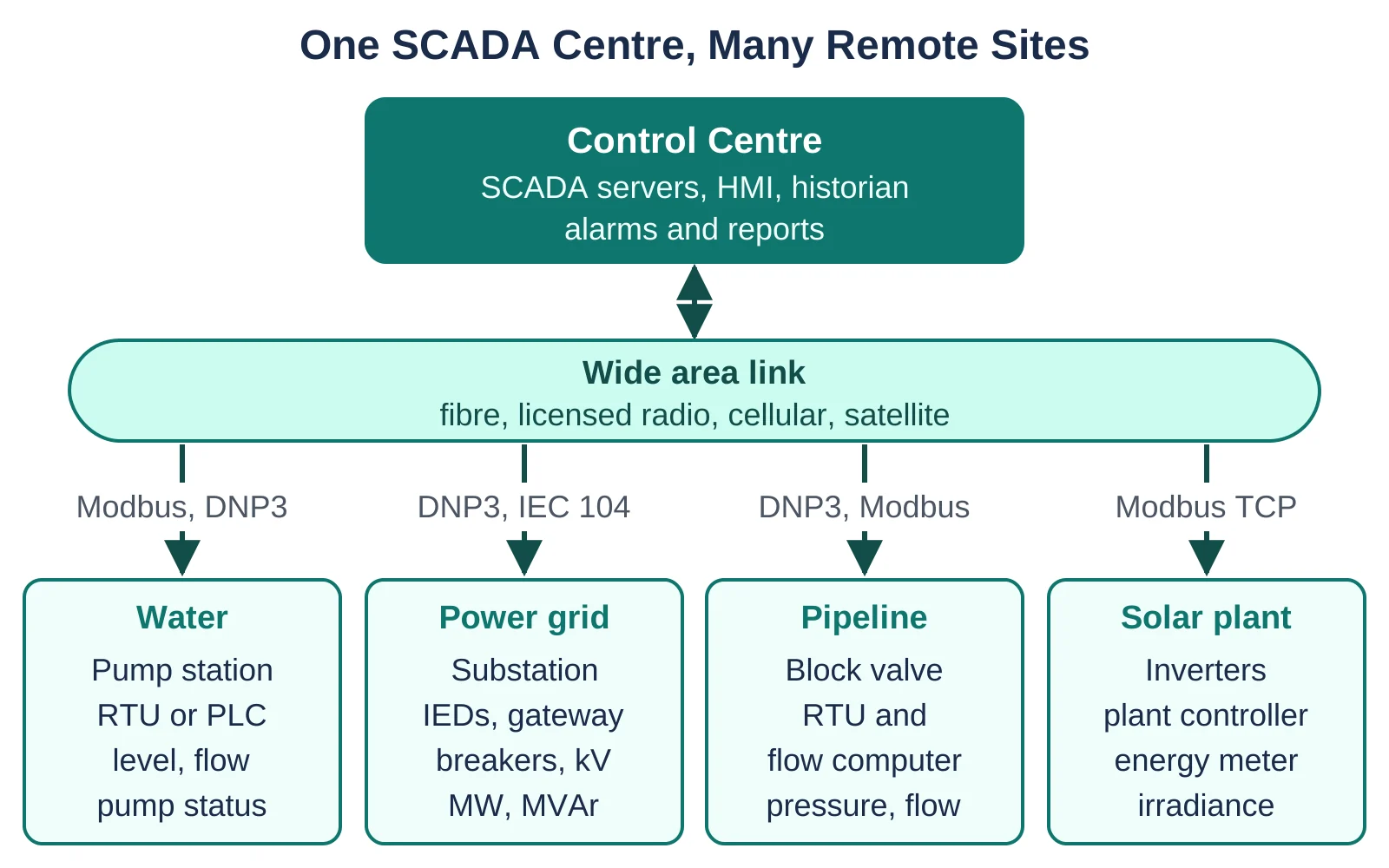
The field device at each site is usually an RTU or a PLC, and the choice between them depends on power, environment and communication needs. Read RTU architecture and communication and the comparison of PLC vs RTU to see why utilities often pick RTUs for unmanned sites.
SCADA in Water and Wastewater
In water and wastewater, SCADA applications monitor reservoir and tank levels, pump stations, flow, pressure and treatment quality across a whole city network. NIST names water distribution and wastewater collection as classic SCADA applications because the assets are spread across many kilometres.
A typical scheme fills an elevated tank from a pump station, with the RTU starting and stopping pumps on level while the control room watches every site. A full worked plant is described in SCADA in water treatment.
For pump stations on licensed radio, set local level control in the RTU so the pumps keep running safely if the link drops. Let SCADA supervise and adjust setpoints, and leave overflow protection to the RTU.
SCADA in Power Grids and Substations
In power grids, SCADA applications monitor breaker status, bus voltage, feeder current and MW and MVAr flows, and lets dispatchers open or close breakers remotely. NIST notes that SCADA collects data from remote field stations and issues commands to control electricity distribution from a central location.
Inside the substation, IEDs talk IEC 61850 GOOSE and MMS, and a gateway passes the data up to the control centre over DNP3 or IEC 60870 5 104. The trade offs between those two are covered in DNP3 vs IEC 104.
Grid SCADA applications need accurate time stamps to rebuild fault sequences, so clocks are tied to GPS or PTP. See SCADA time synchronization.
Oil and Gas Pipeline SCADA
Pipeline SCADA applications monitor line pressure, flow, block valve position, compressor or pump status and supports leak detection along hundreds of kilometres. RTUs and flow computers sit at block valve stations and metering skids, often powered by solar panels and talking over satellite or radio.
Because links are slow and costly, pipeline systems rely on report by exception, where the RTU sends only changed values instead of answering every poll. See report by exception in DNP3 for how it cuts traffic.
NIST lists oil and natural gas pipelines next to water and power as core SCADA applications. Pipelines also use SCADA data for leak detection along the line.
Renewables, Rail and Buildings
Solar and wind farms, metro rail and large buildings also run SCADA applications, each with its own field devices and protocols.
For solar sites, the SCADA data is also used to check yield against design, which links back to solar PV system sizing. In buildings, most controllers speak the BACnet protocol, so the SCADA or BMS server needs a BACnet driver.
SCADA in Manufacturing Plants
In manufacturing, SCADA applications sit on top of PLCs to show line status, production counts, downtime, energy use and batch records for the whole plant. Here the network is plant Ethernet, so update rates of one second or faster are easy to reach.
Most modern plant SCADA connects through OPC UA or Modbus TCP, which lets one server read PLCs from different brands. When the process has many tight control loops in one plant, a DCS may fit better, as compared in SCADA vs DCS differences.
- Assets spread over many sites or kilometres
- Supervision, alarms and data logging from one room
- Mixed vendors of RTUs and PLCs
- Slow or costly links such as radio and satellite
- Fast closed loop control that must not depend on the link
- Large continuous plants with thousands of interlinked loops
- Sites with no reliable communication path
- Systems left on default passwords and flat networks
How to Calculate SCADA Poll Cycle Time
Poll cycle time is the number of bytes sent and received for every RTU, multiplied by the bits per byte and divided by the baud rate, plus a fixed latency for each request. For Modbus RTU each byte takes 11 bits, and one read can return at most 125 holding registers.
Reply bytes = 5 + 2 × registers
Time per RTU = bytes × 11 ÷ baud + latency
Example: 20 RTUs, 100 registers, 9600 baud, 50 ms latency
Bytes per RTU = 8 + 205 = 213
213 × 11 = 2343 bits
2343 ÷ 9600 = 0.244 s
0.244 + 0.050 = 0.294 s
Cycle = 20 × 0.294 = 5.88 s
Latency covers modem keying, radio turnaround and slave response delay, so measure it on site. Polling for SCADA applications is tuned further in SCADA polling rate optimization.
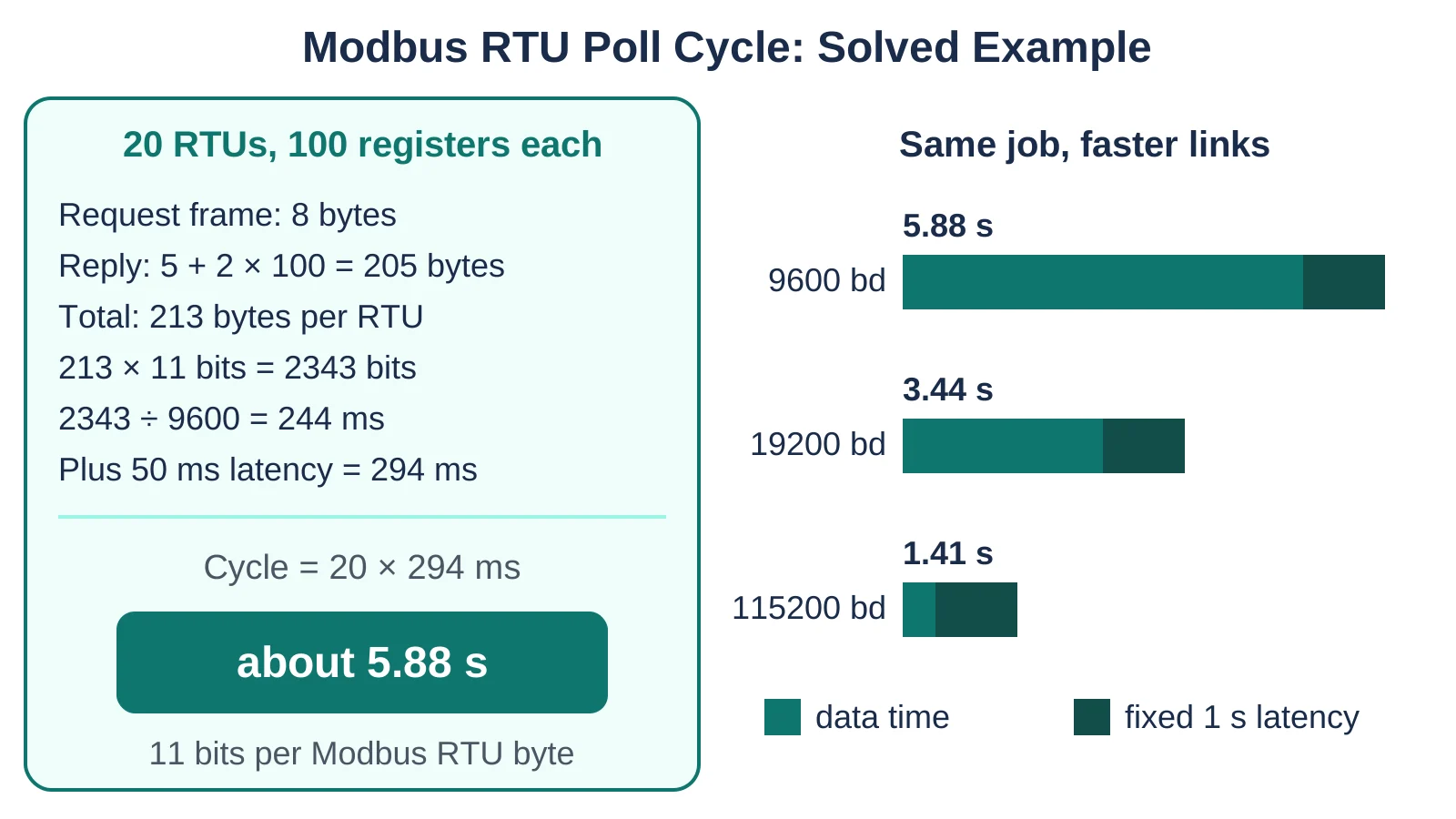
At 19200 baud the same job takes about 3.44 s, and at 115200 baud about 1.41 s, because the 1 s of total latency does not shrink. Register counts above 125 need a second request per RTU, which the calculator adds automatically.
If the cycle is too slow, group registers into one block per RTU and cut latency before paying for a faster link. Plan the Modbus register map with this in mind.
Which SCADA Protocol Suits Each Industry?
DNP3 and IEC 60870 5 104 suit utilities and pipelines, IEC 61850 suits substations, BACnet suits buildings and Modbus, OPC UA and EtherNet/IP suit plants. The cards below summarise each one.
Event based, time stamped, IEEE 1815.
Telecontrol over TCP/IP.
Substation standard with GOOSE and MMS.
Simple register based protocol.
Vendor neutral, secure data model.
Most real SCADA applications mix two or three of these through a gateway, as covered in SCADA communication protocols. Our Modbus protocol guide is a good starting point if you are on the field side.
How to Choose SCADA for Your Application
Choose SCADA by first asking how far apart your sites are, then what kind of equipment is in the field, and then what link is available. The flowchart below covers the first decision.
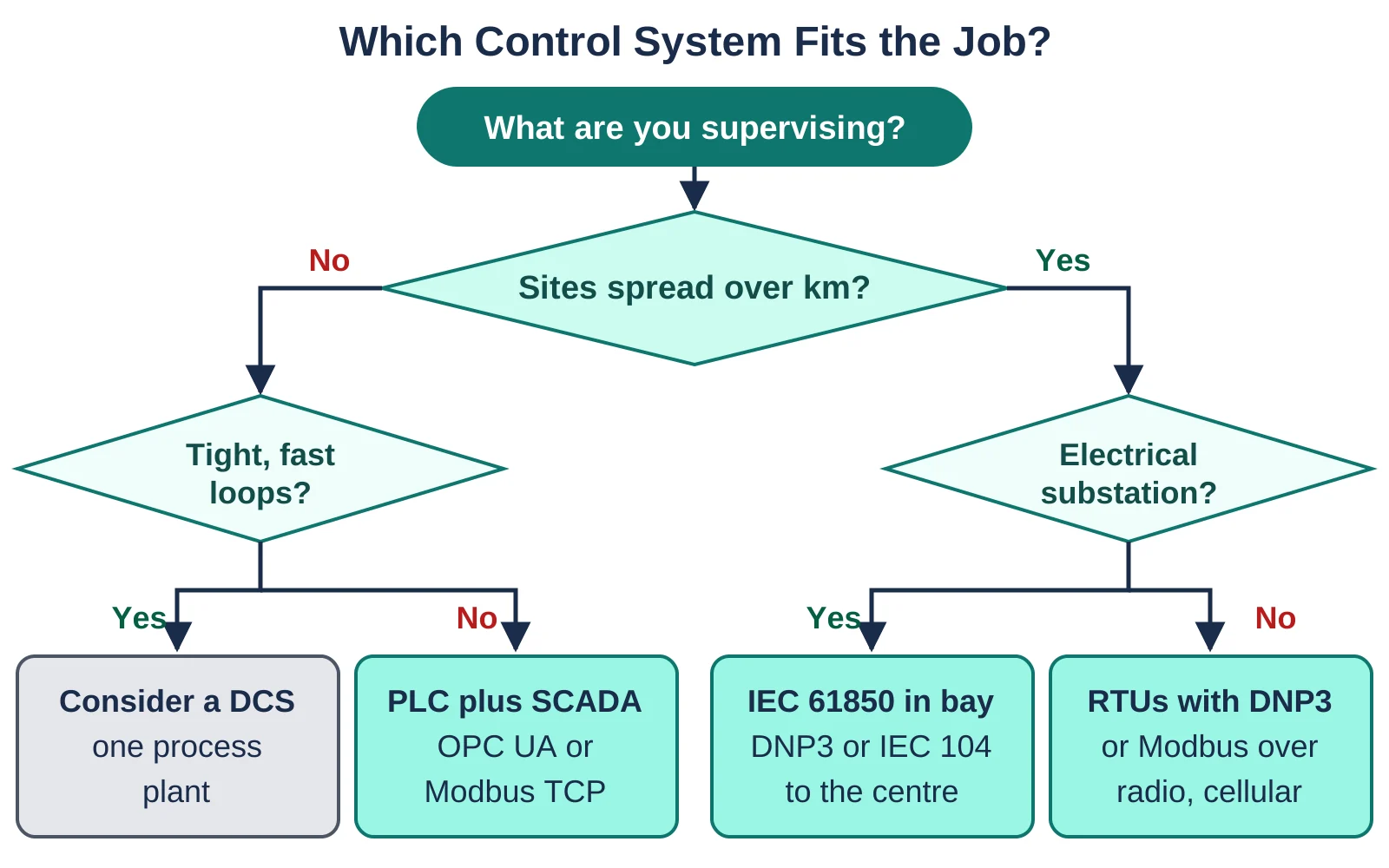
Plan security from the start, because SCADA applications reach unmanned sites that anyone can walk into. Start with SCADA network security and the zone model in IEC 62443 zones and conduits.
- Measured latency for every site
- Poll cycle checked against operator needs
- Local fail safe logic in each RTU or PLC
- Segmentation and remote access plan
Common Mistakes in SCADA Applications
The most common mistakes are depending on SCADA for safety, polling too much data over slow links and leaving remote sites open to attack. These myths come up often during commissioning.
Too many alarms is another common failure, especially when every RTU sends a comms fail alarm during a radio fade. Follow SCADA alarm management practice to keep the alarm list useful.
To check whether a link can carry your polling load, try our network bandwidth calculator along with the poll cycle calculator above.
SCADA Applications FAQ
The main SCADA applications are water and wastewater networks, power grids, oil and gas pipelines, solar and wind plants, rail, buildings and manufacturing.
A water utility, for example, uses SCADA to watch tank levels and start pumps at stations many kilometres away from one control room.
Water SCADA mostly watches levels, pumps and flow over radio or cellular, with update times of several seconds being acceptable.
Power grid SCADA watches breakers, voltage and MW, uses DNP3, IEC 104 or IEC 61850 and needs millisecond time stamps to rebuild fault sequences.
Add request and reply bytes for each RTU, multiply by 11 bits for Modbus RTU and divide by the baud rate.
Then add latency per request and multiply by the number of RTUs, so 20 RTUs with 100 registers at 9600 baud and 50 ms latency take about 5.88 s.
DNP3 is a strong choice for pipelines because it supports report by exception and time stamped events over slow links.
Modbus is also common at flow computers and older RTUs, often with a gateway converting it to DNP3 for the control centre.
A common mistake is putting safety or level control only in the SCADA server, so a radio failure stops the pumps or overflows a tank.
Keep fail safe logic in the local RTU or PLC and let SCADA supervise setpoints and alarms.
Yes, SCADA is widely used in manufacturing to supervise PLCs, show line status, count production and log batch and energy data.
Inside one plant it usually runs over Ethernet with OPC UA or Modbus TCP, giving updates of one second or faster.
Related Articles
- How SCADA Systems Work
- SCADA vs DCS Differences
- SCADA in Water Treatment
- SCADA RTU Architecture and Communication
- DNP3 vs IEC 60870 5 104 Protocol Comparison
External References
- NIST SP 800 82 Rev 3 Guide to Operational Technology Security (PDF)
- Inductive Automation: What is SCADA?
- Wikipedia: SCADA
What We Learn Today
- SCADA applications cover water, power grids, pipelines, renewables, rail, buildings and manufacturing, wherever many remote assets must be supervised from one place.
- Each industry has its own field devices and protocols, such as DNP3 for utilities, IEC 61850 for substations and BACnet for buildings.
- Poll cycle time depends on bytes per RTU, 11 bits per Modbus RTU byte, baud rate and fixed latency for every request sent.