
IEC 61850 is the international standard for communication in power utility automation. It defines how intelligent electronic devices (IEDs) in electrical substations communicate with each other and with the SCADA system.
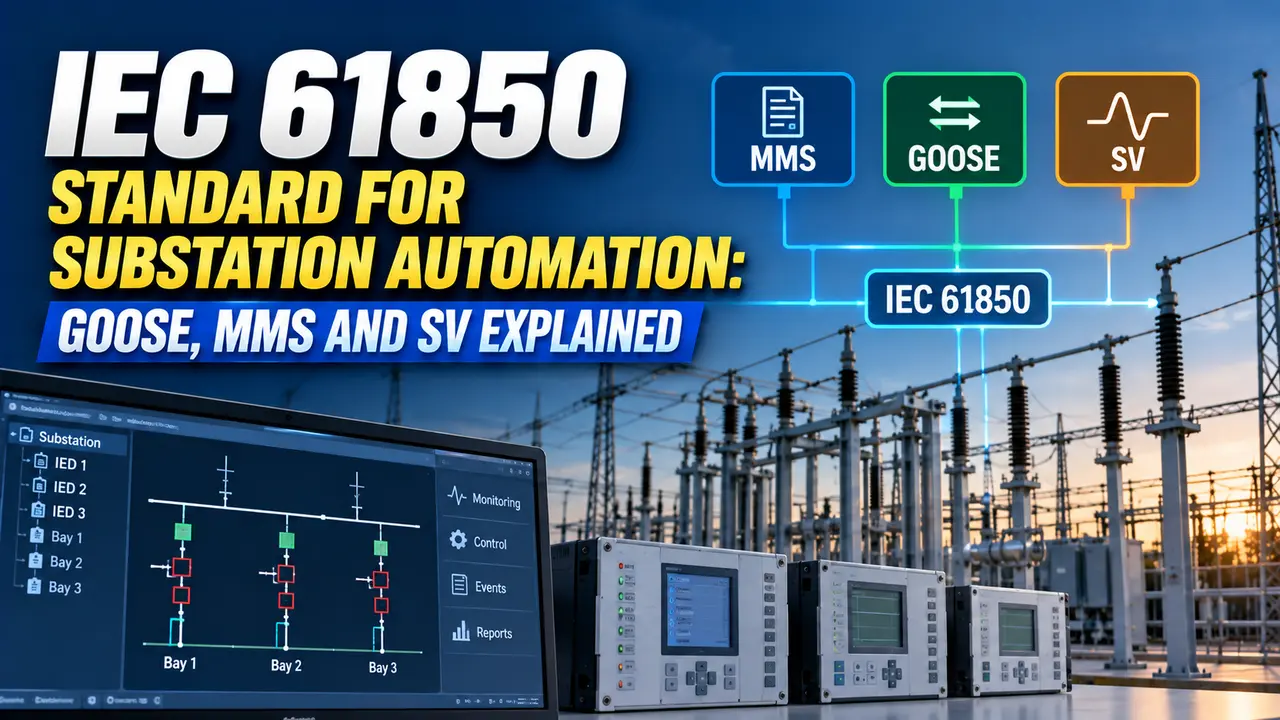
The standard uses three distinct communication services: GOOSE, MMS, and Sampled Values (SV).
This guide explains each service, the substation automation architecture it enables, and how this standard differs from older SCADA protocols such as DNP3 and Modbus.
Before IEC 61850, substation automation meant running copper wires between relays, RTUs, and meters — every signal a separate pair of conductors.
The standard replaced most hardwired connections with an Ethernet-based framework. A protection relay trip that once needed a dedicated copper wire now travels as a GOOSE message in under 4 milliseconds.
What IEC 61850 Replaced and Why It Matters
Before IEC 61850, every signal between protection relays, control panels, and RTUs required a dedicated hardwired connection. A large substation could have tens of thousands of copper wire terminations.
Any change required physical rewiring.
The standard also standardised the data model — defining how a circuit breaker or protection relay describes itself to any other device on the network, regardless of vendor.
The standard was intentionally designed to have a lifespan of at least 30 years without major revision. One of its key architectural decisions was separating the abstract data model from the specific communication mappings — meaning a new communication technology could be added (for example, the standard over XMPP for IoT integration) without changing the data model that IEDs already use.
The second edition added support for communication between substations (not just within a single substation), wide-area protection schemes, and integration with IEC 61968/61970 (the CIM model used by energy management systems).
GOOSE: Generic Object-Oriented Substation Event
What GOOSE Does
GOOSE (Generic Object-Oriented Substation Event) is the IEC 61850 service for transmitting protection trip signals, interlocking signals, and binary status changes between IEDs at very high speed.
GOOSE operates at Layer 2 — no IP, no TCP, no router. It stays within the substation LAN.
When a protection relay detects a fault, it publishes a GOOSE message. Every subscribing device on the LAN acts on it immediately.
The maximum allowable GOOSE latency is 4 milliseconds under performance class P1 of the standard — fast enough to replace a hardwired trip output.
Event occurs (protection trips): GOOSE retransmission burst begins
Retransmission 1: immediately (t = 0)
Retransmission 2: 2 ms later
Retransmission 3: 4 ms later
Retransmission 4: 8 ms later
... doubling each time until T0 is reached again
This burst-and-back-off pattern ensures the event is received even if one packet is lost on the Ethernet LAN. GOOSE carries a sequence number (SqNum) and state number (StNum) so receivers can detect missed packets and duplicate packets.
GOOSE uses Ethernet multicast. Every subscribing device receives the message simultaneously — no point-to-point connections required. This makes GOOSE a direct replacement for hardwired intertripping and interlocking signals.
GOOSE is a Layer 2 protocol with no IP header. It cannot be routed across subnets. Even if you assign a VLAN, routers will not forward Layer 2 frames without a bridge configuration.
If your substation architecture needs GOOSE to cross a network boundary (for example, between two substations for wide-area protection), use an a GOOSE tunnel or a dedicated Layer 2 link. Never assume that a managed switch will forward GOOSE frames correctly without explicit VLAN and multicast configuration — verify it on the actual hardware before commissioning.
MMS: Manufacturing Message Specification
What MMS Does
MMS (Manufacturing Message Specification) is the the non-time-critical data exchange service between IEDs and station-level systems — the substation HMI, SCADA gateway, and energy management system.
MMS uses TCP/IP port 102 in a client-server model.
The SCADA master is the MMS client and each IED is the MMS server. The client reads data from the IED's logical node data objects and receives event reports when data changes.
This is how the SCADA system reads breaker status, protection relay measurements, and energy meter values from the substation.
Unlike GOOSE, MMS can traverse routers and firewalls — the right choice for communication between the substation and the control centre. See the SCADA communication protocol guide.
The standard did not create a new application protocol from scratch — it mapped its abstract communication service interface (ACSI) to MMS for the station-bus communication. This decision gave the standard a proven, well-understood application protocol at its core, with a long track record in industrial automation.
The mapping means that the data objects (like a circuit breaker's XCBR logical node) appear to an MMS client exactly as MMS named variables. Any MMS client stack can read the data without needing IEC 61850-specific knowledge — though understanding the the data model is still required to interpret what the data means.
Sampled Values: The Process Bus
What Sampled Values Do
Sampled Values (SV, also called Sampled Measured Values or SMV) is the this communication service used to transmit time-synchronised digital samples of current and voltage from merging units to protection IEDs.
In a traditional substation, CTs and VTs are wired directly to each relay with heavy analogue cables.
In a digital substation, a merging unit digitises the CT and VT outputs at the instrument transformer.
The merging unit samples the waveforms (typically 80 or 256 samples per power cycle at 50 Hz) and publishes the digital samples as a continuous SV stream on the substation Ethernet network.
Protection IEDs subscribe to this SV stream instead of direct analogue CT/VT connections. Multiple IEDs can subscribe to the same merging unit SV stream, eliminating separate analogue cabling from each CT/VT.
Without accurate time synchronisation, the SV samples from different merging units cannot be correctly correlated to reconstruct the three-phase current and voltage phasors. A phase error equivalent to just 1 microsecond of timing offset at 50 Hz corresponds to a 0.018 degree phase angle error — small but potentially significant for differential protection algorithms that depend on the precise phase relationship between currents at two ends of a protected zone.
Sampled Values is defined in standard part 9-2. The 9-2LE (Light Edition) profile was defined by UCA International Users Group as a subset suitable for practical implementation by equipment vendors.
SV traffic is a continuous high-bandwidth stream — 80 samples per cycle at 50 Hz from one merging unit generates approximately 1 Mbit/s of network traffic. A substation with many merging units can saturate a shared switch if SV and GOOSE traffic compete on the same network segment.
Best practice is to use a dedicated process bus switch for SV traffic, and a separate station bus switch for GOOSE and MMS traffic. Ethernet switches must support IEEE 802.1Q VLAN tagging and IEEE 802.1p priority queuing to correctly prioritise GOOSE over MMS in a shared environment.
GOOSE vs MMS vs Sampled Values: Protocol Comparison
| Parameter | GOOSE | MMS | Sampled Values (SV) |
|---|---|---|---|
| IEC 61850 part | IEC 61850-8-1 | IEC 61850-8-1 (mapped to ISO 9506) | IEC 61850-9-2 |
| OSI layer | Layer 2 (Ethernet frame, no IP) | Layer 7 (application layer over TCP/IP) | Layer 2 (Ethernet frame, no IP) |
| Communication model | Publisher-subscriber multicast | Client-server (IED is server, SCADA master is client) | Publisher-subscriber multicast (continuous stream) |
| Latency class | P1: under 4 ms | P2: under 20 ms | P3: under 100 ms | Non-time-critical (100 ms to seconds typical) | Continuous stream at fixed sample rate. Latency is one sample period: 0.25 ms at 80 samples/cycle, 50 Hz. |
| Transmission pattern | Event-driven burst (retransmit with increasing interval after state change), plus periodic heartbeat | Client polls or subscribes to reports. Server pushes event reports when data changes. | Continuous stream at fixed rate — every sample published unconditionally |
| Network scope | Substation LAN only. Layer 2 — cannot be routed across IP networks without tunnelling. | Can cross routers and firewalls over TCP/IP. Used between substation and control centre. | Substation process bus only. Layer 2 — not routable. |
| Time synchronisation needed? | Not required for basic function. Recommended for event timestamping. | Not required for basic function. IEEE 1588 optional. | Yes — mandatory. IEEE 1588 PTP to within 1 microsecond for protection-grade SV. |
| Typical use | Protection relay trips, breaker interlocking, position feedback, alarm states between IEDs in the substation | SCADA data acquisition, setpoint commands, event logs, disturbance records from the station to control centre | CT and VT current and voltage samples from merging units to protection IEDs on the process bus |
| Replaces what | Hardwired copper trip and interlock outputs between protection relays | DNP3 or Modbus SCADA communication to the RTU or gateway | Analogue CT/VT secondary cables from instrument transformers to protection relays |
IEC 61850 Protocol Use Case Selector
Watch: IEC 61850 — GOOSE, Sampled Values and MMS Animated (2026)
IEC 61850 Questions Engineers Ask
Related Articles on This Site
- OPC UA Explained: Architecture and Industrial Use
- Communication Protocols in DCS Systems
- Modbus RTU vs Modbus TCP: Key Differences
- HART Protocol: How It Works
- 4 Generations of SCADA Architecture
External References
- IEC 61850 Communication Networks and Systems for Power Utility Automation | IEC TC 57
- IEC 61850 Introduction: GOOSE, MMS and Sampled Values | OMICRON (2024)
What We Learn Today
- IEC 61850 defines three communication services for substation automation: GOOSE (Layer 2 multicast, under 4 ms, for protection trips and interlocking between IEDs), MMS (TCP/IP client-server, for SCADA data acquisition and control between the substation and control centre), and Sampled Values (Layer 2 continuous stream of CT/VT samples from merging units to protection IEDs, requiring IEEE 1588 PTP time synchronisation).
- GOOSE and Sampled Values both operate at Ethernet Layer 2 — they have no IP header, cannot be routed across subnets, and must stay within the substation LAN or process bus. MMS operates over TCP/IP and can cross routers and firewalls, making it suitable for wide-area communication between the substation and the SCADA master station.
- IEC 61850 replaced hardwired copper connections between protection relays, CT/VT secondary cabling, and proprietary RTU-to-SCADA protocols with a single standardised Ethernet-based framework. A protection trip that once needed a dedicated copper wire now travels as a GOOSE multicast packet in under 4 milliseconds — with multiple IEDs receiving it simultaneously.