
Building Automation · BACnet · HVAC · Protocols
BACnet Protocol: 4 Must Know Facts for Building Automation Engineers
Before BACnet, choosing one HVAC vendor often meant staying locked to that vendor for the life of the building. This guide explains the BACnet protocol, its objects, services, and network types, with a video walkthrough and a live device instance ID checker.
Why Building Automation Needed a Common Language
Before the BACnet protocol existed, building automation was a collection of closed, proprietary systems. Choosing one manufacturer's HVAC controllers usually meant staying locked into that same manufacturer's sensors, software, and service contracts for the entire life of the building. ASHRAE began developing an open alternative in 1987, and BACnet became ANSI/ASHRAE Standard 135 in 1995.
That openness is exactly why BACnet now dominates commercial building automation, letting HVAC, lighting, fire detection, and access control systems from completely different vendors share data. It plays a similar role to what TCP and UDP play in general networking, just purpose built for building specific data like schedules, alarms, and trend logs.
4 Must Know Facts About the BACnet Protocol
The Core BACnet Building Blocks
These four building blocks form the foundation of the BACnet protocol as used in real installations.
Standardized representations of real world points, such as an Analog Input for a temperature sensor or a Binary Output for a fan.
Key property: Present Value, the actual current reading or command state.
Standardized commands that let one device request data, write a value, or discover other devices on the network.
Common examples: Who-Is, I-Am, ReadProperty, WriteProperty.
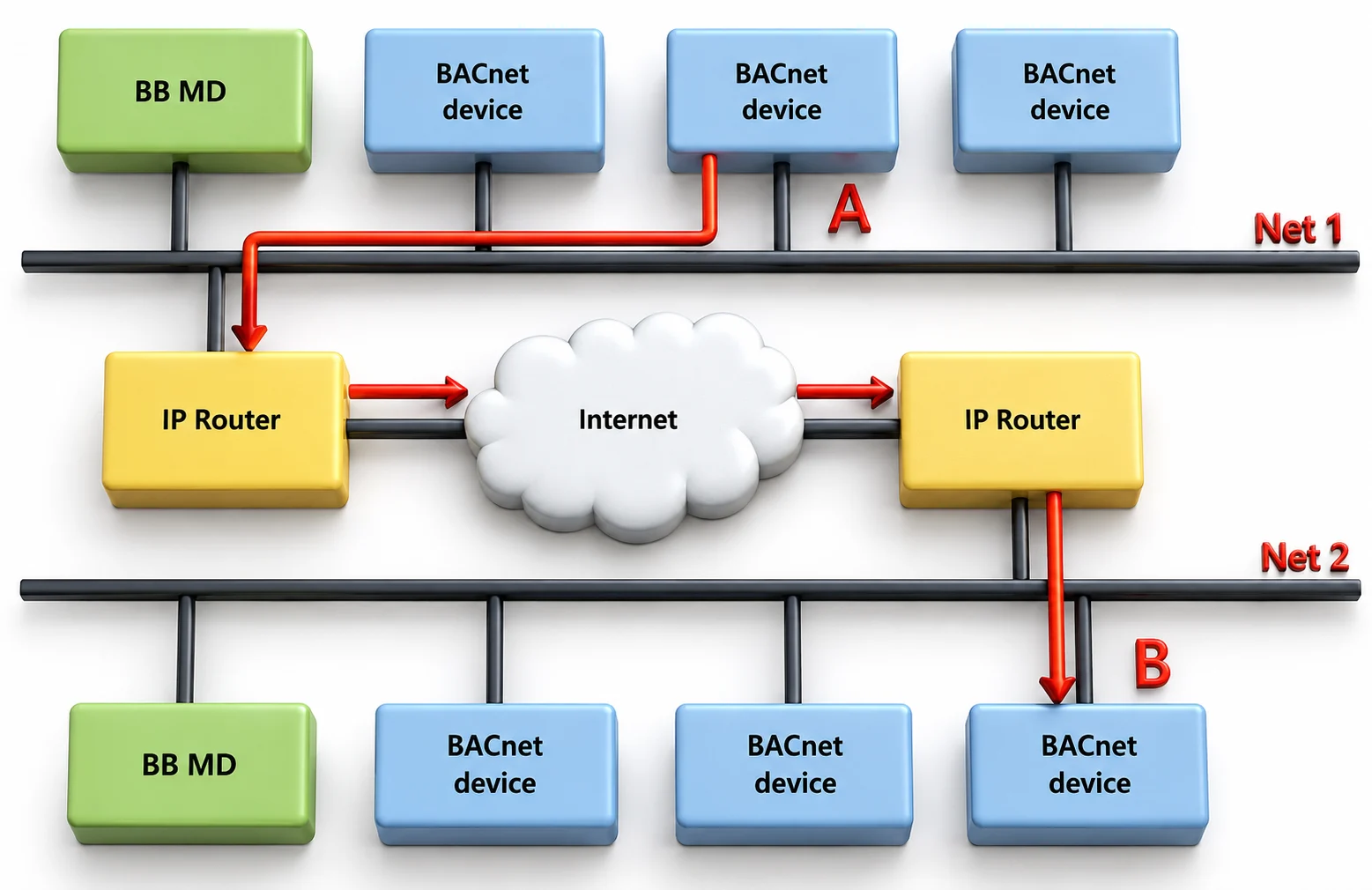
Carries BACnet messages over a standard UDP/IP network, making it easy to integrate with modern corporate IT infrastructure.
Best suited for: larger buildings and campus wide networks.
A serial network running over RS-485, using token passing between devices, common for smaller field level controllers.
Best suited for: lower cost, simpler wiring at the individual equipment level.
How a BACnet Read Request Actually Works
Watch: What Is BACnet?
This video introduces BACnet and explains the basics of how it works in building automation.
BACnet vs Modbus
Comparing the BACnet protocol directly against Modbus highlights why building automation and general industrial automation evolved such different approaches.
| Feature | BACnet | Modbus |
|---|---|---|
| Primary domain | Building automation (HVAC, lighting, access control) | General industrial automation |
| Data model | Self describing objects and properties | Raw numbered registers |
| Device discovery | Automatic, via Who-Is and I-Am services | Manual configuration required |
| Age | Developed starting 1987 | Developed in 1979 |
Where BACnet Is Used
The BACnet protocol shows up across nearly every major system in a modern commercial building.
The most common BACnet application, controlling heating, ventilation, and cooling.
Scheduling and dimming integrated alongside HVAC in a single building management platform.
Fire alarm events can trigger coordinated HVAC responses through shared BACnet data.
Door access events can tie into HVAC occupancy modes for energy savings.
Energy consumption data feeds directly into building wide reporting and optimization.
A single front end can display and control equipment from many different vendors.
Working With BACnet Correctly
Getting the most out of the BACnet protocol in the field comes down to a few consistent habits.
- Use BTL certified devices where possible: for genuinely tested, verified interoperability.
- Rely on Who-Is and I-Am for device discovery: rather than manually configuring every device address.
- Consider BACnet/SC for networks needing modern security: especially where firewalls and NAT are involved.
- Check each device's PICS document: before assuming it supports a specific object or property.
- Don't assume every device supports every optional property: only required properties are guaranteed.
- Don't ignore conformance class differences between devices: capability genuinely varies by device class.
- Don't mix incompatible network types without a proper router: BACnet/IP and MS/TP need a bridging device.
- Don't skip reviewing the PICS during integration planning: it prevents surprises during commissioning.
BACnet Device Instance ID Range Checker
Enter a device instance ID to check whether it falls within the valid BACnet range.
Quick FAQs: BACnet Protocol
External References
What we learn today
- The BACnet protocol was developed by ASHRAE starting in 1987 to break vendor dependency in building automation.
- Objects represent points like sensors and actuators, while services like ReadProperty and WriteProperty move data between devices.
- BACnet runs over multiple network types, including BACnet/IP over Ethernet and BACnet MS/TP over RS-485 serial.
- BACnet/SC adds modern, firewall friendly security using TLS encrypted WebSockets, extending BACnet into current IT security requirements.