
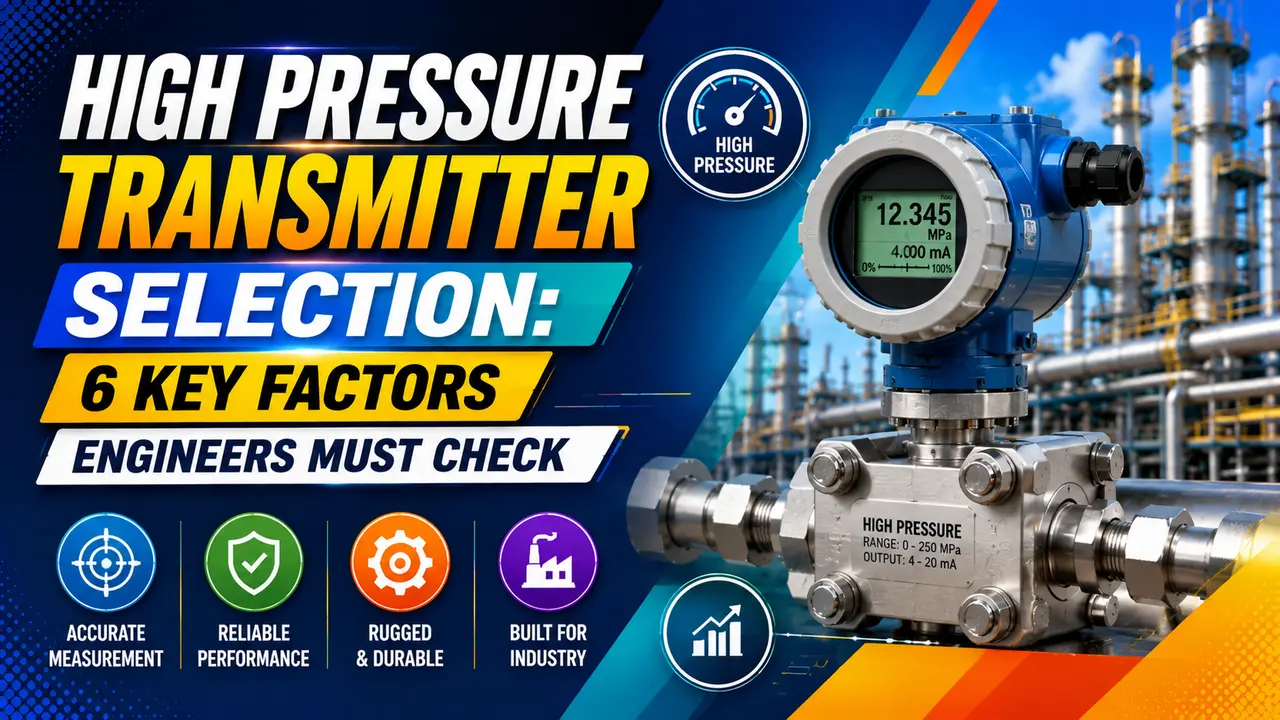
High pressure transmitter selection involves more than picking a pressure range. The sensing technology, wetted materials, process connection, output protocol, accuracy class, and hazardous area certification all affect whether a high pressure transmitter performs reliably in service or becomes a calibration headache within months.
This guide covers the six key selection factors with a practical worked example and an interactive selection advisor.
High pressure transmitter selection starts with the maximum operating pressure -- but it must also account for pressure spikes, temperature extremes, chemical compatibility of wetted parts, and whether the installation site requires hazardous area certification.
What Makes High Pressure Transmitter Selection Different from Standard Pressure Measurement
High pressure transmitter selection is more involved than choosing a pressure range. A transmitter rated for 600 bar in water service may fail within months in hydrogen or acid service -- not because the pressure rating is wrong, but because the wetted material is incompatible.
A unit with excellent reference accuracy may deliver poor results because the URL is too large for the actual operating range.
A transmitter approved for Zone 1 may still be unsuitable if the SIL certificate does not cover the specific pressure class. Click any highlighted term to learn more, then use the advisor below.
6 Key Factors in High Pressure Transmitter Selection
Factor 1: Pressure Range and Overpressure Protection
Selection begins with the maximum allowable working pressure (MAWP) of the process line. The URL must equal or exceed the MAWP.
Pressure spikes from pump start-up, valve slam, or water hammer can exceed the MAWP by 50 to 100%. The sensing element must survive these spikes without damage.
Most high pressure transmitters have a separate overpressure rating (typically 2x to 4x URL) -- verify this against the expected spike. See the pressure transmitter types guide.
Factor 2: Sensing Technology
Piezoresistive (Strain Gauge on Silicon)
Most common for selection up to 1,000 bar. Silicon chip bonded to a thin steel diaphragm. Good accuracy and stability. Sensitive to temperature -- must include temperature compensation circuitry. Subject to hydrogen embrittlement of the steel diaphragm in hydrogen service.
Capacitive Ceramic
Ceramic diaphragm deflects under pressure and changes capacitance. Excellent for corrosive fluids -- the ceramic surface is chemically inert. Suitable for acid, alkali, and food-grade applications. Limited to lower pressure ranges (typically under 400 bar) compared to piezoresistive types.
Resonant Frequency (Quartz or MEMS)
A vibrating element changes resonant frequency under applied pressure. Very high accuracy and long-term stability. Used in fiscal metering and laboratory reference applications. Higher cost than piezoresistive. Some designs are suitable for use above 700 bar.
Metal Thin Film on Steel Diaphragm
Strain gauges deposited directly onto a stainless steel diaphragm -- no oil fill, no intermediate diaphragm. Suitable for very high pressure (above 700 bar) and for applications where oil filled systems risk contamination. Lower accuracy than piezoresistive but better suited to extreme conditions.
Factor 3: Wetted Materials and Chemical Compatibility
Wetted materials -- the diaphragm, process connection body, and seal rings -- must be compatible with the fluid at actual operating temperature and pressure.
Ambient temperature compatibility does not guarantee compatibility at 200°C and 500 bar. See the pressure transmitter installation guide.
| Process Fluid | Recommended Wetted Material | Avoid |
|---|---|---|
| Water and steam (clean) | 316L stainless steel | Carbon steel (corrosion), copper alloys |
| Hydrocarbon oil and gas | 316L SS; Hastelloy C276 for sour service (H2S) | Copper alloys; zinc plated fittings |
| Mineral acids (HCl, H2SO4) | Hastelloy C276, tantalum | 316L SS (pitting), carbon steel |
| Hydrofluoric acid (HF) | Monel, PTFE lined diaphragm | All standard stainless grades; titanium |
| Strong caustic (NaOH) | 316L SS at low concentrations; Hastelloy C276 at high concentration and temperature | Aluminium, zinc, tin (rapidly attacked) |
| Hydrogen (H2) | 316L SS (low strength), Inconel 625 | High strength martensitic steels (embrittlement) |
| Oxygen (O2) | 316L SS, oxygen-cleaned assembly -- no oil or grease contamination | Any oil filled diaphragm system (fire hazard) |
Factor 4: Accuracy, Stability and Temperature Effect
Accuracy is specified as % of URL, not % of reading. A unit with ±0.1% URL at 100 bar on a 500 bar range has an absolute error of ±0.5 bar.
This equals ±0.5% of the reading -- which is why the URL should match the actual operating range as closely as possible.
Temperature effect: additional error from ambient temperature change (% URL per °C or per 10°C band)
Long term drift: annual stability specification (% URL per year)
Combined as root-sum-square (RSS) for independent, random errors
Temperature effect is particularly significant for outdoor installations or near heat sources. A ±0.2% URL per 50°C specification adds directly to the total error budget.
See the temperature effect guide for calculating the combined error budget.
Factor 5: Process Connection and Pressure Rating
The process connection must carry the full line pressure safely. At high pressures, standard flanged connections (ASME Class 150 or Class 300) are not adequate. The correct connection depends on pressure class.
| Pressure Range | Typical Process Connection | Standard |
|---|---|---|
| Up to 100 bar (1,450 psi) | ASME Class 600 flanges (PN100), 1/2" NPT or G1/2" threaded | ASME B16.5, EN 1092-1 |
| 100 to 250 bar | ASME Class 1500 flanges (PN250), 1/2" NPT threaded with rated body | ASME B16.5 |
| 250 to 600 bar | ASME Class 2500 flanges (PN420), high pressure threaded connection (HP connector) | ASME B16.5, DIN 16901 |
| Above 600 bar | Autoclave Engineers cone and thread (HC series), needle-valve body connections | Autoclave Engineers proprietary; manufacturer-specific |
Factor 6: Output Protocol and Hazardous Area Certification
Standard 4 to 20 mA with HART superimposed is the most common output in process plants. Digital protocols (FOUNDATION Fieldbus, PROFIBUS PA, Wireless HART) are available from most manufacturers. See the HART protocol guide for wiring requirements.
For hazardous area installation, the transmitter must carry ATEX or IECEx Zone 1 certification.
The certification must cover the complete assembly, not only the transmitter head. See the hazardous area classification guide for zone definitions.
High Pressure Transmitter URL and Error Calculator
High Pressure Transmitter Selection Comparison
| Factor | Standard Pressure Service | High Pressure Transmitter Selection |
|---|---|---|
| Pressure range | 0 to 10 bar typical | 100 bar and above; verify spike and fatigue rating |
| Process connection | Standard 1/2" NPT or Class 150 flange | Class 600 to 2500 flange or cone and thread above 600 bar |
| Sensing technology | Capacitive or piezoresistive, any type | Piezoresistive preferred; thin-film or resonant for extreme ranges |
| Wetted materials | 316L SS sufficient for most clean fluids | Must verify against specific fluid, temperature, and pressure combination -- Hastelloy C276 or higher may be needed |
| Accuracy specification | % of span acceptable | Must check % of URL vs % of reading at actual operating point; URL ratio to operating pressure matters |
| Fatigue life | Rarely specified | Number of full-pressure cycles the diaphragm can withstand before fatigue failure -- critical for pulsating or cycling loads |
| SIL rating | Optional | Required for high-pressure safety trips -- verify SIL certificate covers the actual pressure class |
Watch: Pressure Transmitter Selection Guide
High Pressure Transmitter Selection Questions
External References
- Rosemount 3051S High Static and High Pressure Transmitter -- Emerson
- Pressure Transmitter Selection Guide -- Endress and Hauser
What We Learn Today
- High pressure transmitter selection needs URL at least 1.5x the maximum operating pressure, including expected spikes
- Accuracy is % of URL -- operating at 10% of URL multiplies the absolute error 10x relative to the reading
- Total error = RSS of reference accuracy, temperature effect, and long-term drift -- all in % of URL
- Wetted materials must be verified for the specific fluid at actual pressure and temperature, not just ambient conditions
- Process connection class must match or exceed the line pressure class at operating temperature using ASME B16.5 derating
- SIL certification must cover the complete assembly at actual operating pressure and temperature, not just the electronics