
Hydrogen sulfide is a colourless, flammable, and extremely toxic gas found in oil and gas, wastewater, paper mills, and mining.
A calibrated detector gives the only reliable warning -- human smell is unreliable above 100 ppm because olfactory paralysis sets in.
This guide covers how H2S gas detectors work, detector types, alarm setpoints, installation requirements, and field calibration.
A calibrated H2S gas detector converts concentration to electrical current using an electrochemical cell. Most fixed detectors output 4 to 20 mA, with alarms at 10 ppm and 15 ppm per OSHA and NIOSH guidelines.
H2S Gas Detector: Why Hydrogen Sulfide Demands a Dedicated Sensor
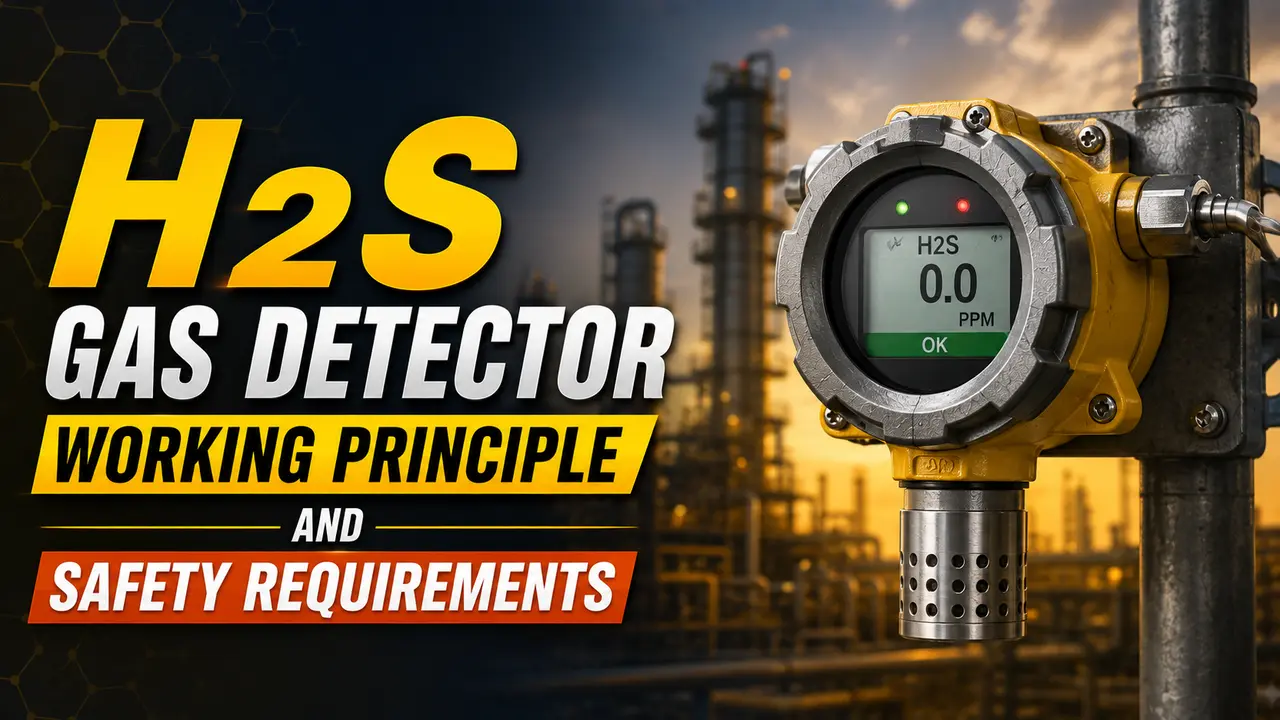
Hydrogen sulfide is produced in crude oil processing, sewage, paper mills, and mining. At low concentrations it smells like rotten eggs.
Above 100 ppm, olfactory fatigue removes the smell -- victims may believe the air is safe when it is not.
Three properties make H2S especially hazardous: it is acutely toxic at very low concentrations, it is flammable across a wide range, and it is heavier than air so it accumulates in low points and confined spaces. Click any term to expand.
H2S Gas Detector Working Principle: Electrochemical Cell
Most H2S gas detectors -- both portable and fixed -- use an electrochemical sensor. This sensor contains three electrodes (working, counter, and reference) immersed in an electrolyte, housed behind a gas permeable membrane.
When The gas diffuses through the membrane, it reaches the working electrode where oxidation occurs:
H2S → S + 2H⁺ + 2e⁻
The electrons released produce a current proportional to the H2S concentration. The counter electrode accepts the electrons to complete the circuit. The reference electrode maintains a stable potential. The detector electronics convert the current (in nanoamps) to a ppm reading and a 4 to 20 mA output. At zero H2S the current corresponds to 4 mA; at full scale (typically 50 or 100 ppm) it corresponds to 20 mA. See the 4-20 mA signal guide for how this output is wired to a control system.
Other Detection Technologies
| Technology | Working Principle | H2S Use | Limitation |
|---|---|---|---|
| Electrochemical | The gas oxidises at working electrode producing current proportional to concentration | Most common -- portable and fixed, 0 to 100 ppm range | Sensor depletes over time (1 to 3 year life). Cross sensitive to SO2, CO at high ppm. |
| Metal Oxide Semiconductor (MOS) | H2S adsorbs on heated SnO2 surface and reduces resistance -- measured as conductance change | Low cost detectors, industrial screening | Not specific to H2S. Requires regular calibration. High power consumption for heater. |
| Photoionisation (PID) | UV lamp ionises gas molecules; ion current is proportional to concentration | Low level H2S in ambient air monitoring | H2S ionisation potential 10.46 eV -- requires a 10.6 eV lamp. Poor in humid conditions. |
| Tunable Diode Laser (TDLAS) | Laser tuned to H2S absorption wavelength measures gas concentration by light attenuation | Process analysers and CEMS. High accuracy, fast response. | High cost. Path length must be controlled. Water vapour interference at some wavelengths. |
H2S Alarm Setpoints and Safety Requirements
Alarm setpoints must comply with the applicable standard for your jurisdiction and industry. The most widely referenced limits come from OSHA (US), NIOSH (US), and EN 60079-29 (IEC, used globally for fixed detectors in hazardous areas).
| Limit Type | Authority | Concentration | Meaning |
|---|---|---|---|
| TWA (8-hour) | OSHA | 1 ppm | Maximum average exposure over an 8-hour shift |
| Ceiling | OSHA | 20 ppm | Maximum at any moment -- must not be exceeded |
| STEL (15-min) | NIOSH | 10 ppm | Short term exposure limit -- no more than 15 minutes at this level |
| IDLH | NIOSH | 100 ppm | Immediately Dangerous to Life and Health -- evacuate immediately |
| Low alarm | Industry practice | 10 ppm | Warning -- investigate and prepare to evacuate |
| High alarm | Industry practice | 15 ppm | Evacuate immediately, isolate source, activate emergency response |
Detector Installation and Placement Rules
Mounting Height
H2S is heavier than air (vapour density 1.19). Mount fixed detectors 300 to 500 mm above floor level in enclosed spaces, near drain openings, at sump entrances, and at the lowest accessible point of confined spaces. Do not mount at head height or ceiling level.
Number of Detectors
IEC 60079-29-2 recommends spacing based on area, ventilation, and risk assessment.
A common rule: one fixed detector per 100 m² of enclosed area, plus detectors at all known release points such as wellheads and separator vents.
Signal Output and Alarming
Fixed detectors output 4 to 20 mA to a gas controller or DCS. NAMUR NE43 (see the NAMUR NE43 guide) defines fault signalling below 3.6 mA.
Alarm relays activate audible and visual alerts and can trigger ventilation, process isolation, or ESD.
Explosion Proof Housing
All fixed gas detectors in hazardous areas require a certified explosion proof or intrinsically safe housing. See the explosion proof vs IS guide for the difference. Transmitter enclosures are typically Ex d (flameproof) or Ex ia/ib (intrinsically safe) in Zone 1 areas.
H2S Gas Detector Calibration: Bump Test vs Full Calibration
Two maintenance procedures keep an H2S detector reliable: the bump test and the full calibration. These are not interchangeable.
Bump Test (Daily or Before Entry)
A bump test briefly exposes the detector to calibration gas to confirm it responds and alarms trigger. It does not verify accuracy.
Bump tests take under 30 seconds and are mandatory before every confined space entry in hazardous environments.
Full Calibration (Monthly or per Manufacturer Schedule)
A certified span gas (typically 25 ppm for a 0 to 50 ppm detector) is applied and the reading adjusted if it drifts beyond plus or minus 10% of span. Zero gas is applied first.
See the correction factor guide for how calibration adjustments are applied.
H2S Gas Detector Exposure Risk Checker
Watch: H2S Gas Safety Training, OSHA Guidelines and Detection
H2S Gas Detector Questions
External References
- OSHA Hydrogen Sulfide: PELs, IDLH and Safety Requirements
- Portable H2S Detectors for Oil and Gas -- International Gas Detectors (2026)
What We Learn Today
- Hydrogen sulfide is acutely toxic at 100 ppm (IDLH), flammable above 4.3% LEL, and heavier than air -- it accumulates in low points and confined spaces
- Electrochemical H2S detectors oxidise H2S at a working electrode, generating a current proportional to concentration, output as 4 to 20 mA
- Standard alarm setpoints: 10 ppm low alarm (NIOSH STEL), 15 ppm high alarm, 20 ppm OSHA ceiling, 100 ppm IDLH
- Fixed detectors in hazardous areas must be ATEX or IECEx certified for IIC gas group and the appropriate zone
- Mount fixed H2S detectors 300 to 500 mm above floor level -- heavier than air means ceiling mounting is wrong
- Bump test before every entry confirms response; full calibration (monthly) verifies and corrects ppm accuracy using certified span gas