A DO reading is only as good as its last calibration, and most errors come from wrong pressure, temperature or a tired membrane rather than the sensor itself. This guide covers zero and air calibration, the saturation table, corrections and a calculator for your own site.
Dissolved oxygen sensors drift, membranes age and site pressure changes the answer. Here we walk through zero and 100 percent air calibration, the mg/L saturation table and the corrections every aeration tank and boiler feedwater loop needs.
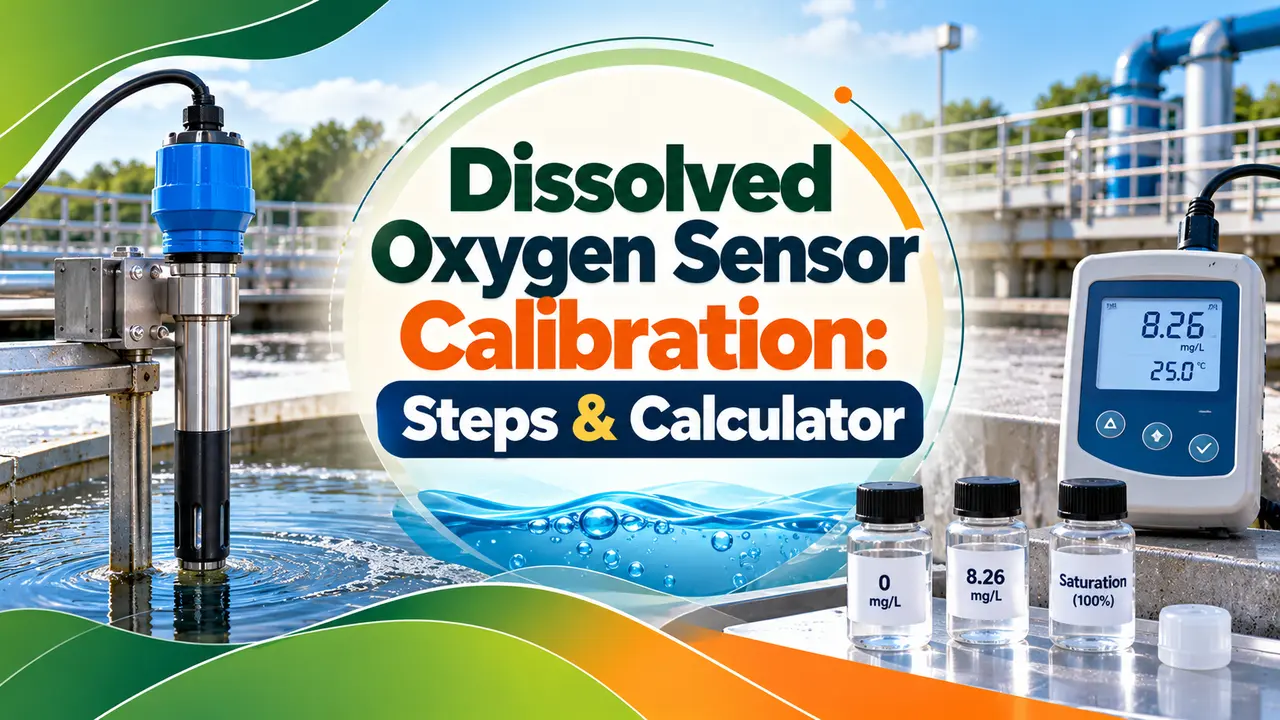
What Is Dissolved Oxygen Sensor Calibration?
Dissolved oxygen sensor calibration sets the sensor slope at 100 percent saturation in water saturated air and, where needed, its zero in oxygen free conditions. The analyser then uses temperature, barometric pressure and salinity to turn the calibrated signal into percent saturation and mg/L.
- Air calibration: sensor in water saturated air = 100 % saturation
- Zero calibration: nitrogen gas or oxygen free solution = 0 %
- Saturation at 760 mmHg, fresh water: 9.09 mg/L at 20 °C, 8.26 mg/L at 25 °C
- Lower barometric pressure lowers the mg/L value in proportion
- Enter true local pressure and salinity before you accept the calibration
DO is measured in aeration basins, fish farms, fermenters and boiler feedwater, and it is one of the core values covered in our guide to the importance of analytical measurements. The calibration idea is close to a slope and offset check on a pH meter with buffers, but the reference here is air instead of a bottle of buffer.
In a membrane probe, oxygen diffuses through a thin membrane to a cathode, and the current is proportional to the oxygen partial pressure. That is why the calibration is really a calibration against partial pressure, which air gives us for free.
DO Saturation Table in mg/L
The YSI oxygen solubility table lists mg/L for water exposed to water saturated air at 760 mmHg. These are the numbers your analyser uses internally to convert percent saturation to mg/L after dissolved oxygen sensor calibration.
| Temperature | Fresh water (mg/L) | Salinity 9.0 ppt | Salinity 36.1 ppt |
|---|---|---|---|
| 0 °C | 14.62 | see table | see table |
| 5 °C | 12.77 | see table | see table |
| 10 °C | 11.29 | see table | see table |
| 15 °C | 10.08 | see table | see table |
| 20 °C | 9.09 | 8.62 | 7.35 |
| 25 °C | 8.26 | 7.85 | 6.72 |
| 30 °C | 7.56 | see table | see table |
| 35 °C | 6.95 | see table | see table |
| 40 °C | 6.41 | see table | see table |
Two trends stand out: warm water holds less oxygen, and salty water holds less than fresh water. At 25 °C, sea water near 36 ppt holds about 6.72 mg/L against 8.26 mg/L for fresh water.
Water at 0 °C holds 14.62 mg/L of oxygen, but at 40 °C it holds only 6.41 mg/L. That is less than half, which is why temperature compensation is built into every DO analyser.
Dissolved Oxygen Sensor Calibration Steps: Zero and Air
Most field transmitters support a one point air calibration and an optional zero. Hamilton notes that a bottle partly filled with water and left alone for about 15 minutes gives 100 percent water vapour saturated air.
YSI advises in its EXO calibration guide that the cal cup must not be sealed, because it needs to vent to the atmosphere. YSI also says about 3 cm of water is enough, with the sensors sitting above the water, and that calibrating in DO percent calibrates all DO parameters.
Never calibrate a sensor straight out of a hot tank into a cold room. Let the sensor and the calibration air reach the same temperature first, or the reading will creep during the whole calibration.
Barometric Pressure and Temperature Correction
Air calibration depends on the oxygen partial pressure, which falls with barometric pressure at higher sites. Hamilton points out that modern DO transmitters include a small barometric pressure sensor so the software can correct automatically.
Exact form also removes water vapour pressure
% saturation = reading ÷ Cs × 100
Temperature enters twice: it sets the solubility from the table and it changes the membrane permeability of the sensor. Hamilton adds that an absolutely constant water temperature is required during a water based calibration.
Salinity Correction for Sea Water and Brine
Dissolved salts reduce how much oxygen water can hold, so a coastal cooling water intake or a brine line needs a salinity value. If you leave salinity at zero, the mg/L figure will read high while percent saturation stays the same.
Many transmitters accept salinity in ppt or derive it from a conductivity sensor reading. In sea water service, set it during dissolved oxygen sensor calibration and again whenever the process salinity changes.
Solved Example: Dissolved Oxygen Sensor Calibration at a Site
An effluent treatment plant aeration tank is at 25 °C, the barometer reads 950 mbar and the water is fresh. After air calibration the sensor reads 7.20 mg/L in the tank.
Simple ratio: 8.26 × 950 ÷ 1013.25 = 7.74 mg/L
Exact Cs with water vapour = 7.73 mg/L
% saturation = 7.20 ÷ 7.73 × 100
= 93.1 % saturation
If the technician had left the pressure at 1013.25 mbar, the analyser would compare the reading with 8.26 mg/L. That would report 87.2 percent saturation, wrong by about 6 points, purely from a missing pressure entry.
DO Saturation and Percent Saturation Calculator
The calculator uses the Benson and Krause solubility equation used for standard DO tables, with a pressure correction that removes water vapour. With 20 °C, 1013.25 mbar and zero salinity it returns 9.09 mg/L, matching the YSI table.
After calibration, record as found and as left values and the error, which you can compute with our calibration error calculator. The same values belong on the calibration certificate for the analyser.
Polarographic vs Galvanic vs Optical DO Sensors
Clark type cell with an applied voltage, oxygen consumed at the cathode.
Self polarising cell with dissimilar metal electrodes, ready almost at once.
Luminescent dye on a cap, oxygen quenches the light, no oxygen is consumed.
Sensorex states that polarographic sensors need a 5 to 15 minute warm up time, while galvanic sensors are self polarising. Sensorex adds that its galvanic models need a minimum inflow velocity of 2 inches per second to stay accurate, a limit that optical sensors avoid, as our page on how optical dissolved oxygen sensors work explains.
Fondriest reports that the luminescent method in the YSI ProODO removes the need for stirring. It also says that calibrations stored in each sensor can be stable for up to one year, depending on use.
Hydrogen sulphide can pass through the membrane of a galvanic DO sensor and upset its reading, according to Sensorex. Fondriest notes that optical technology avoids probe fouling by common gases such as hydrogen sulphide.
Membrane and Electrolyte Care
For membrane sensors, most dissolved oxygen sensor calibration problems trace back to the membrane and the electrolyte. A wrinkled, scratched or fouled membrane changes the diffusion rate and therefore the slope.
- Membrane free of wrinkles, scratches and biofilm.
- No air bubble trapped under the membrane after refilling.
- Electrolyte replaced with the type and amount the manufacturer specifies.
- Optical cap within its service life and free of scratches.
- Temperature sensor reading checked against a reference thermometer.
- Local barometric pressure and salinity entered before accepting the slope.
Biofilm in wastewater service is the most common reason for a slow, low reading. Plants that also run ammonia analysers and COD analysers usually clean all probes on one routine.
Dissolved Oxygen Sensor Troubleshooting Table
| Symptom | Likely Cause | Field Fix |
|---|---|---|
| Slope low, calibration rejected | Fouled or aged membrane, old electrolyte | Clean, replace membrane and electrolyte |
| Reading drifts after calibration | Sensor not polarised or not at air temperature | Polarise longer and let temperature settle |
| Reads high in sea water | Salinity left at zero | Enter correct salinity |
| All values off by a few percent | Wrong barometric pressure entered | Use true local pressure, not sea level |
| Low reading in still water | Flow too low for membrane sensor | Increase flow or use optical sensor |
| Noisy, jumping reading | Air bubbles on sensor face | Change mounting angle, use bubble deflector |
Advantages and Limits of Air Calibration
- Air is a free, stable 100 % reference.
- No chemical standards needed for the slope.
- Fast, usually done within a few minutes.
- Works for polarographic, galvanic and optical sensors.
- Needs true local barometric pressure.
- Wet or warm sensors give false slopes.
- Does not check the low end without a zero.
- A fouled membrane can still pass on the day.
If low range accuracy matters, as in boiler feedwater, add the zero point. Hamilton notes that the zero point can be read after about 2 to 3 minutes with nitrogen flowing over the sensor tip, and good sample conditioning keeps the reading steady after that.
Write the barometric pressure, temperature and slope on the calibration record every time. A slope that falls step by step over several calibrations warns you to change the membrane before the sensor fails.
The same disciplined approach is used for the oxygen analyser calibration of gas analysers. For a wider view of loop checks, see measurement uncertainty in calibration.
YSI Oxygen Solubility Table PDF
Video: Calibrating a DO Sensor With a CM44 Transmitter
Dissolved Oxygen Sensor Calibration FAQ
Clean and inspect the sensor, then hold it in water saturated air in a vented cup at a steady temperature. Enter local barometric pressure and salinity, wait for a stable reading and accept the air point.
Add a zero point with nitrogen or an oxygen free solution if you measure low levels. Record the slope and conditions on the calibration sheet.
It is the air point, where the sensor sees air saturated with water vapour and the analyser sets that value as 100 percent. The mg/L value then comes from the saturation table.
Because the reference is air, no chemical standard is needed. The result is only right when temperature and barometric pressure are entered correctly.
The sensor responds to oxygen partial pressure, and partial pressure falls when barometric pressure falls. At a site with a lower barometer, water holds less oxygen at full saturation.
If the transmitter assumes sea level pressure, every mg/L value will be slightly wrong. Enter the actual local reading or use a transmitter with a built in barometer.
The YSI table gives 9.09 mg/L for fresh water at 20 degrees and 760 mmHg of barometric pressure. At 25 degrees the value falls to 8.26 mg/L in the same table.
These values drop further with salinity and with lower barometric pressure at your site. Your analyser uses the same table to turn percent saturation into mg/L after every dissolved oxygen sensor calibration.
Yes, optical sensors still need calibration, but they drift much less than membrane sensors. Fondriest reports stored calibrations that can stay stable for up to one year, depending on use.
They also do not consume oxygen, so they do not need stirring. A regular air check against a known reference is still good practice for any critical aeration or boiler loop.
Sensorex gives a warm up time of 5 to 15 minutes for polarographic sensors. During this time the applied voltage polarises the electrodes.
Calibrating before polarisation is complete gives a drifting slope that fails the next check. Galvanic and optical sensors do not need this warm up, so they can be used almost at once after installation.
Related Articles
- How Do Optical Dissolved Oxygen Sensors Work
- Oxygen Analyzer Calibration
- pH Meter Calibration Buffers
- Conductivity Sensor Cell Constant Calibration
- Importance of Analytical Measurements
External References
What We Learn Today
- Dissolved oxygen sensor calibration uses water saturated air as the 100 percent point and nitrogen or an oxygen free solution as an optional zero.
- Barometric pressure, temperature and salinity all change the mg/L value, so true site values must be entered before accepting the slope.
- Optical sensors drift less and need no stirring, while membrane sensors need polarisation, clean membranes and fresh electrolyte to calibrate well.