
A pressure gauge failure is not just a maintenance problem. A ruptured gauge on a steam or chemical line is a safety hazard.
The sensing element inside a Bourdon tube gauge is designed for a specific pressure range and can be permanently damaged by a single over-pressure event.
Selecting the right protection method depends on the type of hazard: thermal damage, chemical attack, pressure spikes, or sustained overpressure from process excursions.
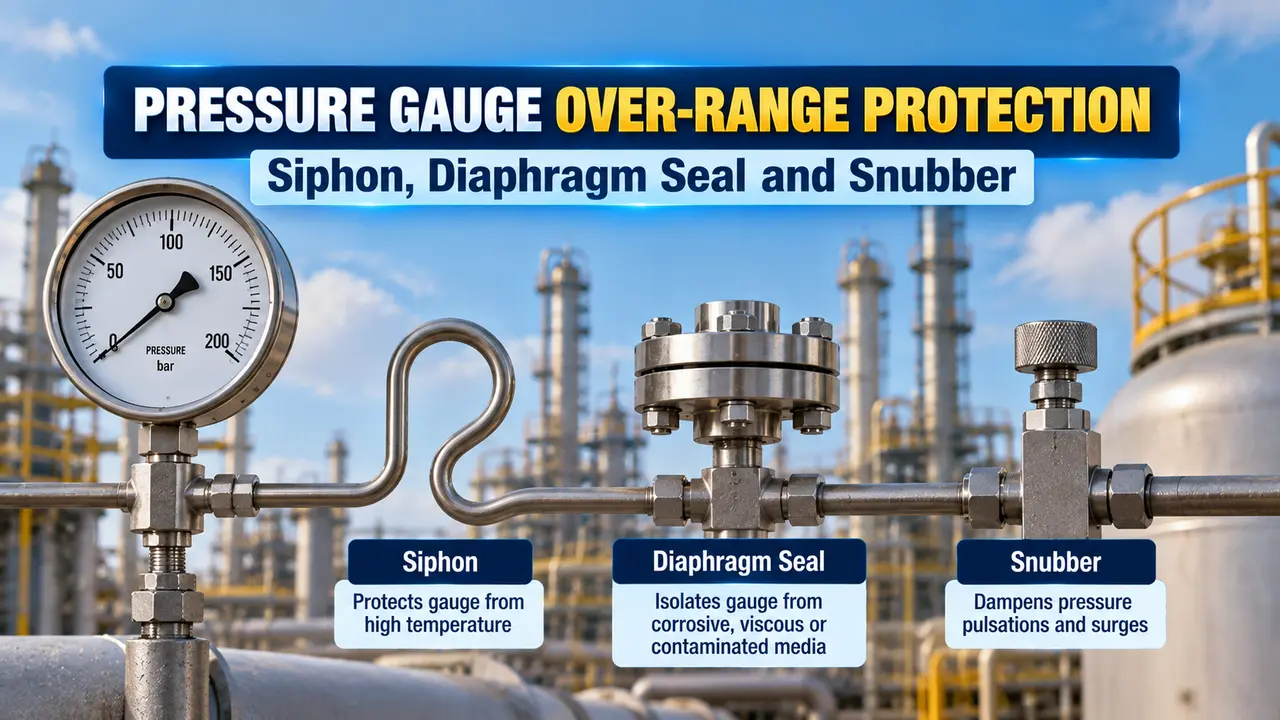
Three protection devices cover most pressure gauge hazards: siphon for thermal damage, diaphragm seal for chemical attack and fouling, and snubber for pulsation and pressure spikes. Each solves a different failure mode.
We will cover how each device works, what specific hazard it protects against, the key selection criteria for each type, and how to combine them when a single protection method is not enough.
We will also look at worked selection examples, a failure mode table, a full comparison of all three devices, and the most common mistakes engineers make when specifying gauge protection.
Why Pressure Gauges Fail and What Over Range Protection Prevents
A Bourdon tube pressure gauge is a mechanical instrument with a thin-walled oval cross-section tube that straightens under pressure.
This tube has a defined elastic limit. Beyond this limit, the tube deforms permanently and the gauge reads incorrectly or stops reading entirely.
Most gauges withstand 130% of their full-scale range before permanent damage per ASME B40.100 and EN 837-1. A brief excursion permanently shifts the zero and span.
Sustained overpressure above 130% will rupture the sensing element.
Beyond overpressure, gauges also fail from four other causes that protection accessories address directly.
The Three Main Protection Devices at a Glance
A coiled or U-shaped tube that fills with condensate and forms a cool liquid barrier between a hot process and the gauge. Protects against thermal damage from steam and hot vapours.
Does not protect against overpressure, chemical attack, or pulsation.
A restrictor fitting that limits the rate of pressure change reaching the gauge. Protects against pulsation, water hammer, and fast pressure spikes by slowing their transmission.
Does not protect against chemical attack, fouling, or sustained overpressure.
A flexible metal or elastomer membrane that separates the process fluid from the gauge. Protects against chemical attack, fouling, plugging, and high process temperature via a compatible fill fluid.
Does not protect against pulsation unless a snubber is added on the instrument side.
Siphon Tube: How It Works and When to Use It
A siphon tube is a coiled or pig-tail shaped tube installed between the process tap and the gauge body.
When the system is first pressurised, vapour enters the siphon and condenses on the cooler tube walls. The condensate fills the tube and forms a standing liquid column.
This liquid column transmits process pressure accurately but insulates the gauge from the high process temperature. The Bourdon tube sees only the condensate temperature. The process steam never contacts the gauge directly.
Problem: Temperature exceeds gauge design limit. No pulsation, no corrosive fluid.
Solution: Pigtail siphon in stainless steel, pre-filled with water before commissioning.
Gauge range: 0 to 16 barg (covers process pressure with 60% range use).
Liquid head correction: Siphon height 150 mm = 0.015 bar offset, noted in calibration record.
Result: Gauge protected from thermal damage. Bourdon tube sees condensate at approximately 40 to 50 degrees C, well within design limits.
Snubber: How It Works and When to Use It
A pressure snubber is a restrictor fitting installed between the process connection and the gauge body.
It contains a small calibrated orifice, a sintered porous element, or a spring-loaded needle that limits the flow rate of fluid into and out of the gauge cavity.
When a pressure pulse arrives, the restrictor slows its transmission into the gauge cavity. The gauge pressure rises more slowly and to a lower peak than the true process spike.
The Bourdon tube never sees the full amplitude of the spike. After the spike passes, the gauge equalises back to the steady process pressure through the same restrictor.
Types of Snubbers
Process: Water at 20 degrees C, 25 barg normal, pulses to 45 barg at pump frequency
Problem: Pointer flutters violently. Bourdon tube fatigue failure expected within months.
Solution: Piston-type snubber, stainless steel, installed at the gauge connection.
Gauge range: 0 to 40 barg (changed from 0 to 25 barg to accommodate pulsation amplitude).
Result: Pointer steadied. Gauge reads steady process pressure. Spikes damped before reaching the tube. Gauge life extended to normal service interval.
Diaphragm Seal: How It Works and When to Use It
A diaphragm seal completely isolates the gauge from the process fluid. A thin flexible metal or elastomer diaphragm is clamped or welded between the process connection and the gauge body.
The space between the diaphragm and the gauge is filled with a hydraulic fill fluid (silicone oil, glycerine, or a process-compatible fluid).
When process pressure acts on the diaphragm, it deflects and transmits pressure through the fill fluid to the Bourdon tube. The process fluid never contacts the gauge internals.
When to Specify a Diaphragm Seal
Combining Protection Methods
Many industrial applications require more than one protection method. The three devices are stackable and are frequently used together on the same gauge point.
Siphon vs Snubber vs Diaphragm Seal: Full Comparison
| Parameter | Siphon Tube | Snubber | Diaphragm Seal |
|---|---|---|---|
| Primary hazard addressed | Thermal damage from hot fluid or steam | Pulsation, water hammer, pressure spikes | Chemical attack, fouling, plugging, high temperature (with capillary) |
| Works by | Creating a cool liquid condensate buffer between process and gauge | Restricting the rate of pressure change reaching the gauge | Isolating the gauge from the process fluid entirely |
| Process fluid contacts gauge? | Condensate contacts gauge, not the hot vapour directly | Yes, process fluid still reaches the gauge at reduced rate | No, fill fluid only contacts the gauge |
| Cost | Low | Low to medium | High: seal, fill fluid, and gauge must be ordered together as a system |
| Accuracy impact | Small liquid head offset (typically 0.01 to 0.02 bar) | None on steady-state readings | Significant: temperature error, volume displacement, and lag |
| Response time | Unchanged | Slowed (damping time depends on orifice size) | Slightly slowed by diaphragm stiffness and capillary volume |
| Plugging risk | Low if condensate is clean | High for orifice and sintered types in dirty fluids | Very low for flush diaphragm seals |
| Combinable with? | Snubber (on instrument side of siphon) | Siphon, diaphragm seal | Snubber (on instrument side of seal) |
| Typical applications | Steam boilers, steam headers, hot water lines | Reciprocating pumps, compressors, water hammer risk | Corrosive chemicals, slurries, viscous or crystallising fluids, toxic services |
How to Select the Right Protection for Your Application
Common Mistakes When Specifying Gauge Protection
Watch: Pressure Gauge Accessories Explained
Pressure Gauge Over-Range Protection Questions
Related Articles on This Site
- Bourdon Tube Pressure Gauges: Working Principle Explained
- Pressure Snubber Working Principle, Types and Selection
- Siphon Tube for Pressure Gauge Protection
- What Is a Diaphragm Seal and How Does It Work?
- Hammer Effect in Pressure Gauges: Causes and Prevention
External References
- Pressure Gauge Snubber Types and Selection | Tameson
- Pressure Gauge Accessories: Snubbers and Seals | NOSHOK
What We Learn Today
- Siphon insulates the gauge from hot steam by filling with condensate. Snubber restricts pressure change rate to damp pulsation. Diaphragm seal isolates the gauge from the process fluid, protecting against chemical attack and fouling.
- Each device addresses a different failure mode. Multiple hazards need multiple devices: siphon plus snubber for hot pulsating service; diaphragm seal plus snubber for corrosive pulsating service.
- Pre-fill the siphon before commissioning steam service. Order diaphragm seal and gauge as one factory-filled assembly. Specify an overpressure protector when process design pressure exceeds 1.3 times the gauge range.