A storage tank breathes out vapour when it fills or warms up, and breathes in air when it empties or cools down. Two pallets handle those jobs, API 2000 tells you how much flow they must pass, and the pallet weight fixes the set pressure.
Every fixed roof tank needs a way to relieve small pressure and vacuum swings without losing product. Below you will find the pallet mechanism, API 2000 venting, a set pressure calculation and the field faults that stop these valves working.
What is a breather valve and how does it work on a storage tank?
Breather valve is the common name for a pressure vacuum relief valve (PVRV), also called a conservation vent, mounted on a fixed roof tank. A weighted or spring loaded pressure pallet lifts when vapour pressure exceeds its set point, and a second vacuum pallet lifts to admit air when the tank pulls vacuum. Set pressure equals pallet weight divided by seat area, so 2.5 kg on a 200 mm seat gives about 7.81 mbar.
What Is a Breather Valve?
A breather valve is a self acting pressure and vacuum relief device fitted on the roof nozzle of an atmospheric or low pressure storage tank. It keeps the vapour space within a few millibar of atmosphere, venting vapour on pressure and admitting air or blanket gas on vacuum.
- Also called PVRV, pressure vacuum vent or conservation vent.
- One pallet opens outward on pressure, another opens inward on vacuum.
- Dead weight or a spring holds the pallets shut, so no power is needed.
- Venting requirements come from API 2000 and ISO 28300.
- Weight loaded designs often need about 100% overpressure for full lift.
Think of the tank as a thin walled box that takes very little pressure either way. A large API 650 tank can buckle under a vacuum you would hardly see on a gauge, which is why vacuum effects matter well beyond instruments.
The device belongs to the family of pressure relief valve types, but it works in millibar, not bar. On flammable service it is usually paired with a flame arrester so a flame outside cannot travel back into the tank.
The word conservation in conservation vent refers to product. Because the pallets stay shut until set, the tank stops losing vapour every time the sun heats the roof.
How Does a Breather Valve Work?
A breather valve works by balancing tank pressure against a fixed closing force on each pallet. When the pressure difference creates more force than the weight or spring load, the pallet lifts and gas flows until the difference falls.
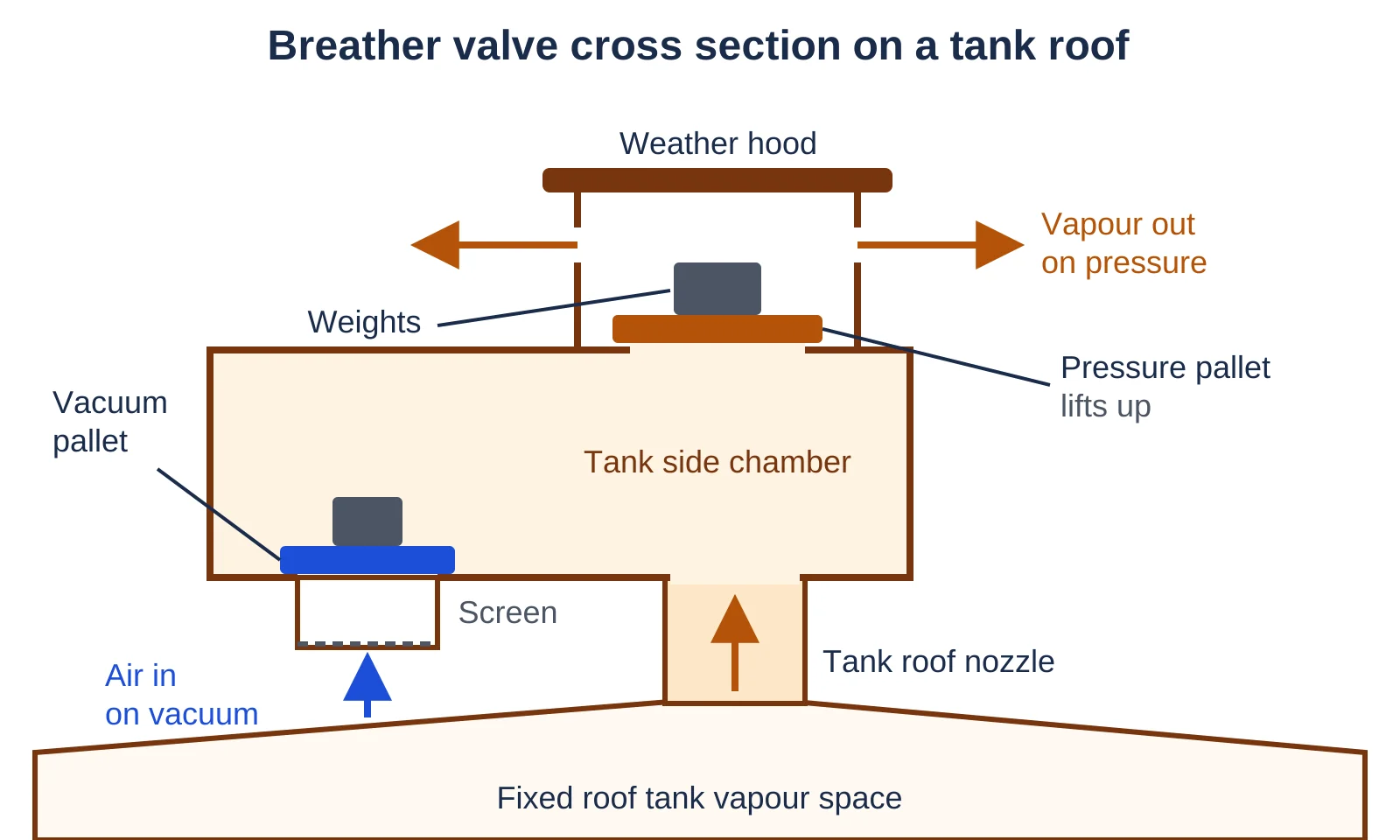
The pressure pallet sits on a seat at the top of the tank side chamber. Tank pressure acts from below, so it pushes the pallet up into the hood and vapour escapes sideways.
The vacuum pallet sits on a seat in the chamber floor with atmosphere underneath. When the tank drops below atmosphere, outside air pushes this pallet up and enters through the screened inlet.
Manufacturers build several body styles around the same pallet idea. You will meet these names on vent datasheets.
Discs or lead weights on the pallet set the opening pressure.
A spring holds the pallet and allows higher settings.
A pilot senses tank pressure and opens the main pallet fully.
Vents to air, or through a flanged outlet to a header.
Check whether a vent setting is in mbar, mm WC or inches WC. A factor of ten mix up here is a classic commissioning mistake.
Why Does a Storage Tank Need to Breathe? API 2000 Venting
A tank breathes because liquid movement and temperature change keep altering the vapour volume. API 2000 splits this into normal venting from pumping and thermal change, and emergency venting for fire.
Pumping in and heating cause outbreathing, while pumping out and cooling cause inbreathing. API 2350 overfill protection covers a different hazard on the same roof.
| Case | Direction | API 2000 basis |
|---|---|---|
| Pump in | Out | Filling rate, doubled if volatile |
| Heating | Out | Y × V0.9 × Ri |
| Pump out | In | Emptying rate |
| Cooling | In | C × V0.7 × Ri |
| Fire | Out | Separate emergency vent |
Here V is tank volume in m³, the result is in Nm³/h and Ri is 1 for a bare tank. API 2000 gives Y = 0.32 below 42 degrees latitude and C from 4 to 6.5, so every Indian site falls in the hot band.
Thermal out = 0.32 × 10000.9 = 160 Nm³/h
Out total = 60 + 160 = 220 Nm³/h
Thermal in = 6.5 × 10000.7 = 818 Nm³/h
In total = 60 + 818 = 878 Nm³/h
Inbreathing comes out four times larger than outbreathing here, and almost all of it is thermal. A 2023 Hydrocarbon Processing article by Covestro and Bechtel engineers explains that heavy rain on a sun heated roof cools the vapour space fast, just like a monsoon shower on a tank farm.
How to Calculate Breather Valve Set Pressure from Pallet Weight
Breather valve set pressure equals the closing force on the pallet divided by the seat area. For a weight loaded pallet you only need its total mass and the effective seat diameter.
m = 2.5 kg, d = 200 mm = 0.2 m
A = π × 0.2² ÷ 4 = 0.0314 m²
F = 2.5 × 9.81 = 24.5 N
P = 24.5 ÷ 0.0314 = 781 Pa = 7.81 mbar
Water column: 781 ÷ 9.81 = 79.6 mm WC
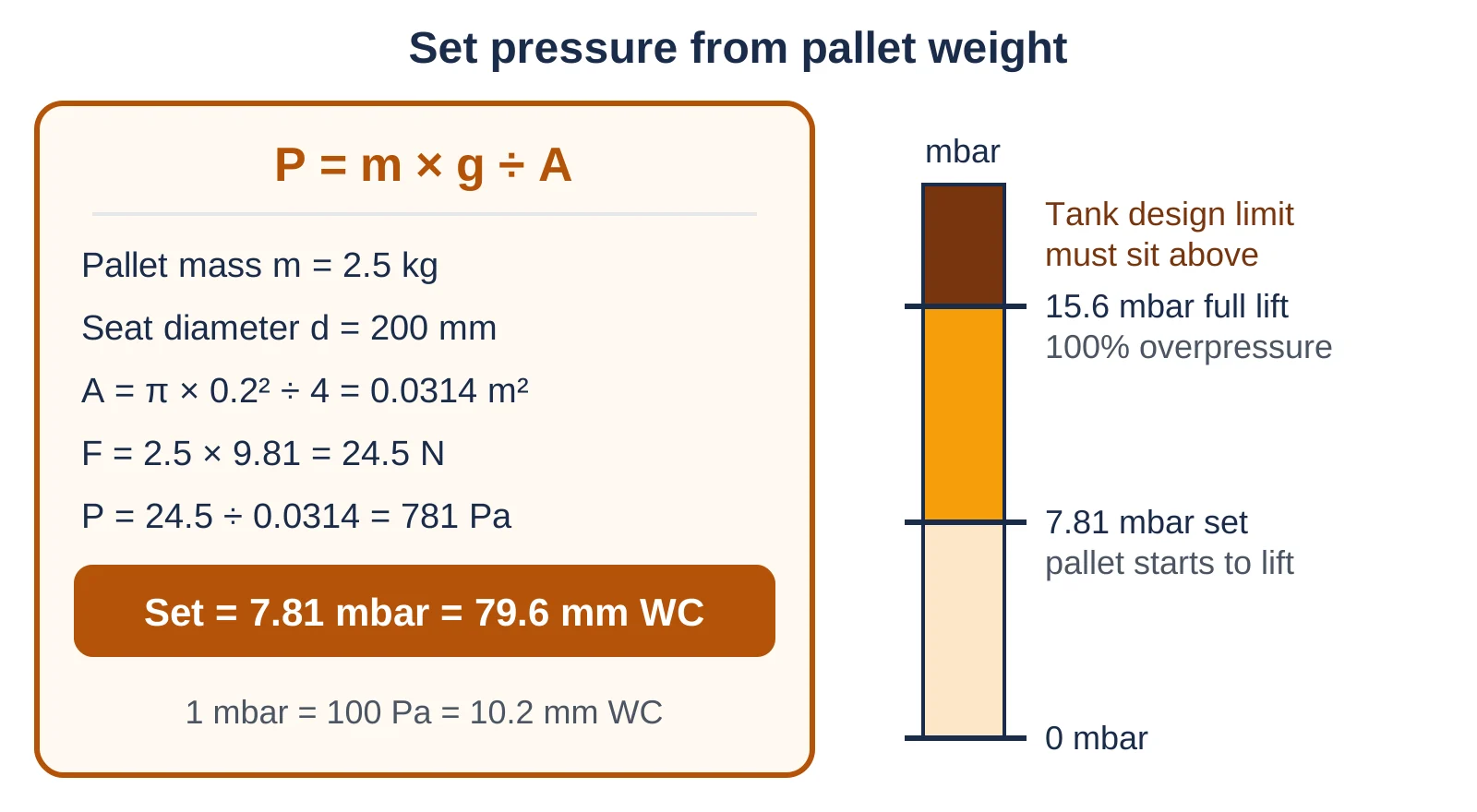
Look at the ladder on the right of the figure too. With 100% overpressure to full lift, this pallet passes rated flow only near 15.6 mbar, so the tank design pressure must sit above that.
On site you can read tank pressure with a water filled U tube manometer, where 10.2 mm of water is about 1 mbar. The vacuum side uses the same formula, and our note on vacuum pressure calculation explains gauge and absolute reference.
Run any weight change through the calculator before you touch the valve. Raising the setting to about 10 mbar on the same 200 mm seat needs a pallet assembly of close to 3.2 kg.
Breather Valve Sizing and Selection
Size the breather valve so its rated flow at the allowed overpressure covers the larger of the API 2000 outbreathing and inbreathing totals. Then pick set points with enough margin below tank design pressure and vacuum for full lift.
In our example the vacuum side needs 878 Nm³/h against 220 Nm³/h on pressure, so vacuum decides the size. Read the vendor flow curve at set plus overpressure, since wermac.org warns against sizing these valves like a safety valve at 10 to 20% overpressure.
- Simple, no spring to corrode
- Setting checked by weighing
- Suits very low settings
- Cheap and easy to service
- Higher settings in a smaller body
- Emerson states rated lift within 10% overpressure for the 4020HP
- Spring needs corrosion checks
- Costs more, needs a test bench
- Tank design pressure and vacuum from the datasheet
- API 2000 outbreathing and inbreathing totals
- Set plus overpressure below tank limits
- Material suited to the vapour: aluminium, 316 SS or PTFE coated
- Flame arrester for flammable service
- Blanketing regulator set below the pressure pallet
Wermac.org quotes API 2521 guidance that each extra 1 oz per square inch of setting cuts breathing losses by about 7%, while large welded tanks are usually limited near 0.5 oz per square inch.
On nitrogen padded tanks the regulator and vent work as a pair, so read our nitrogen purging basics first. The vent outlet also sets a hazardous area zone around it, which limits the instruments you can mount nearby.
What Is the Difference Between a Breather Valve and a Safety Valve?
A breather valve protects a low pressure tank at millibar settings against normal breathing flows, while a safety valve protects a pressure vessel at bar settings against process upsets. Each is sized to its own standard.
| Point | Breather valve | Safety valve |
|---|---|---|
| Equipment | Storage tanks | Pressure vessels |
| Setting | A few to tens of mbar | Bar and above |
| Vacuum relief | Built in | None |
| Sizing | API 2000, ISO 28300 | API 520 |
| Overpressure | 10% to 100% | Usually 10% |
Vessel relief sizing is covered in our PSV sizing guide. Vessels may also use a rupture disc, while tanks usually get an emergency hatch for fire.
Breather Valve Maintenance and Troubleshooting
Most breather valve faults come from a pallet that cannot move, a blocked flow path or a wrong setting. Check them in that order.
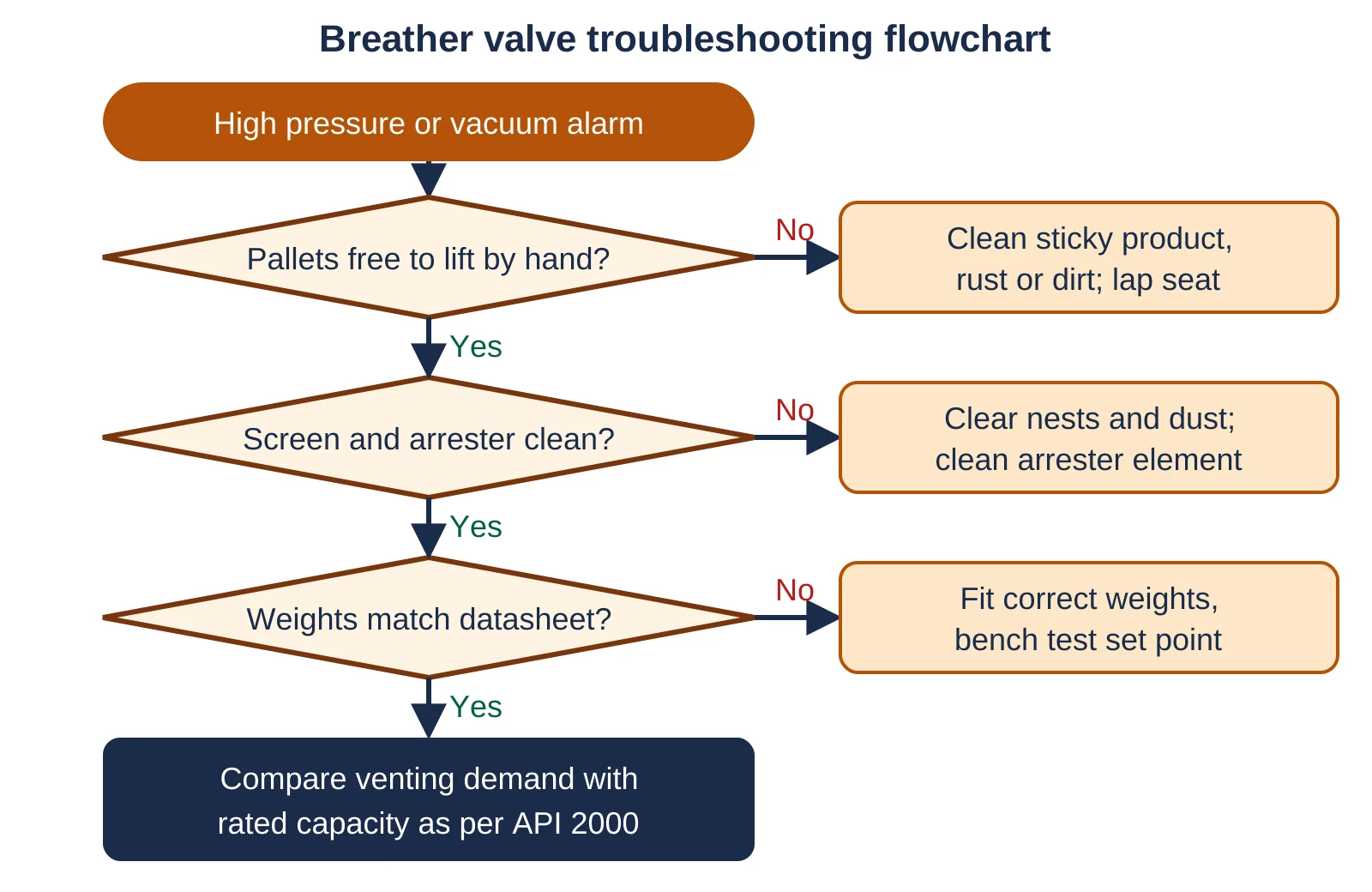
Start at the top of the chart whenever someone reports a pressure alarm or a dented roof. A level trend from automatic tank gauging or a radar level transmitter shows whether pumping was running at that moment.
| Symptom | Likely cause | Action |
|---|---|---|
| Roof bulging | Pressure pallet stuck | Clean, lap seat, new seal |
| Dent after pump out | Vacuum pallet or screen blocked | Clear screen, free pallet |
| Vapour smell at rest | Damaged seal | Replace soft goods |
| Flutter or knocking | Oversized valve | Review sizing |
| Opens below set | Weights missing | Weigh and restore |
Write the weight of every pallet in the maintenance record. If a valve later opens low, a scale gives the answer in two minutes.
Thermal venting needs tank volume, which the tank volume calculator gives from dimensions. Put the valve in your preventive maintenance plan with an interval set by how sticky or corrosive the product is.
The Aager GmbH video shows both pallets moving inside a real valve. Watch the guides that keep the disc centred, because a bent guide leaves a valve hanging open, much like the seat leakage problems on control valves.
Breather Valve FAQ
A breather valve handles both pressure and vacuum in one body, while a vacuum breaker only admits air when the tank pulls vacuum. Use the combined unit when the tank must stay sealed both ways to cut vapour loss.
A vacuum breaker suits tanks that already vent freely on pressure through another route.
Divide pallet weight in newtons by seat area in square metres to get pascals. For 2.5 kg on a 200 mm seat that is 24.5 N over 0.0314 m², giving 781 Pa.
Divide by 100 for 7.81 mbar, or about 79.6 mm of water.
Settings are usually a few millibar, well below the tank design pressure so full lift comes before the roof is stressed. Wermac.org quotes about 0.5 oz per square inch, close to 2.2 mbar, for large welded tanks.
Always confirm the limit on the tank datasheet and vendor flow curves.
A light pallet gains very little extra lift force above set, so it opens gradually and often needs double the set pressure for rated flow. Spring loaded designs open faster, and Emerson states 10% overpressure for the 4020HP.
Check the vendor curve for the exact figure.
Sticky product, rust, dirt and damaged seals are the usual causes. Blocked bird screens and a fouled flame arrester also raise tank pressure even when pallets move freely.
Regular cleaning and a bench test of both settings prevent most failures.
Related Articles
- Flame Arrester Explained
- 7 Types of Pressure Relief Valves
- Safety Relief Valve PSV Sizing
- Tank Overfill Protection API 2350
- How Nitrogen Purging Works
External References
- Emerson: Anderson Greenwood 4020HP Pressure and Vacuum Relief Valve IOM (PDF)
- Wermac: Breather Valves for Storage Tanks
- Wikipedia: Relief valve
What We Learn Today
- A breather valve uses a weighted or spring loaded pressure pallet and a separate vacuum pallet to keep a storage tank within a few millibar of atmosphere.
- API 2000 normal venting adds pumping flow to thermal flow, and in hot climates thermal inbreathing from sudden rain cooling can dominate the vacuum side.
- Set pressure equals pallet weight divided by seat area, and the tank design limit must stay above the full lift pressure, not only the set point.