
Rupture Disc Explained: Forward-Acting vs Reverse-Buckling
Every rupture disc has exactly one job to do, exactly once. There's no reset button, no reseal, just a precisely engineered membrane whose entire purpose is to fail on command.
A rupture disc is a non-reclosing pressure relief device that bursts at a predetermined pressure to protect equipment from overpressure or vacuum damage. This guide explains forward-acting vs reverse-buckling designs, how a rupture disc compares to a pressure relief valve, and where each earns its place in a real system.
What is a Rupture Disc?
A rupture disc, also called a bursting disc or burst diaphragm, is a thin membrane, usually metal, engineered to fail reliably at a specific differential pressure and coincident temperature. Unlike a pressure relief valve, which opens and then recloses once pressure drops, a rupture disc is a sacrificial, one-time-use device: once it bursts, it stays open permanently and must be physically replaced before the system can be safely returned to service.
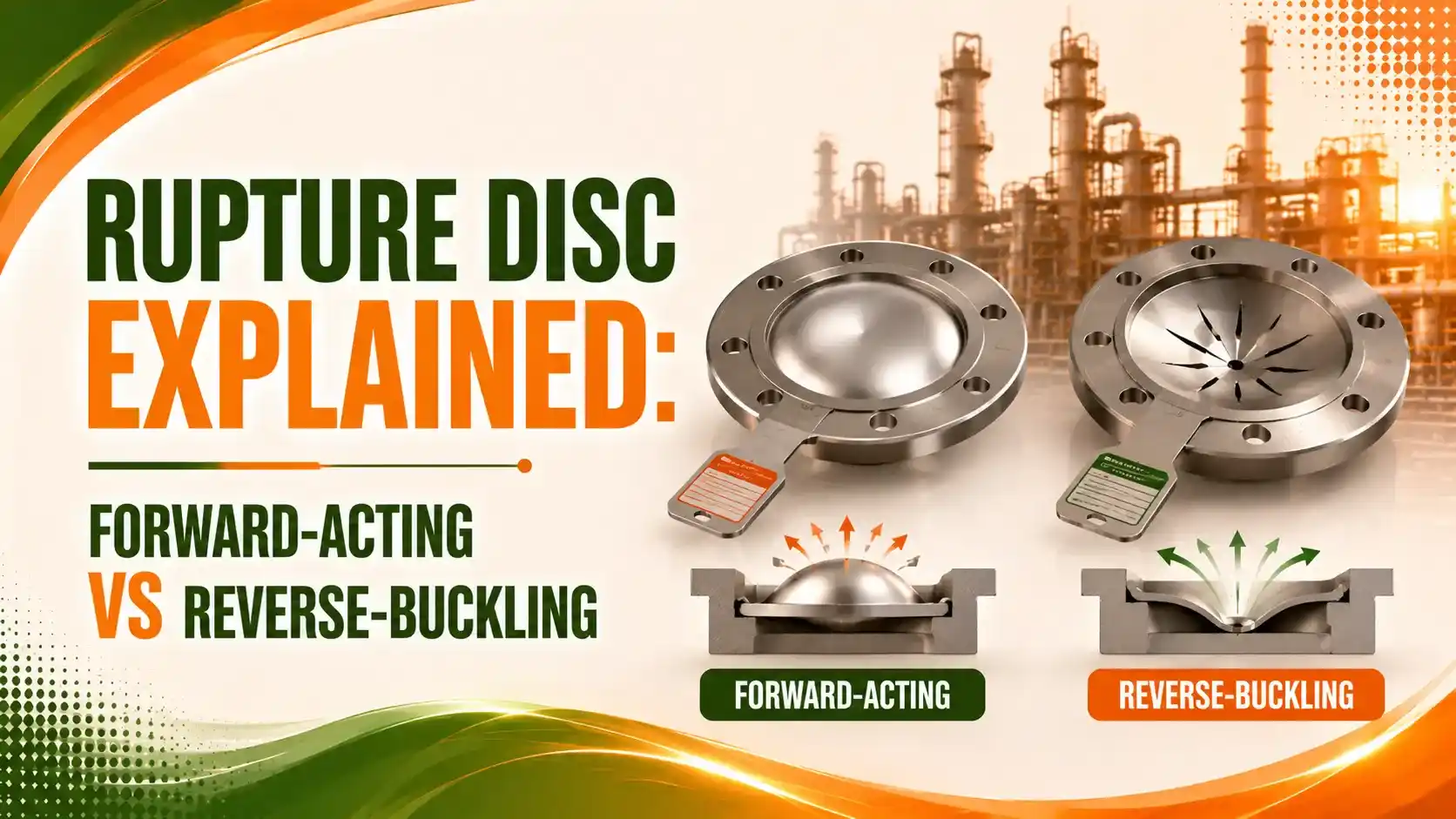
The rupture disc's simplicity is exactly its advantage in the right application: no moving parts to stick, no seat to leak, and response times measured in milliseconds, often faster than a mechanical valve can react. It essentially functions like a fuse in an electrical circuit, a deliberately engineered weak point that fails first, protecting everything downstream.
Real Life Example
Think of a rupture disc like the perforated tear-strip on a bag of chips, engineered to rip open cleanly under a specific amount of pressure from inside, rather than the bag bursting randomly and unpredictably somewhere else. Once torn, that strip doesn't magically reseal itself, the bag stays open. A pressure relief valve, by contrast, is more like a pressure cooker's weighted valve: it lifts to vent excess steam, then drops back down and reseals once pressure normalizes, ready to do the same job again on the very next cook.
How a Rupture Disc Fails: Step by Step
Normal Operation
The disc holds a full, leak-tight seal, isolating process media at working pressures typically up to 70-90% of its marked burst pressure, depending on design.
Pressure Rise
As system pressure climbs toward the disc's rated burst pressure, the dome begins to visibly deform, stretching under tension (forward-acting) or reversing under compression (reverse-buckling).
Burst Point Reached
At the precisely calibrated burst pressure, the disc fails, either tearing at the center (forward-acting) or buckling and splitting at scored lines (reverse-buckling).
Full-Bore Relief
The disc opens to its full cross-sectional area almost instantly, in milliseconds, releasing pressure through an unobstructed flow path with no partial-lift throttling.
Replacement Required
The disc does not reseal. The ruptured disc must be physically removed and replaced with a new one before the system can be safely restarted.
Rupture Disc vs Pressure Relief Valve
💿 Rupture Disc
⚙️ Pressure Relief Valve
Rupture discs and relief valves aren't strictly competitors, they're often used together. A rupture disc installed upstream of a relief valve protects it from constant process exposure and corrosive media, while the relief valve still provides automatic reclosing capability for the system as a whole once the disc has done its job and been replaced.
Applications
Reactor Overpressure Protection
Chemical reactors use rupture discs for fast-acting protection against runaway reactions.
Petrochemical Vessels
Rupture discs protect pressure vessels where leak-tight isolation is essential.
Aerospace Systems
Lightweight, instant-response discs suit weight-sensitive aerospace applications.
Pharmaceutical Vessels
100% leak-tightness prevents any product loss or contamination prior to activation.
Nuclear Applications
Predictable, calibrated burst pressure supports critical safety system design.
Relief Valve Isolation
Close-coupled discs protect valves from corrosion and reduce maintenance needs.
Rupture Disc: Video Walkthrough
Frequently Asked Questions
- Wikipedia, Rupture Disc
- OsecoElfab, Where and How Are Rupture Discs Used?
- ZOOK Rupture Disks, Frequently Asked Questions
What We Learn Today
- A rupture disc is a non-reclosing, sacrificial pressure relief device that bursts at a calibrated pressure
- Forward-acting discs fail in tension; reverse-buckling discs fail in compression with better durability
- Rupture discs offer near-instant response and 100% leak-tightness, but must be replaced after every burst
- Rupture discs and relief valves are often combined, with the disc isolating and protecting the valve
- Burst pressure is temperature-dependent, so coincident temperature must always accompany a burst rating