A heated wire, a Wheatstone bridge and a little gas physics give you a vacuum reading from atmosphere down to about 0.0005 mbar. Learn how the bridge works, why the gas type matters and how to calibrate and troubleshoot the gauge.
A Pirani gauge measures rough and medium vacuum by watching how fast gas carries heat away from a hot filament. We go through the bridge circuit, the useful range, gas correction factors, calibration and the faults you meet in the field.

What is the working principle of a pirani gauge?
Pirani gauge operation relies on thermal conductivity: a filament heated to about 110 °C loses heat to the surrounding gas, and fewer molecules at lower pressure carry away less heat. A Wheatstone bridge holds the wire temperature constant, so the bridge voltage tracks pressure. For example, a nitrogen calibrated gauge showing 0.5 mbar in argon really sees 1.7 × 0.5 = 0.85 mbar.
What Is a Pirani Gauge?
A pirani gauge is a thermal conductivity vacuum gauge that reads pressure from the heat a hot filament loses to the surrounding gas. It covers roughly 1000 mbar down to about 0.0005 mbar and is a common rough and medium vacuum sensor on pumps, dryers and coating machines.
- Invented by Marcello Pirani of Siemens and Halske and described in 1906
- Sensing element is a tungsten or nickel filament held near 110 °C
- Typical range 0.0005 to 1000 mbar for air and nitrogen
- Reading depends on gas type, so other gases need a correction factor
- Usually run in constant temperature mode inside a Wheatstone bridge
Wikipedia notes that Pirani first used it to watch vacuum in tantalum lamp production. Our overview of vacuum measurement sensor types shows where the pirani gauge fits in the full family.
Pirani Gauge Working Principle
Gas molecules hit the hot wire, pick up energy and carry it to the cooler tube wall. At lower pressure there are fewer molecules, so less heat leaves the wire and the electrical power needed to keep it hot falls.
It is the same physics as thermal conductivity in solids and liquids, except that in a gas the conductivity changes with pressure only inside a certain window. Sens4 explains that a long mean free path at low pressure gives low conductivity, while a short mean free path at high pressure gives high conductivity.
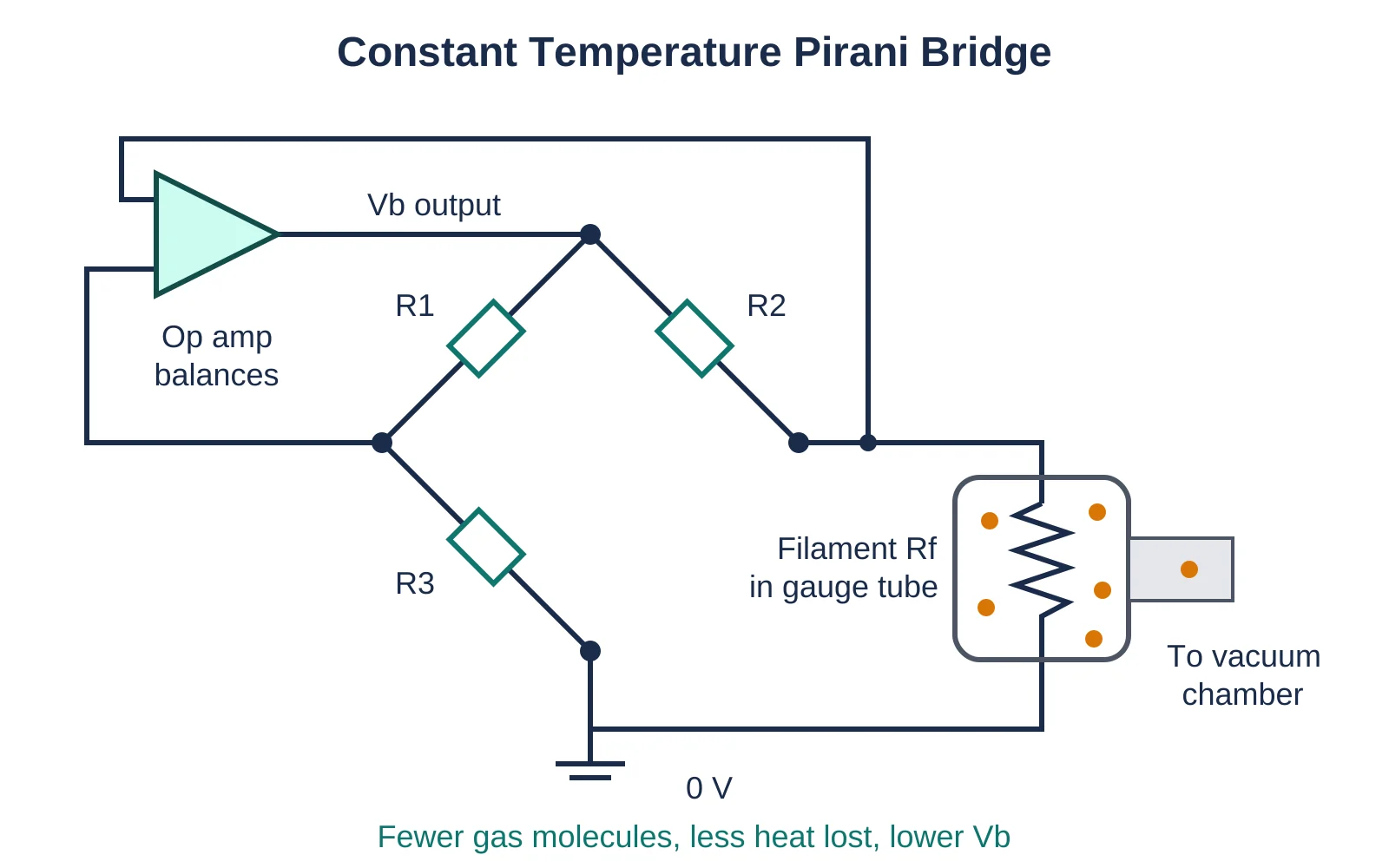
In a pirani gauge the filament Rf forms one arm of the bridge while R1, R2 and R3 are stable reference resistors. MKS Instruments notes that the element runs at about 100 to 150 °C, and Pfeiffer Vacuum quotes a constant 110 to 130 °C for its designs.
The same hot element idea is used in thermal mass flow meters, where moving gas instead of pressure decides how much heat the sensor loses.
How Does a Pirani Gauge Work With a Wheatstone Bridge?
The bridge compares the filament resistance with fixed resistors, and an amplifier adjusts the bridge voltage until the bridge balances again. That balancing voltage is the pressure signal, and MKS Instruments states that it is proportional to pressure.
Because a tungsten or nickel wire has a positive temperature coefficient, its resistance rises as it heats, much like the platinum element in an RTD. Our guide to Wheatstone bridge applications shows the same circuit in strain gauges and RTD transmitters.
An op amp or microcontroller changes the bridge voltage so the wire stays at one fixed temperature and resistance.
A fixed current flows through the wire and the resistance change with pressure is measured as a bridge imbalance.
A resistive heater sits on an ultra thin suspended membrane with a temperature sensing resistor close by.
Ambient temperature shifts the reading because it changes how much heat the wall can absorb. Mount the gauge away from heaters and hot pump exhausts, and see thermal effect on zero and span for how temperature moves any sensor.
What Is the Range of a Pirani Gauge?
A standard pirani gauge reads from about 1000 mbar down to about 0.0005 mbar, but the accurate part is narrower. The Kurt J. Lesker KJLC PIR manual gives ±15 percent of reading from 0.001 to 100 mbar and ±50 percent outside that span.
At the top end, Pfeiffer Vacuum explains that between about 10 hPa and atmosphere the heat loss barely changes, so a classic design cannot tell 50 mbar from 500 mbar. MKS Instruments adds that convection designs use gas movement inside the tube to keep good accuracy up to 760 Torr.
At the bottom end, the few remaining molecules carry very little heat compared with radiation and losses through the wire supports. MKS Instruments puts this floor near 0.0001 Torr, so a high vacuum gauge must take over below it.
To turn these numbers into practical figures for a pump specification, our article on how to calculate vacuum pressure walks through absolute and gauge values with solved examples.
Pirani Gauge Gas Correction Factor
Every pirani gauge reading assumes the gas it was calibrated on, usually nitrogen or air, so for other gases you multiply the reading by a correction factor C. Kurt J. Lesker gives the rule as true pressure = C × reading and says it applies below 1 mbar.
| Gas | Factor C (KJLC PIR) | Effect on reading |
|---|---|---|
| Air, O2, CO, N2 | 1.0 | Reads correctly |
| Helium | 0.8 | Reads high |
| Hydrogen | 0.5 | Reads high |
| Water vapour | 0.5 | Reads high |
| CO2 | 0.9 | Reads slightly high |
| Argon | 1.7 | Reads low |
Light gases such as helium and hydrogen conduct heat well, so the gauge thinks there is more gas than there really is. Argon conducts heat poorly and reads low, and that difference matters when you backfill a sputtering chamber with argon.
Reading = 0.5 mbar, C = 1.7
True p = C × reading
True p = 1.7 × 0.5 = 0.85 mbar
In Pa: 0.85 × 100 = 85 Pa
In Torr: 0.85 ÷ 1.33322 = 0.6376 Torr
One mbar equals 100 Pa and one Torr equals 133.322 Pa, so the conversion takes one line once the gas is corrected. For a quick unit check outside vacuum work you can also use this pressure unit converter or our PSI to bar conversion page.
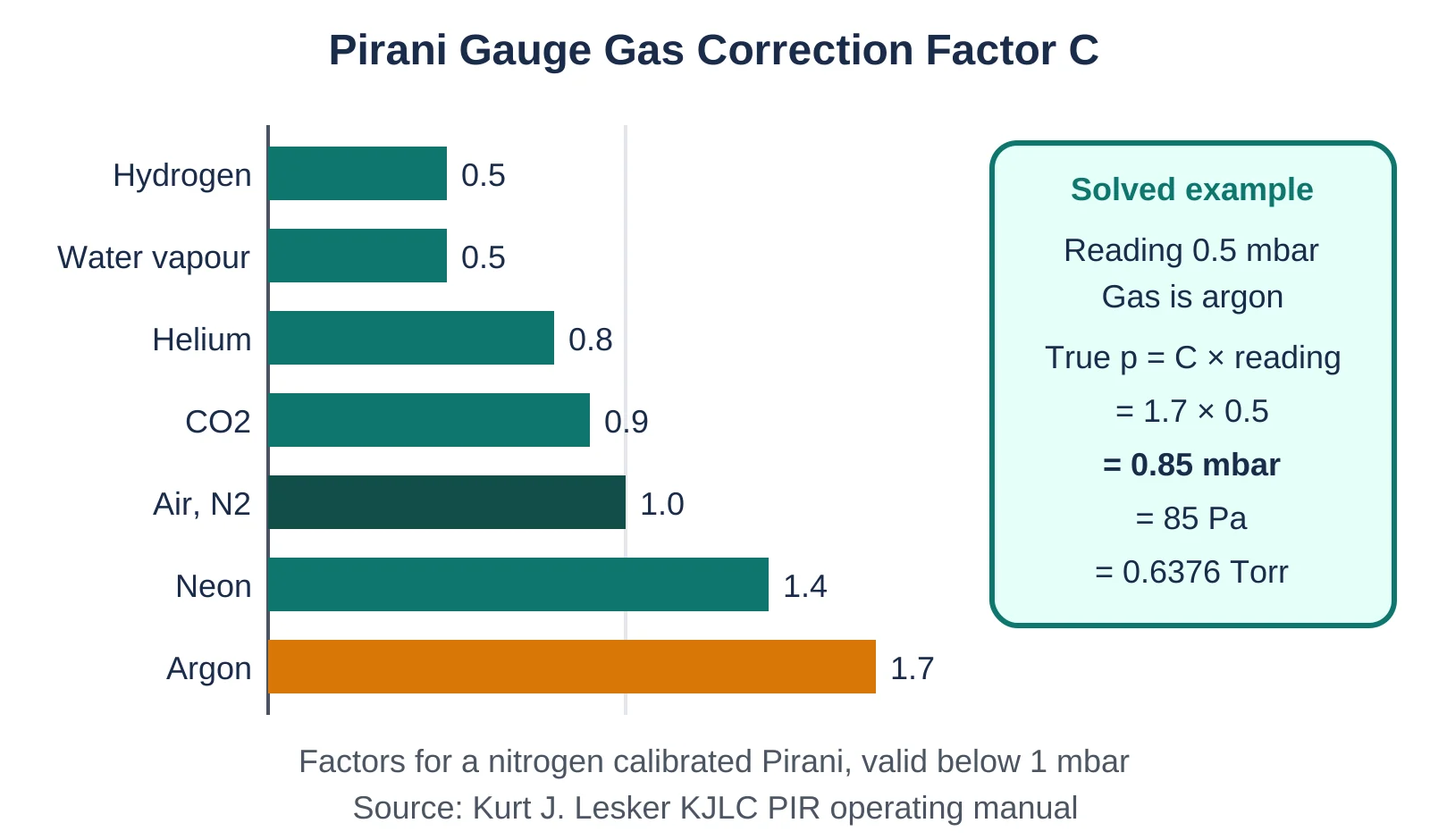
Correction factors belong to one gauge type. The Pfeiffer PKR 251 lists helium as 5.9 for its cold cathode section, while the KJLC pirani gauge table gives 0.8.
How to Calibrate a Pirani Gauge
You calibrate a pirani gauge by setting two points: an atmosphere adjustment at 1000 mbar and a high vacuum zero below the gauge floor. For a lab grade check, compare it with a gas independent capacitance manometer on the same chamber so the result stays inside your calibration traceability chain.
Record the error at each point the same way you would for a transmitter, and if you need a refresher on the maths, the calibration error calculator does it as a percentage of reading or span.
Pirani Gauge Troubleshooting
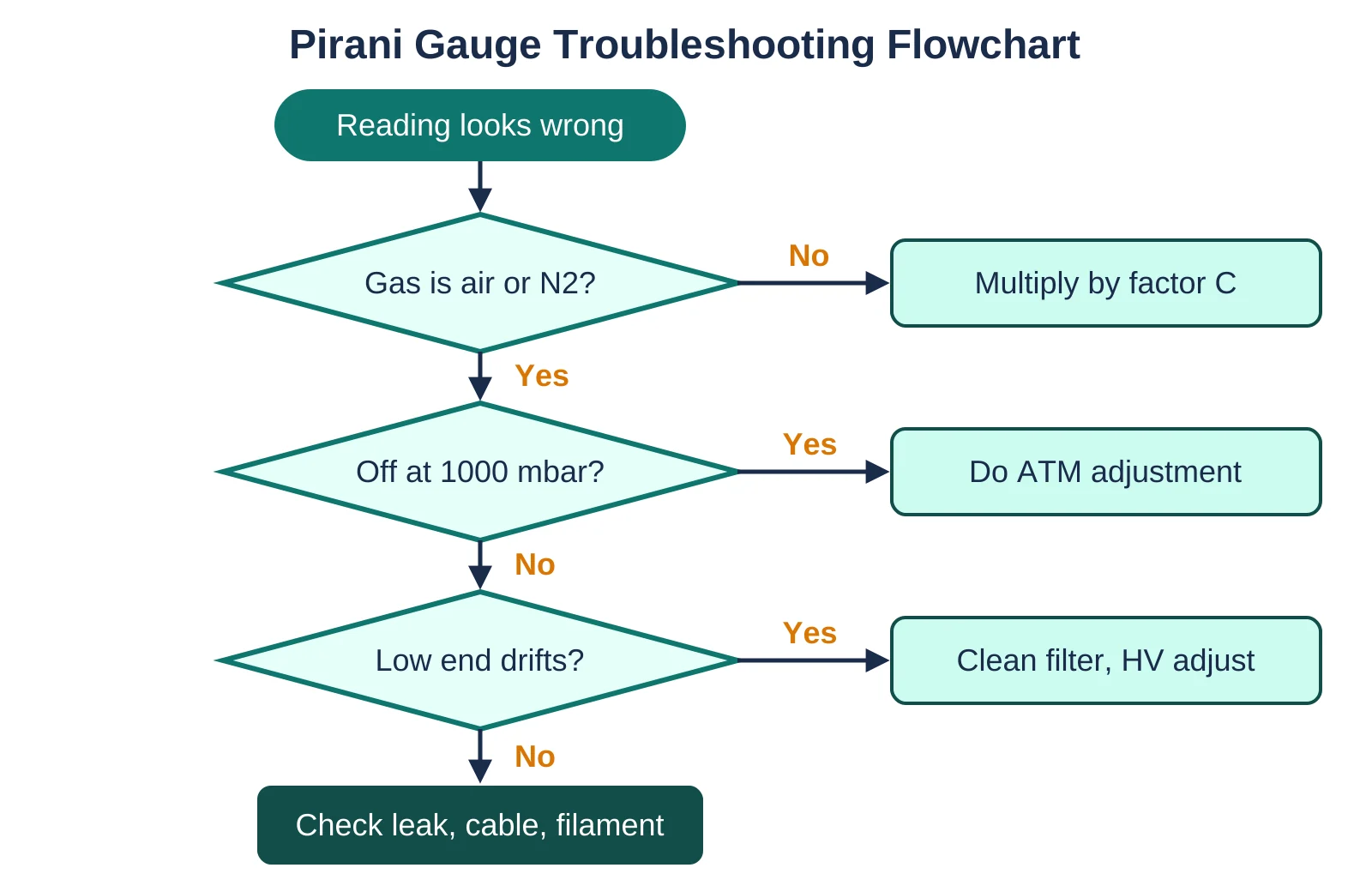
Most wrong readings come from three causes: the wrong gas, a contaminated filament or an adjustment that has drifted. Work through them in that order before you suspect leaks or wiring.
| Symptom | Likely cause | What to do |
|---|---|---|
| Reads high in helium | Gas factor not applied | Multiply by 0.8 below 1 mbar |
| Reads low in argon | Gas factor not applied | Multiply by 1.7 below 1 mbar |
| Floor rises over months | Oil vapour or deposits on wire | Clean filter, HV adjust or replace |
| Wrong at atmosphere | ATM point drifted | Vent and do ATM adjustment |
| Never pumps below 1 mbar | Leak or pump problem | Leak check the system |
A slow pump down is not always the gauge at fault, so before a leak hunt read our list of common leak testing errors. Kurt J. Lesker also warns that bare hand contact raises outgassing, so wear clean lint free gloves when you open the vacuum side.
Pirani Gauge vs Capacitance Manometer vs Penning
A pirani gauge is cheap and wide range but gas dependent, a capacitance manometer is gas independent and accurate, and a Penning cold cathode gauge covers the high vacuum region below the Pirani floor. Many plants use two of them together on one chamber.
| Feature | Pirani | Capacitance manometer | Penning cold cathode |
|---|---|---|---|
| Principle | Heat loss from hot wire | Diaphragm deflection | Gas discharge current |
| Gas dependent | Yes | No | Yes |
| Typical region | 0.0005 to 1000 mbar | Four decades per diaphragm | Below 0.01 mbar |
| Cost | Low | High | Medium |
| Best use | Rough vacuum, pump control | Process pressure, reference | High vacuum |
Pfeiffer Vacuum explains that a capacitance diaphragm gauge reads force on a diaphragm, so its reading does not depend on gas type. That makes it the natural reference, and our ceramic vs metal diaphragm article covers the diaphragm materials used.
- Low cost and simple electronics
- Wide range from atmosphere to about 0.0005 mbar
- Fast response of about 0.1 s
- Reading depends on gas type
- Poor resolution above about 10 mbar in classic designs
- Drifts with contamination and ambient temperature
Sens4 reports that the first commercial MEMS Pirani gauges appeared in 1993 from Wenzel Electronics, placing the heater on a thin membrane instead of a wire.
Low vacuum can also harm the field transmitters on the same skid. Our note on vacuum effect on field instruments explains fill fluid and seal issues.
Where Is a Pirani Gauge Used?
You will find a pirani gauge wherever a rough or medium vacuum reading is needed at low cost. It often gives the interlock that allows a high vacuum pump or a second gauge to start.
- Confirm the calibration gas on the datasheet
- Apply the gas factor below 1 mbar
- Mount horizontal to upright with a filter
- Pair with a high vacuum gauge for pressures below 0.001 mbar
If you want to test your understanding after the video, try our pressure measurement questions and answers, which include vacuum gauge questions asked in interviews.
Pirani Gauge FAQ
A Pirani reads heat loss from a hot wire, so its reading changes with gas type. A capacitance manometer measures diaphragm deflection and reads the same in any gas.
That is why the manometer is used as the reference, while the Pirani gives a cheap rough vacuum signal from 1000 mbar down to about 0.0005 mbar.
Multiply the indicated pressure by the argon factor from the gauge manual, which is 1.7 for the KJLC PIR. A reading of 0.5 mbar therefore means 0.85 mbar of argon.
Convert to pascal by multiplying by 100, giving 85 Pa. The factor is valid only below about 1 mbar.
Above about 10 hPa the gas already carries heat as well as it can, so heat loss barely changes with pressure. A classic gauge then cannot separate 50 mbar from 500 mbar.
Convection designs use gas movement inside the tube to extend accuracy. MKS Instruments quotes good accuracy up to 760 Torr for such designs.
A standard unit such as the KJLC PIR reads down to about 0.0005 mbar. Below about 0.001 mbar the reading becomes coarse because radiation and support losses dominate.
For lower pressures you add a cold cathode or hot cathode gauge. Combination heads like the Pfeiffer PKR 251 switch over at 0.01 mbar.
The most common mistake is forgetting the gas correction, for example reading helium or argon as if it were nitrogen. Oil vapour on the filament comes a close second.
Wrong mounting, hot ambient air and skipping the warm up also shift the reading. Check these before you suspect a leak.
A Pirani is usually the best choice for a rotary pump line because it covers atmosphere to about 0.0005 mbar at low cost.
If the process gas changes often, or you need better accuracy than the ±15 percent of a KJLC PIR, choose a capacitance manometer instead.
Related Articles
- Vacuum Measurement Sensor Types
- How to Calculate Vacuum Pressure
- Absolute Pressure Transmitter Working Principle
- Wheatstone Bridge Applications
- Thermal Mass Flow Meter Working
External References
- Kurt J. Lesker KJLC PIR Operating Manual (PDF)
- MKS Instruments: Thermal Conductivity Gauge Physics
- Wikipedia: Pirani gauge
What We Learn Today
- A pirani gauge measures vacuum from the heat a hot filament loses to gas, using a Wheatstone bridge that holds the filament temperature constant.
- Readings are correct only for the calibration gas, so multiply by the manual factor, such as 1.7 for argon, below about 1 mbar.
- Calibrate with an ATM adjustment at 1000 mbar and an HV adjustment below the floor, after warm up in the normal mounting position.