
What is Thermal Conductivity? Working Principle, Formula, Units, and Applications
Why a metal spoon burns your fingers in seconds while a wooden one stays cool, and the single material property that explains it.
Thermal conductivity is a material property that determines how efficiently heat flows through a substance. Learn its working principle, formula, units, factors affecting it, and industrial applications in this easy to understand engineering guide.
What is Thermal Conductivity?
Have you ever noticed that a metal spoon becomes hot quickly when left inside a cup of hot tea, while a wooden spoon stays relatively cool? Both spoons sit in the same hot liquid, yet they transfer heat at very different rates. This difference comes down to a material property called thermal conductivity, represented by the symbol k and measured every time engineers size a gas filled thermometer bulb or select a sheath for a temperature sensor.
Thermal conductivity is a physical property that describes how easily heat can flow through a material. When two parts of the same material sit at different temperatures, heat naturally flows from the hotter region to the colder one, and this property tells you how efficiently that transfer happens. Copper transfers heat very quickly because it has a high value, while wood transfers heat much more slowly because its value is low. This one property influences everything from heat exchangers and thermowells to the response time of the temperature sensors that measure your process.
Let us take an Example
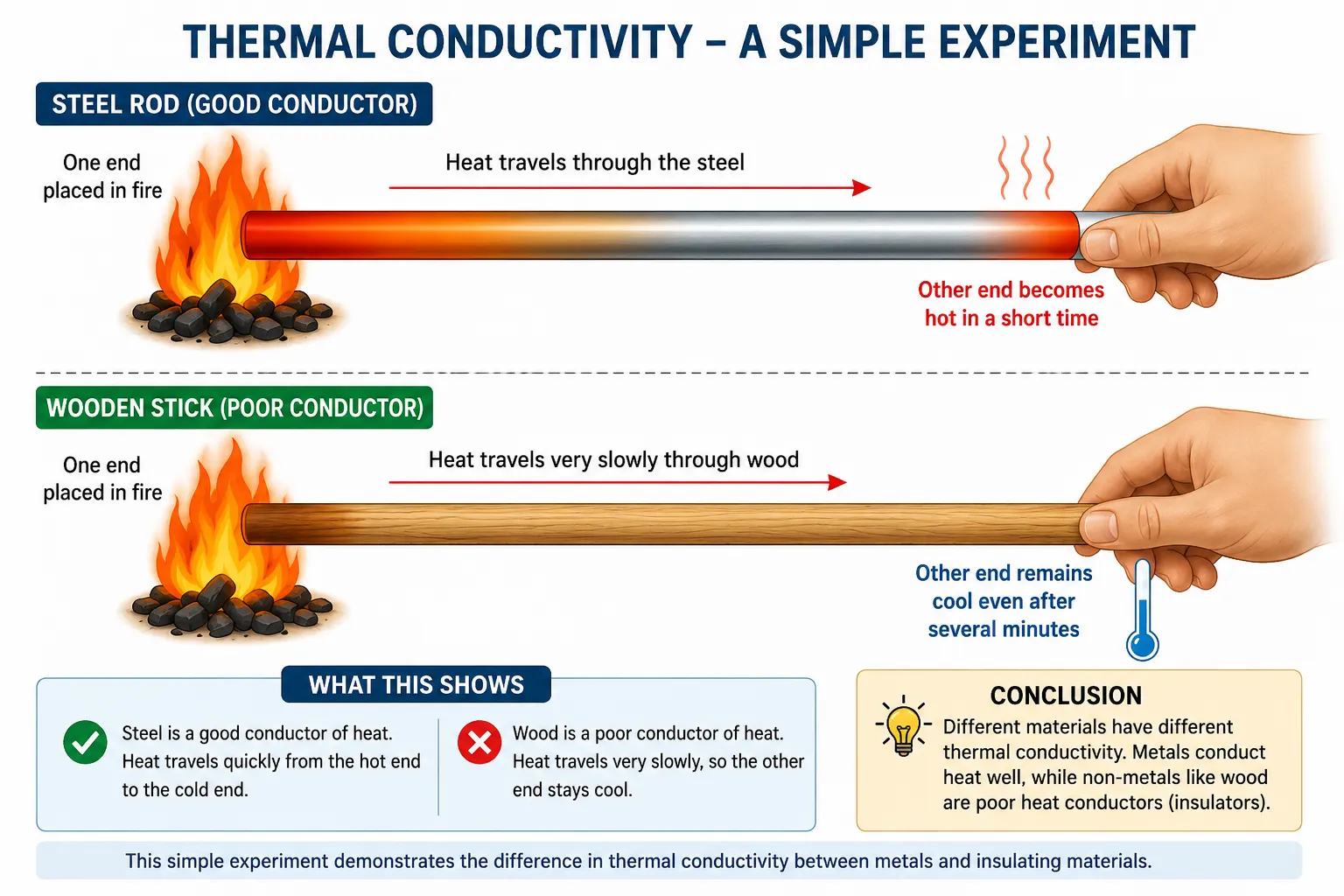
Imagine placing one end of a steel rod into a fire. After a short time, the other end also becomes hot because heat travels efficiently through the steel. Now replace the steel rod with a wooden stick. Even after several minutes, the far end stays much cooler because wood is a poor conductor of heat. That simple experiment sums up the entire difference between metals and insulating materials.
How Does Thermal Conductivity Work?
Heat always flows naturally from a region of higher temperature to a region of lower temperature until thermal equilibrium is reached. Inside a solid, this transfer happens mainly through two mechanisms: molecular vibration and free electron movement. In non-metallic materials such as wood or plastic, heat moves mostly through vibrations of atoms and molecules. In metals, free electrons also carry thermal energy, letting heat move much faster, which is why metals generally conduct far better than insulating materials.
Consider a saucepan on a gas stove. The flame heats the bottom of the pan directly, and because aluminum and copper conduct heat so well, it spreads quickly and evenly across the cooking surface. If the pan were made entirely of wood, very little heat would ever reach the food, since wood is such a poor conductor.
Thermal Conductivity Formula: Fourier's Law
The rate of heat transfer through a material is described by Fourier's Law of Heat Conduction.
From this equation, heat transfer increases when thermal conductivity is higher, surface area is larger, or temperature difference is greater. Heat transfer decreases as the material gets thicker.
SI Unit of Thermal Conductivity
The SI unit of thermal conductivity is W/m·K, watts per meter per Kelvin. This means the amount of heat transferred through a material that is 1 meter thick with a temperature difference of 1 Kelvin across it. A higher value of k indicates better heat conduction, while a lower value indicates better insulation.
| Unit | Description |
|---|---|
| W/m·K | SI unit, most common in engineering calculations |
| kcal/hr·m·°C | Metric engineering unit |
| BTU/hr·ft·°F | Imperial unit |
6 Factors Affecting Thermal Conductivity
This property is not a fixed number for every material. It changes depending on several physical and environmental factors, and understanding them helps engineers pick the right material for the job.
Material Type
Metals conduct heat far better than non-metals because free electrons carry thermal energy rapidly.
Temperature
Values shift with temperature, sometimes decreasing slightly in metals as temperature rises.
Density
Denser materials pack particles closer together, usually transferring heat more efficiently.
Moisture Content
Water conducts heat far better than air, so damp insulation loses much of its effectiveness.
Crystal Structure
Highly ordered crystal structures generally conduct heat more effectively than amorphous ones.
Porosity
Tiny trapped air pockets lower conductivity, which is why foam and fiberglass insulate so well.
Good Thermal Conductors vs Thermal Insulators
🔥 Good Thermal Conductors
Silver, copper, aluminum, brass, gold, and steel. Used in heat exchangers, heat sinks, cooking utensils, radiators, and electronic cooling systems.
🧊 Thermal Insulators
Wood, rubber, plastic, fiberglass, ceramic fiber, air, and polyurethane foam. Used in building insulation, refrigerators, cold storage, and furnace linings.
Thermal Conductivity of Common Materials
The table below compares approximate thermal conductivity values for common engineering materials, based on published reference data.
Note: values are approximate and vary with material composition, temperature, and manufacturing process.
8 Applications of Thermal Conductivity in Engineering
Heat Exchangers
Copper and aluminum improve heat transfer efficiency between two fluids.
Heat Sinks
Aluminum or copper sinks pull heat away from processors and power transistors quickly.
Industrial Temperature Measurement
Thermowells and sensor sheaths rely on good conductivity for fast, accurate response.
Boilers and Furnaces
Thermal conductivity directly influences boiler efficiency and fuel consumption.
Refrigeration and Cold Storage
Low conductivity insulation keeps unwanted heat out of freezers and cold rooms.
Building Insulation
Low conductivity walls and roofs cut heating and cooling costs significantly.
Automotive Industry
Radiators and battery thermal management systems depend on the right conductivity.
Electronics
Highly conductive materials manage heat in ever smaller, hotter running devices.
How to Select the Right Material by Thermal Conductivity
| Application | Recommended Material |
|---|---|
| Heat Exchanger | Copper, Aluminum |
| Heat Sink | Aluminum |
| Thermowell | Stainless Steel |
| Building Insulation | Fiberglass, Mineral Wool |
| Furnace Insulation | Ceramic Fiber |
| Refrigerator | Polyurethane Foam |
| Electrical Cable Insulation | Rubber, PVC |
| Cookware | Aluminum, Copper |
Common Thermal Conductivity Mistakes to Avoid
- Assuming all metals conduct heat equally
- Confusing thermal conductivity with thermal diffusivity
- Ignoring the effect of temperature on this property
- Selecting materials based only on cost rather than performance
- Using highly conductive materials where insulation is actually required
- Neglecting environmental factors such as moisture and corrosion
Thermal Conductivity Explained: Video Walkthrough
Frequently Asked Questions About Thermal Conductivity
- Thermal Engineering, What is Fourier's Law of Thermal Conduction
- tec-science, Thermal Conductivity (Fourier's Law)
- The Engineering ToolBox, Thermal Conductivity of Common Materials
What We Learn Today
- Thermal conductivity describes how efficiently heat flows through a material, represented by k
- Metals conduct heat well because free electrons carry thermal energy, non-metals rely on slower molecular vibration
- Fourier's Law, Q = k × A × (ΔT / L), ties conductivity to real heat transfer rates
- Material type, temperature, density, moisture, crystal structure, and porosity all shift conductivity
- High conductivity materials like copper and aluminum move heat fast, low conductivity materials like foam and fiberglass block it
- Choosing the right material means matching conductivity to the job, not just picking on cost