
A delta winding has no neutral, so an earth fault on it draws almost no current and the healthy phases rise towards line voltage. A small zigzag or star delta unit gives the system a neutral point, a controlled fault current and protection that actually sees the fault.
Many 33 kV and 11 kV systems are fed from delta windings that offer no neutral for earthing. An earthing transformer creates that neutral, and with a resistor it limits fault current so earth fault relays can trip quickly and selectively.
What Is an Earthing Transformer?
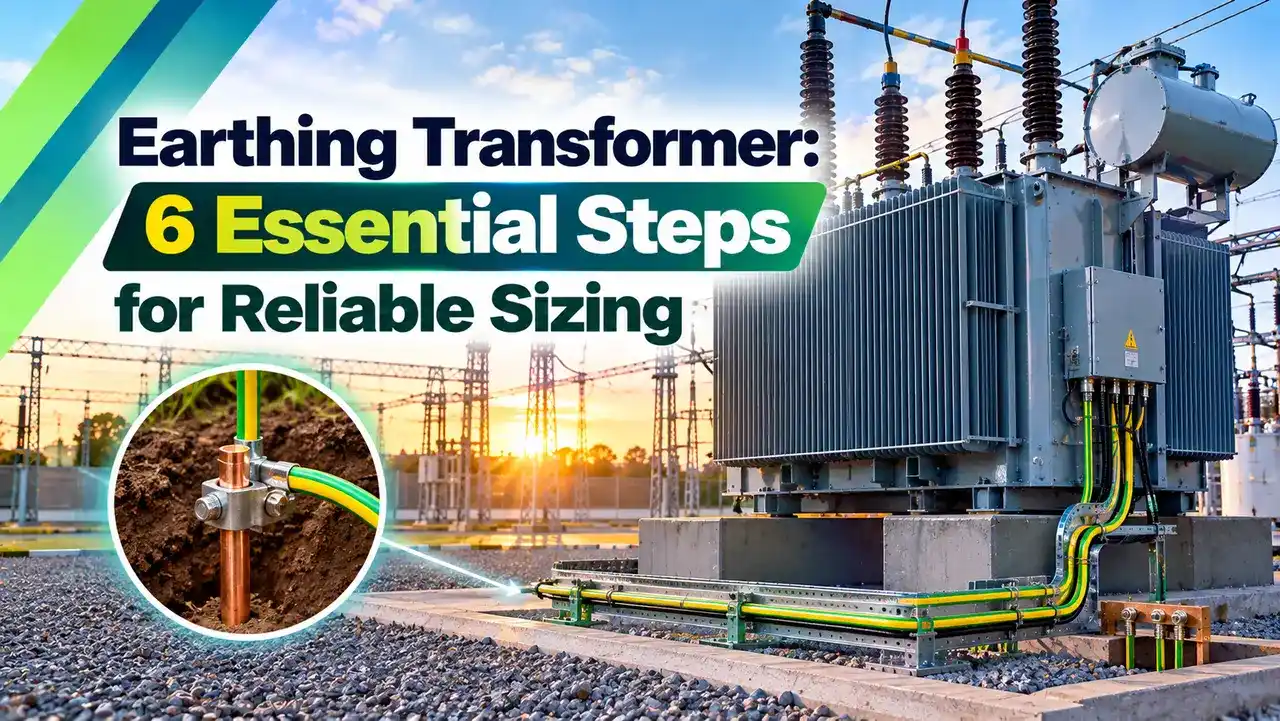
An earthing transformer is a three phase transformer, usually zigzag or star delta connected, whose only job is to create an artificial neutral point on a system that has none, such as a delta winding. It carries almost no current in normal service, but during an earth fault it provides a low impedance path for zero sequence current.
Without it, a delta system behaves like an isolated neutral system, described in TN, TT and IT earthing systems. A single earth fault then draws only a tiny capacitive current, protection may not see it, and the two healthy phases rise towards full line voltage to earth.
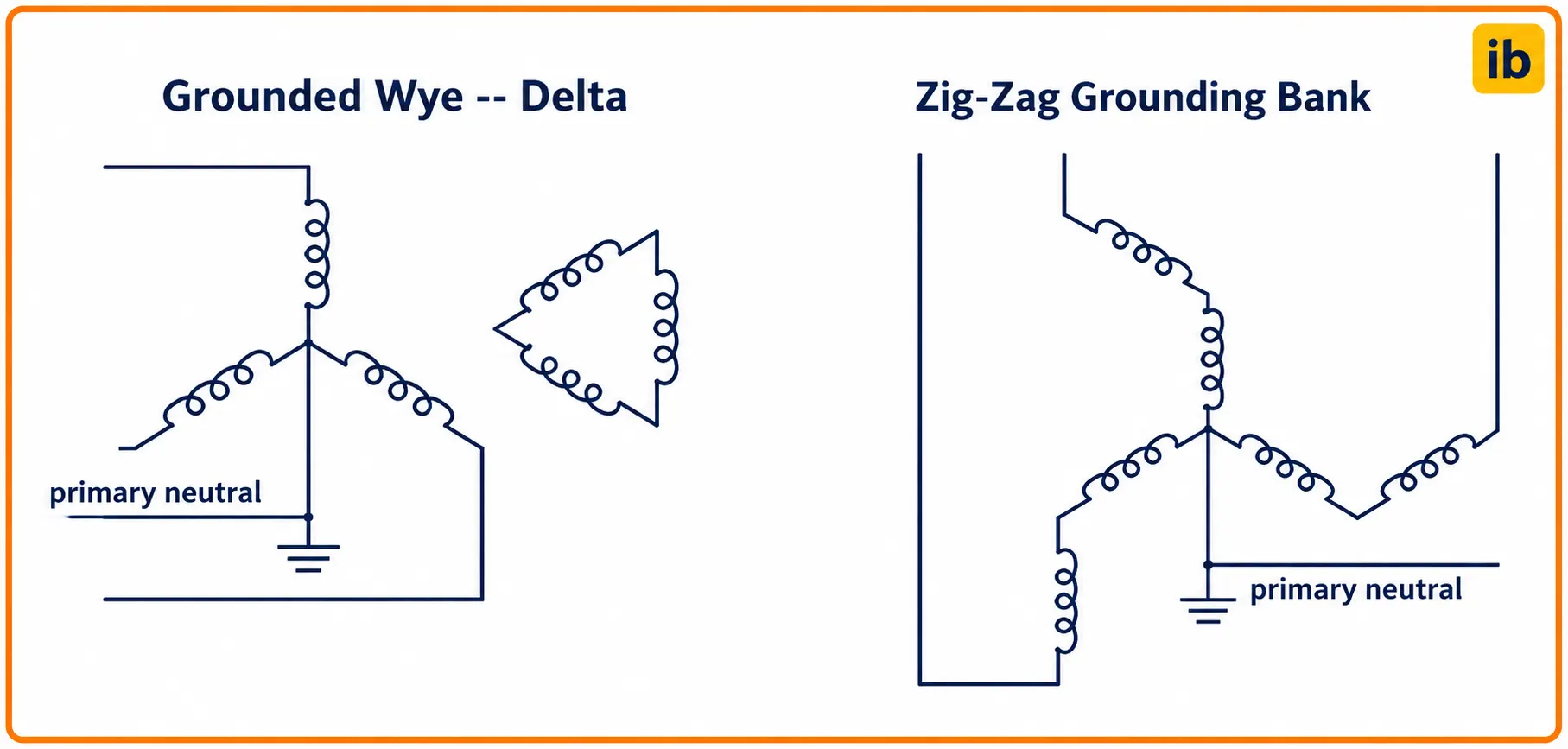
Electrical Engineering Portal describes the grounding transformer as a source of zero sequence current that turns a three wire ungrounded circuit into a four wire grounded one. It also notes that the zigzag connection is the most widely used design.
Why Delta Systems Need an Earthing Transformer
Most Indian generating stations and pooling substations use step up transformers with a delta winding on the lower voltage side, because the delta traps triplen harmonics and gives a stable vector group, as explained in transformer vector groups. The penalty is that this side has no star point to earth.
An isolated neutral is allowed in some small systems, but it brings high transient overvoltages during arcing earth faults and difficult fault location. The difference between floating and referenced systems is covered in floating versus grounded voltage.
The PSCAD example from Manitoba Hydro International shows the effect of an earthing transformer clearly in simulation. Without a zigzag unit the healthy phase voltages swell and fault current is nearly zero, while with it the fault becomes detectable and the voltage rise is much smaller.
An earthing transformer on a healthy, balanced system carries only its small magnetising current. It wakes up only when zero sequence voltage appears, which is during an earth fault or a heavy unbalance.
Zigzag and Star Delta Earthing Transformer Types
Each core leg carries two half windings from different phases, connected in opposite sense.
Earthed star primary with a closed delta secondary that circulates zero sequence current.
Zigzag primary plus a star LV winding for station supply.
In the zigzag connection, zero sequence currents in the two half windings on each leg produce opposing ampere turns, so the zero sequence flux cancels and the impedance is low. Positive sequence voltage, however, sees the full magnetising impedance, so normal load current hardly flows, a point worth comparing with star and delta connection.
In the star delta type, zero sequence current enters the earthed star and is balanced by a current circulating in the closed delta. Electrical Engineering Portal notes that for both designs the zero sequence impedance equals the impedance between one primary winding and its secondary.
On the nameplate, look for the rated neutral current and its time, for example 400 A for 10 s, rather than the kVA alone. The neutral current and time are what the protection study needs.
Zero Sequence Path Through an Earthing Transformer and NER
Most medium voltage installations connect a neutral earthing resistor between the star point and earth, so the fault current is limited to a planned value, often a few hundred amperes. Resistor sizing is covered step by step in neutral grounding resistor sizing.
Together with the earthing transformer, the NER keeps damage at the fault point low and controls transient overvoltages, while still giving enough current for a definite time or IDMT relay on the neutral CT. A reactor can replace the resistor where a larger fault current is acceptable.
Earthing Transformer Rating Formulas
Star delta bank rating S = VLG × IN
NER resistance R ≈ VLG ÷ IN
Example, 33 kV solar plant bus, 400 A for 10 s:
S = 33 × 400 ÷ 3 = 4400 kVA short time
Continuous equivalent = 3 percent × 4400 = 132 kVA
R ≈ 33000 ÷ 1.732 ÷ 400 = 47.63 Ω
Electrical Engineering Portal, quoting ANSI and IEEE Standard 32, states that a 10 second unit has a continuous rating of 3 percent of its short time rating, and a 1 minute unit 7 percent. Because each zigzag winding sees less than line to earth voltage by a factor of √3, the zigzag unit is smaller than a star delta bank for the same duty.
The NER value above ignores the earthing transformer zero sequence impedance, which is small compared with the resistor at medium voltage. Fault levels for the wider study come from short circuit fault current calculation, and the per unit system helps combine impedances.
Earthing Transformer Calculator
Second Worked Example: 11 kV Plant Bus
Take an 11 kV delta bus in a process plant, with the fault current limited to 300 A for 10 seconds. The zigzag rating is 11 × 300 ÷ 3 = 1100 kVA short time, and 3 percent of that gives a continuous equivalent of 33 kVA.
The NER is about 11000 ÷ 1.732 ÷ 300 = 21.17 Ω, rated for 300 A for 10 seconds. Electrical Engineering Portal gives a larger utility case, where a 12.47 kV system with 6000 A of earth fault current needs a 24.9 MVA zigzag unit for 10 seconds.
6 Essential Steps to Size an Earthing Transformer
Step five matters on feeders with single phase loads, because standing unbalance flows through the earthing transformer all the time. Electrical Engineering Portal warns that losing the only ground source can cause high phase to neutral voltages, so the unit must be in service whenever the source is.
Earthing Transformer Use in Solar and Wind Plants
In large Indian solar and wind parks, the 33 kV collector system is often fed through transformers whose 33 kV winding is delta, so an earthing transformer with an NER is installed on each 33 kV bus section. The inverters themselves, explained in power inverter working principle, usually cannot supply zero sequence current.
Electrical Engineering Portal also notes that distributed generation often needs a grounded source to prevent overvoltage when a generator islands on a feeder. The zigzag unit gives that reference, so earth fault relays at the collector feeders can still operate.
A zigzag winding can also trap triplen harmonic currents, because those currents behave like zero sequence quantities. Some data centres and commercial buildings use zigzag units mainly to relieve overloaded neutrals.
- Creates a neutral on any delta system.
- Allows resistance earthing and selective relaying.
- Limits overvoltage on healthy phases.
- Short time rating keeps the unit small.
- Must stay in service whenever the source is live.
- Overloads if an upstream phase opens.
- Adds cost, space and a protection zone.
- Standing unbalance raises the continuous duty.
Protection and Testing Practice
- Fit a CT in the neutral and set an earth fault relay with a time below the transformer and NER time rating.
- Protect the unit itself with phase overcurrent or differential relays.
- Interlock so the source cannot run without the earthing path.
- Measure winding resistance and insulation resistance at site.
- Check the zero sequence impedance against the test report.
- Confirm NER resistance and continuity before energising.
- Monitor oil temperature where the unit has a continuous rating.
Routine factory tests follow the same pattern as other units in transformer routine and type tests, with the zero sequence impedance test being the key extra check. At site, a Megger insulation test confirms the windings before the first energisation.
Never apply a back up earth fault time longer than the NER time rating. A 10 second resistor that sees 15 seconds of fault current can crack or open, leaving the system unearthed.
The protection for the zigzag unit is part of the overall scheme described in protective relays explained. Its own earth mat connection should follow the conductor sizing in earth conductor size calculation.
Common Earthing Transformer Myths
Standards and Selection Notes
IEC 60076 part 6 covers reactors and earthing transformers, and IEEE C57.32 covers neutral grounding devices including resistors and earthing transformers. The specification should state the neutral current, the time rating, the zero sequence impedance, the insulation level and the cooling method.
Oil filled units suit outdoor substations, while dry type units are common indoors, with cooling chosen as in transformer cooling methods. Also coordinate the system with surge protection, as in surge arrester selection, because earthing affects the arrester voltage rating.
Zig Zag Transformer Simulation Note
Grounding Transformer Fundamentals Video
Earthing Transformer FAQ
It is a three phase transformer used only to create a neutral point on a system without one. It is usually zigzag or star delta connected and installed on a delta bus.
In normal service it carries almost no current. During an earth fault it gives zero sequence current a path, so protection can detect and clear the fault.
In a zigzag winding, the zero sequence ampere turns of the two half windings on each leg cancel. This gives a low zero sequence impedance in a compact core.
Each winding sees less than line to earth voltage by a factor of root three. The unit is therefore smaller than a star delta bank for the same fault duty.
The resistor limits earth fault current to a planned value, often a few hundred amperes on medium voltage systems. This greatly reduces burning and damage at the fault point.
It also controls transient overvoltages during arcing faults. The fault current still stays high enough for a sensitive neutral CT relay to trip quickly and selectively.
The unit is designed to carry its full neutral current only for a short time, commonly 10 seconds or 1 minute. This keeps its size and cost low.
Electrical Engineering Portal states that a 10 second unit has a continuous rating of about 3 percent. A 1 minute unit has a continuous rating of about 7 percent.
Multiply the line voltage in kV by the neutral current in amperes and divide by three. The answer gives the short time rating of the earthing transformer in kilovolt amperes.
For a 33 kV bus with 400 A for 10 seconds, the short time rating is 4400 kilovolt amperes. The matching NER for that duty is about 47.6 ohms.
Their 33 kV collector buses are often fed through transformer windings connected in delta, which have no star point. The solar inverters and wind converters also usually cannot supply zero sequence current.
The earthing transformer gives the whole collector system a stable neutral reference. Earth fault relays on each cable feeder can then operate reliably and selectively.
The system becomes unearthed and an earth fault will raise healthy phase voltages towards line voltage. Earth fault relays may also stop seeing faults on any of the outgoing feeders.
For this reason the earthing transformer is interlocked with the source breaker. Losing the only earthing source should trip or block the source as well.
Related Articles
- Neutral Grounding Resistor Sizing
- TN, TT and IT Earthing Systems
- Transformer Vector Group Explained
- Grounding Techniques Explained
- Earthing Aspects in Industrial Process Plants
External References
- Zig Zag Transformer for Grounding System, Manitoba Hydro International
- Where and Why Do We Use Grounding Transformer, Electrical Engineering Portal
- Grounding Transformer, Wikipedia
What We Learn Today
- An earthing transformer creates an artificial neutral on a delta system, so earth faults draw a controlled current that protection relays can detect.
- A zigzag unit is rated V line to line times neutral current divided by three, and a 10 second unit has about 3 percent continuous rating.
- Solar and wind plants often earth their 33 kV collector buses with a zigzag unit and NER, because inverters cannot supply zero sequence current.