
What Is a Protective Relay?
A protective relay is an electrical protection device that detects abnormal operating conditions in a power system and initiates corrective action before serious damage occurs. Instead of carrying load current like a circuit breaker, a relay acts as the decision making component of the protection system. It analyzes signals received from current transformers and voltage transformers, determines whether a fault exists and commands the associated circuit breaker to open whenever necessary.
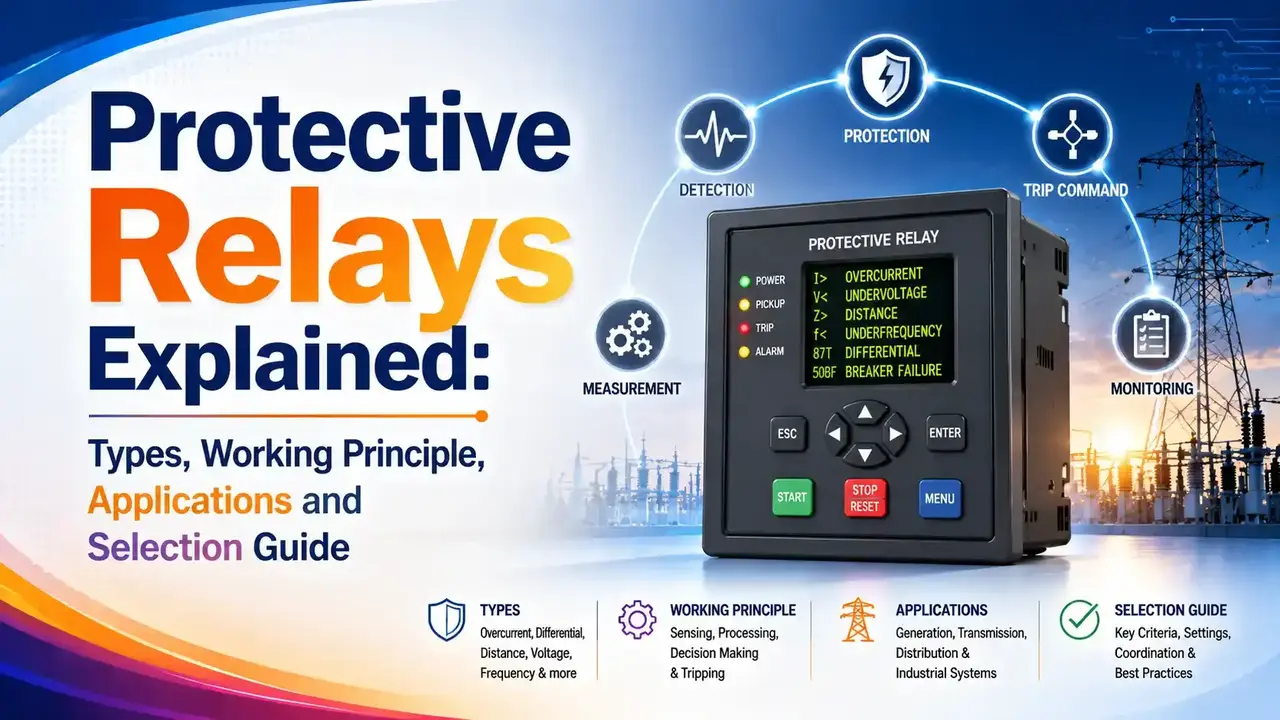
Protective relays are used throughout electrical power systems, including generating stations, substations, transmission networks, distribution systems and industrial facilities. They help protect expensive electrical equipment such as transformers, generators, motors, feeders, capacitors and transmission lines from faults including short circuits, overloads, earth faults and abnormal operating conditions.
Modern numerical relays can perform dozens of protection functions within a single device while also providing event recording, disturbance analysis, fault diagnostics and communication with supervisory control systems.
A circuit breaker interrupts electrical current, but it cannot determine when to operate. The protective relay performs this intelligent decision making process by continuously evaluating electrical conditions and issuing the trip command only when a genuine fault is detected.
Why Are Protective Relays Important?
Electrical faults can develop within milliseconds and quickly escalate into catastrophic equipment failures if they are not cleared immediately. Protective relays significantly reduce the duration of faults by detecting abnormal conditions and isolating only the affected section of the electrical network. This selective protection minimizes equipment damage while allowing the remaining system to continue operating normally.
Without protective relays, electrical faults could damage transformers, destroy generators, burn motors, overheat cables and create serious safety hazards for maintenance personnel. In modern industrial plants, protective relays also reduce costly production downtime by preventing faults from spreading through interconnected electrical systems.
Personnel Safety
Rapid fault isolation reduces the risk of electric shock, arc flash incidents and fire hazards.
Equipment Protection
Protects generators, transformers, motors, cables and switchgear from permanent damage.
System Reliability
Limits fault propagation and helps maintain continuous operation of healthy electrical circuits.
Reduced Downtime
Only the faulty section is disconnected, allowing unaffected parts of the power system to remain energized.
Lower Maintenance Cost
Early fault detection reduces repair costs and extends equipment service life.
Regulatory Compliance
Supports electrical safety requirements established by IEC, IEEE and other international standards.
Protective relays operate together with properly designed grounding systems to detect and safely clear electrical faults. To understand the importance of grounding in electrical protection, read our detailed guide onGrounding Techniques Explained: Types, Working Principle, Applications and Best Practices.
Working Principle of a Protective Relay
A protective relay continuously receives electrical measurements from current transformers and voltage transformers installed within the power system. These measurements are compared against predefined protection settings programmed into the relay. Under normal operating conditions, the measured values remain within acceptable limits and the relay takes no action.
Whenever a fault such as an overload, short circuit, earth fault, undervoltage or frequency deviation occurs, one or more measured quantities exceed their preset limits. The relay immediately recognizes the abnormal condition, verifies that the protection criteria have been satisfied and sends a trip signal to the corresponding circuit breaker. The circuit breaker then disconnects the faulty circuit, preventing further damage and maintaining overall system stability.
Normal Operation → Fault Occurs → Current Transformer and Voltage Transformer Detect Abnormal Values → Protective Relay Analyzes the Fault → Trip Signal Sent to Circuit Breaker → Fault Isolated → Healthy Power System Continues Operating
Types of Protective Relays
Protective relays can be classified according to their construction, operating principle and protection function. Earlier power systems relied on electromechanical relays, whereas modern substations and industrial facilities primarily use numerical relays because they offer higher accuracy, faster response and advanced communication capabilities.
Electromechanical Relay
Electromechanical relays use coils, springs, discs and electromagnetic forces to detect abnormal electrical conditions. Although they are reliable and easy to understand, they require periodic maintenance because of their moving mechanical components.
Static Relay
Static relays replace moving mechanical parts with electronic circuits. They provide improved operating speed, higher accuracy and lower maintenance compared with electromechanical designs.
Digital Relay
Digital relays use microprocessors to sample electrical signals and execute programmed protection algorithms. They provide better flexibility and support multiple protection functions.
Numerical Relay
Numerical relays represent the latest generation of protection devices. A single relay can perform numerous protection functions while recording events, communicating with SCADA systems and storing fault records for detailed analysis.
Classification Based on Protection Function
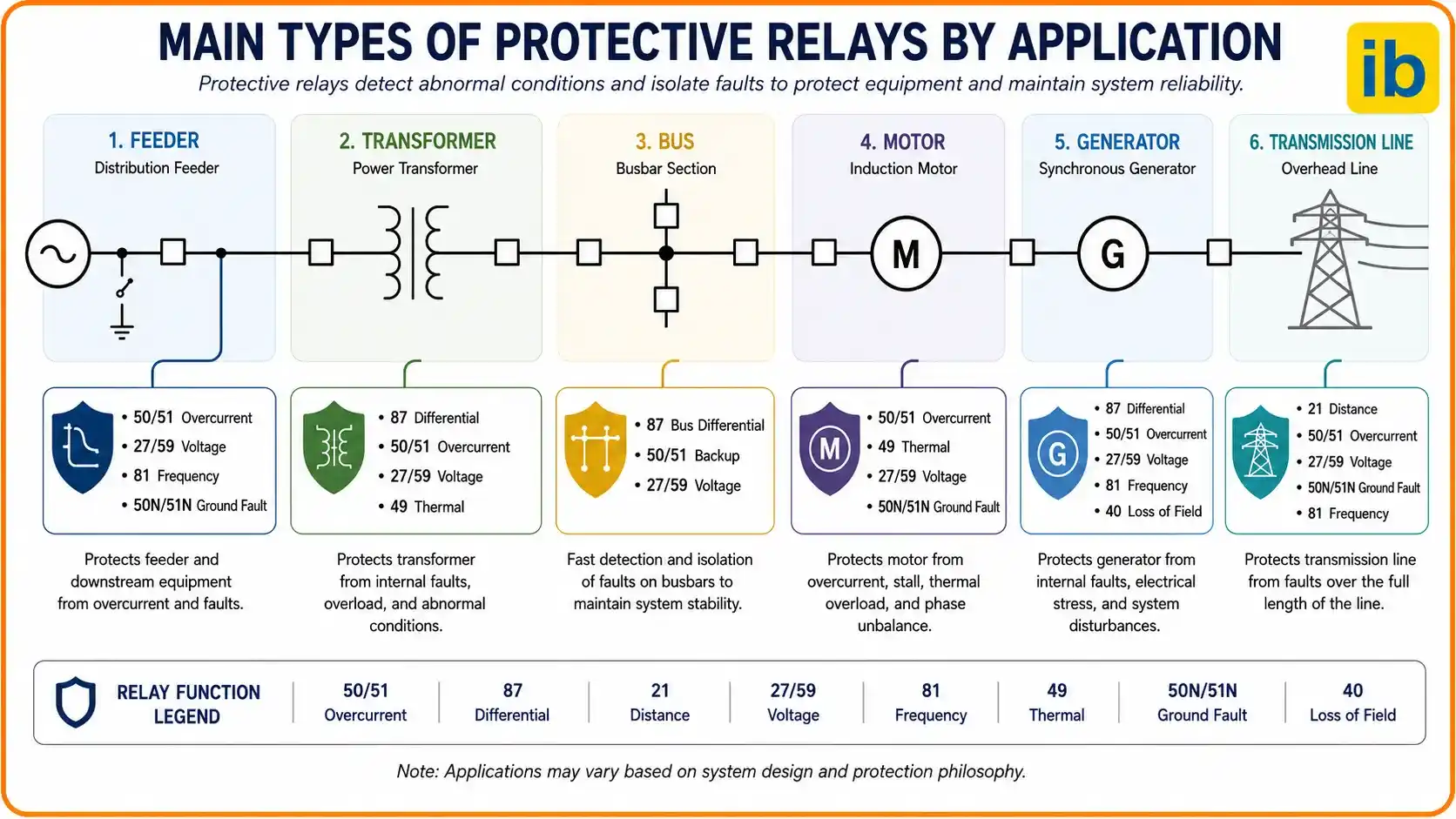
Different electrical faults require different protection methods. Protective relays are therefore designed to monitor specific electrical quantities and respond only when abnormal conditions match their programmed operating characteristics.
| Relay Type | Primary Protection Function | Typical Application |
|---|---|---|
| Overcurrent Relay | Detects excessive current. | Feeders, motors and distribution systems. |
| Earth Fault Relay | Detects leakage current flowing to ground. | Industrial plants and electrical panels. |
| Differential Relay | Compares current entering and leaving equipment. | Transformers, generators and busbars. |
| Distance Relay | Measures line impedance to locate faults. | High voltage transmission lines. |
| Directional Relay | Determines the direction of fault current. | Ring distribution networks. |
| Reverse Power Relay | Detects reverse power flow. | Generators and synchronous machines. |
| Frequency Relay | Monitors system frequency. | Power plants and grid protection. |
| Voltage Relay | Detects overvoltage or undervoltage conditions. | Industrial power systems. |
| Thermal Relay | Protects equipment against overheating. | Electric motors. |
Modern numerical relays often combine overcurrent, earth fault, thermal, voltage, frequency, breaker failure and communication functions within a single device. This reduces panel space, wiring complexity and maintenance requirements.
Characteristics of an Ideal Protective Relay
An effective protective relay should detect faults quickly while avoiding unnecessary tripping during normal operating conditions. Engineers evaluate relay performance using several important characteristics.
Reliability
The relay must operate correctly whenever an actual fault occurs and remain stable during normal system operation.
Selectivity
Only the faulty section should be disconnected while healthy parts of the electrical system continue operating normally.
Sensitivity
The relay should detect even small fault currents without responding to harmless operating conditions.
Operating Speed
Rapid fault clearing minimizes equipment damage and improves overall power system stability.
Stability
The relay should remain inactive during external faults, switching operations and temporary disturbances.
Accuracy
Protection decisions should be based on precise measurements to avoid nuisance tripping and unnecessary outages.
Applications of Protective Relays
Protective relays are installed throughout electrical power systems to safeguard valuable equipment and maintain uninterrupted electrical service. Every major component within a power system typically has dedicated protection designed specifically for its operating characteristics.
Power Stations
Protect generators, excitation systems, transformers and auxiliary equipment against internal and external faults.
Electrical Substations
Protect transformers, busbars, feeders and transmission lines while maintaining network stability.
Industrial Facilities
Protect motors, drives, switchboards, process equipment and production machinery.
Commercial Buildings
Provide protection for distribution panels, standby generators and emergency power systems.
Renewable Energy Plants
Monitor solar farms, wind turbines, battery storage systems and grid interconnections.
Utility Distribution Networks
Ensure dependable electrical supply by isolating faults before they affect large areas of the network.
Effective protective relays depend on properly designed grounding systems for accurate fault detection. Learn more in our articleGrounding Techniques Explainedto understand how grounding improves protection system performance.
How to Select the Right Protective Relay
Selecting a protective relay requires a thorough understanding of the electrical system, fault characteristics and operational requirements. An improperly selected relay may fail to clear faults quickly or may trip unnecessarily, leading to equipment damage and unwanted production interruptions. Engineers therefore evaluate several technical factors before choosing an appropriate relay for a specific application.
Voltage Level
Select a relay designed for the operating voltage of the electrical system. Protection requirements differ significantly between low voltage, medium voltage and high voltage installations.
Fault Current
Estimate the maximum and minimum fault current levels so the relay can detect abnormal conditions accurately under every operating scenario.
Protected Equipment
Different equipment requires different protection functions. Motors, transformers, generators and transmission lines each have unique protection requirements.
Operating Speed
Critical industrial processes often require very fast fault clearing to minimize equipment damage and production losses.
Communication Features
Modern substations frequently require Ethernet communication, IEC 61850 compatibility and SCADA integration for remote monitoring and diagnostics.
Future Expansion
Selecting a numerical relay with multiple programmable functions provides flexibility for future system upgrades without replacing the protection hardware.
Protective Relay Coordination
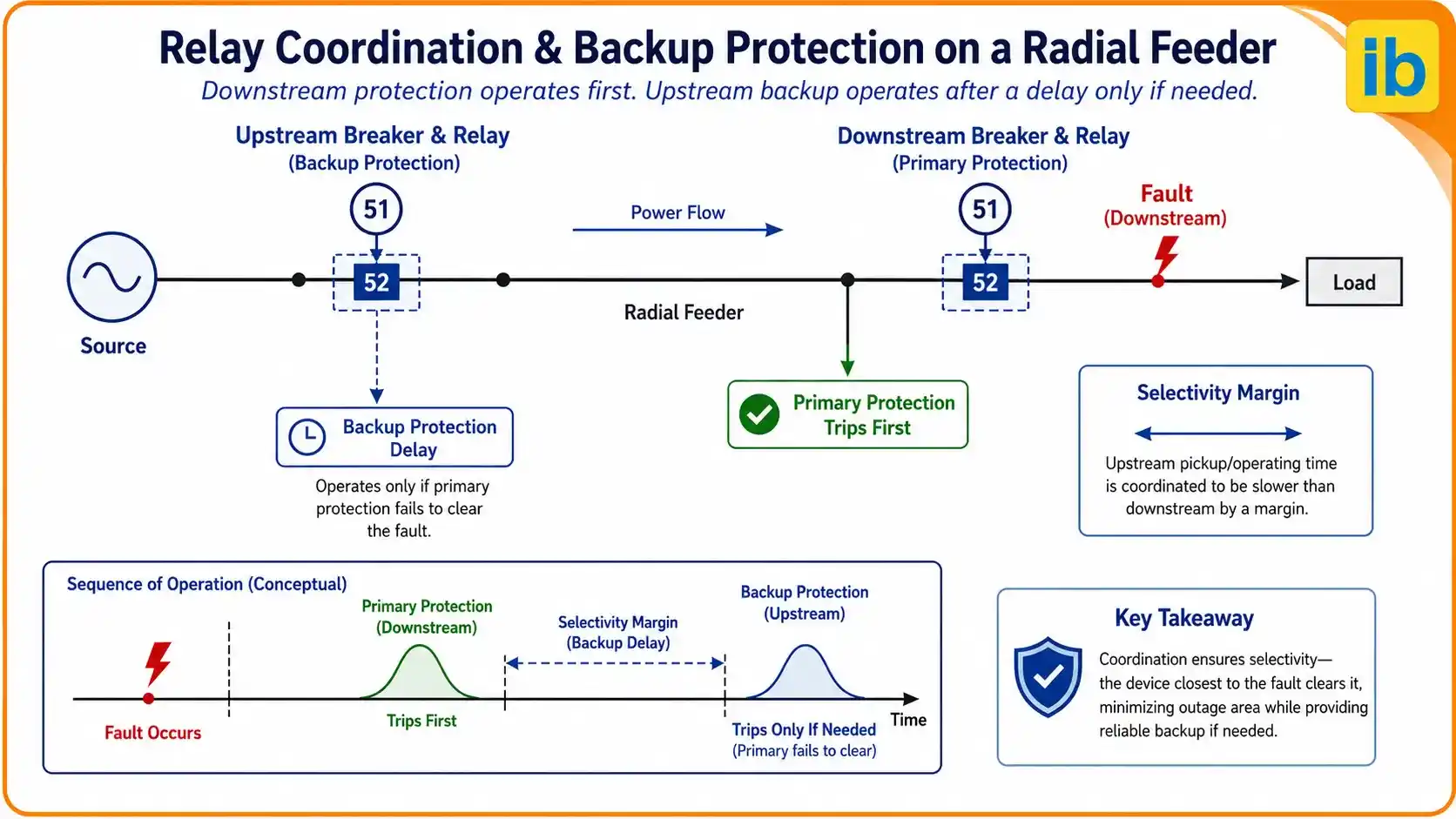
Protective relay coordination ensures that only the device closest to the fault operates while upstream protective devices remain closed. Proper coordination improves system reliability because healthy sections of the electrical network continue operating even when one circuit experiences a fault.
Coordination studies are normally performed during system design using time current characteristic curves. Engineers adjust relay pickup settings and operating times so that downstream relays clear faults before upstream relays operate.
Good coordination minimizes unnecessary outages, improves plant availability and reduces maintenance costs because only the affected circuit is disconnected during a fault.
Common Mistakes When Applying Protective Relays
Even advanced numerical relays cannot provide reliable protection if they are incorrectly selected, configured or maintained. Many protection related failures occur because of incorrect engineering practices rather than equipment defects.
| Common Mistake | Possible Consequence |
|---|---|
| Incorrect relay settings. | False tripping or failure to clear faults. |
| Poor relay coordination. | Large sections of the power system disconnect unnecessarily. |
| Ignoring current transformer accuracy. | Incorrect fault measurement and unreliable protection. |
| Using outdated protection settings. | Reduced protection after system modifications. |
| Skipping routine testing. | Hidden failures remain undetected until a real fault occurs. |
| Poor event record management. | Difficult fault investigation and slower troubleshooting. |
Best Practices for Protective Relay Maintenance
Regular testing and preventive maintenance help ensure that protective relays operate correctly throughout their service life. Modern numerical relays include self diagnostic functions, but periodic inspection remains an essential part of every electrical maintenance program.
Verify Relay Settings
Review protection settings whenever electrical equipment or network configuration changes.
Perform Secondary Injection Tests
Confirm that every protection function operates according to the intended settings.
Inspect Current Transformers
Ensure current transformers and voltage transformers provide accurate measurement signals.
Review Event Records
Analyze fault records regularly to identify recurring electrical problems before they become major failures.
Maintain Backup Files
Store relay configuration files securely so settings can be restored quickly whenever required.
Update Firmware
Install approved firmware updates recommended by the relay manufacturer to improve reliability and cybersecurity.
Protective Relay Standards
Protective relays are designed and tested according to internationally recognized standards that define performance, communication, testing procedures and environmental requirements. Following these standards helps ensure interoperability, safety and dependable operation throughout the electrical system.
| Standard | Purpose |
|---|---|
| IEC 60255 | Requirements and testing for measuring relays and protection equipment. |
| IEC 61850 | Communication networks for digital substations and intelligent electronic devices. |
| IEEE C37 Series | Protection and control requirements for power systems. |
| IEC 60044 | Current transformers and voltage transformers used with protection systems. |
| IEC 60364 | Electrical installation requirements supporting protective devices. |
Protective relays work together with grounding systems, electrical standards and proper switchgear design. You may also find these InstrumentationBlog articles useful while studying electrical protection systems.
Related Articles on InstrumentationBlog
If you are learning power system protection, the following articles will help you build a stronger understanding of electrical safety, industrial automation and protection engineering.
External Resources
The following organizations publish internationally recognized standards, technical guidance and educational material related to protective relays and power system protection.
Engineering standards covering protective relays, substations and power system protection.
Visit IEEE StandardsInternational standards for protection equipment, electrical installations and automation systems.
Visit IECElectrical safety codes and installation practices including the National Electrical Code.
Visit NFPATechnical articles, application guides and educational resources related to electrical protection.
Visit Schneider ElectricFrequently Asked Questions
What We Learn Today
Protective relays are among the most important devices in modern electrical power systems because they detect abnormal operating conditions and isolate faults before they cause serious equipment damage or safety hazards.
Different relay technologies have evolved from electromechanical designs to sophisticated numerical relays capable of performing multiple protection functions within a single intelligent device. Selecting the correct relay requires understanding the electrical network, protected equipment, fault characteristics and communication requirements.
Reliable protection depends not only on selecting the appropriate relay but also on proper coordination, accurate settings, periodic testing and regular maintenance. Following internationally recognized standards such as IEC 60255, IEC 61850 and the IEEE C37 series helps engineers design dependable protection systems that improve safety, minimize downtime and extend equipment life.
References
- IEEE Standards Association
- International Electrotechnical Commission
- National Fire Protection Association
- Turn2Engineering Educational Resources
- IEC 60255 Measuring Relays and Protection Equipment
- IEC 61850 Communication Networks and Systems for Power Utility Automation
- IEEE C37 Series for Power System Protection