A safety officer cannot watch every camera in a large plant, yet a missing helmet or vest takes only seconds to turn into an injury. Computer vision models can now check each video frame for protective gear and raise an alert in real time.
AI based PPE detection reads live CCTV video and flags workers without helmets, vests, gloves or glasses. This guide explains how the models work, how to size cameras and edge hardware, and where the accuracy and privacy limits lie.
What Is PPE Detection?
PPE detection is the use of computer vision to check, from camera images, whether each worker is wearing the required personal protective equipment such as a helmet, high visibility vest, gloves or safety glasses. It is a close cousin of machine vision for quality inspection, except that the object under inspection is a person and the defect is a missing item of gear.
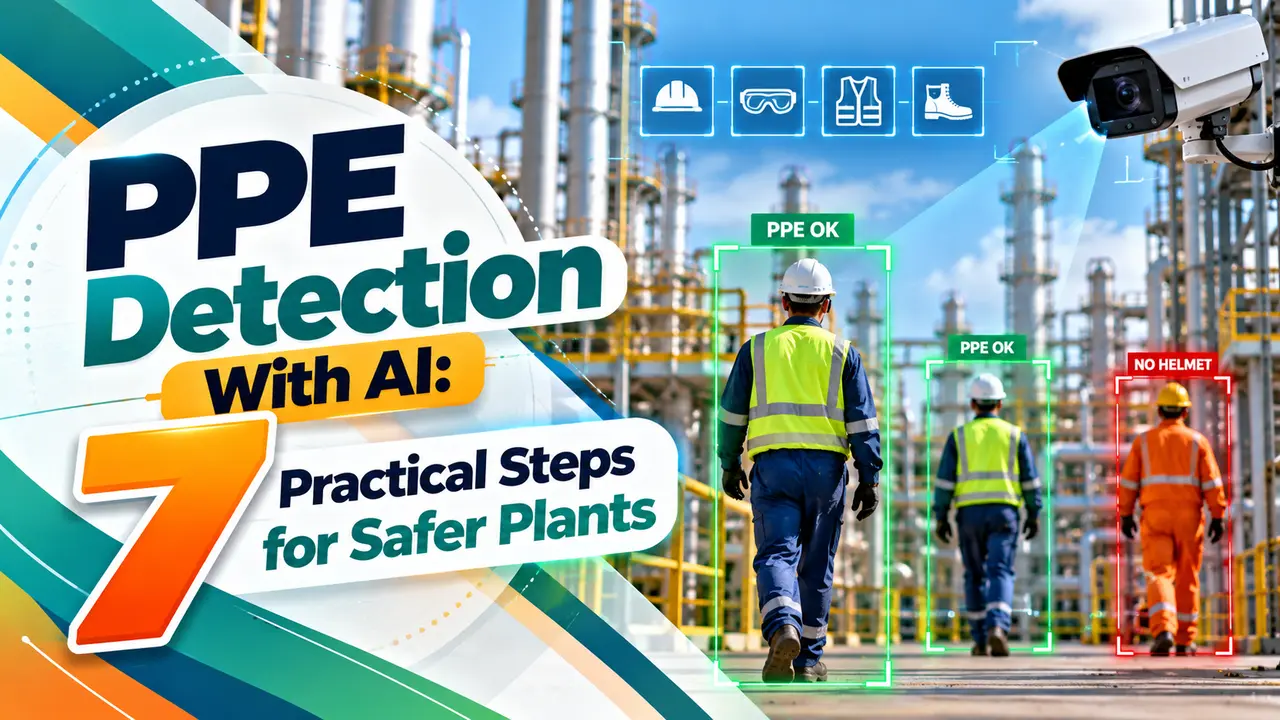
The system takes frames from existing CCTV or new IP cameras, runs a trained neural network on each frame and marks every person and every PPE item with a bounding box. Rules then decide whether a person in a given zone is compliant, and alerts go to a supervisor, a screen or a plant HMI.
The PPE itself still has to be chosen correctly, as covered in the electrical safety PPE selection guide. PPE detection only checks that the selected gear is actually being worn.
How a Vision Model Finds Helmets and Vests
Every PPE detection system follows the same basic pipeline, whether it runs on a small edge box or a rack of GPU servers. The steps below show the path from camera to alert.
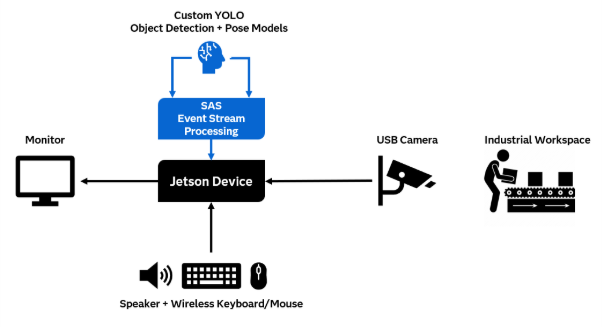
The SAS applied AI team describes a PPE detection system built on an NVIDIA Jetson Orin edge computer, where a fine tuned YOLOX small model checks helmets and vests. They report inference times below 100 milliseconds, which makes the alert feel instant to a worker standing in front of the camera.
The same SAS setup runs a YOLOv7 Pose model beside the PPE detection model to flag risky lifting postures. Pose and object models together form a broader AI layer for plant systems, not just a gear checker.
SAS cites the U.S. Bureau of Labor Statistics figure of 3.5 fatal injuries per 100,000 full time workers for 2022 to 2023. That number is the motivation behind most vision based safety projects in heavy industry.
Detection Models Behind PPE Detection
Predicts boxes and classes in one pass, fast enough for many live streams.
First proposes regions, then classifies them, often slightly more accurate.
Detects people first, then crops each one and classifies the gear.
Most commercial PPE detection products use a YOLO style single stage detector because it balances speed and accuracy well. The underlying ideas of training, validation and overfitting are covered in artificial intelligence and machine learning.
Researchers at Halmstad University trained a YOLOv4 model for PPE detection across five classes: hardhat, safety vest, safety gloves, safety glasses and hearing protection. They combined about 3,541 public Kaggle images with about 2,700 images collected from the web.
The drop from 99 percent to 89 percent mean average precision as the distance grew from 3 m to 5 m is the most useful lesson from that study. Small objects in the frame are harder to detect, so camera placement matters as much as model choice.
Camera Pixel Density for Reliable PPE Detection
PPE detection can only find a helmet if the helmet covers enough pixels in the frame. The useful measure is pixel density, the number of image pixels that fall on one metre of the scene at the working distance.
Pixel density: PPM = horizontal resolution ÷ W
Object size in pixels = PPM × object width
Example:
1920 px camera, HFOV = 90°, d = 10 m, helmet width 0.3 m
W = 2 × 10 × tan(45°) = 20.00 m
PPM = 1920 ÷ 20 = 96.0 px per metre
Helmet = 96 × 0.3 = 28.8 px
The video surveillance standard IEC 62676 4 describes pixel density levels for tasks such as detecting, recognising and identifying a person. Adequate lighting matters too, because a dark scene loses detail long before the pixel count runs out.
Camera Pixel Density Calculator
Second Worked Example: Sizing Edge GPUs
Lenovo, in its validated design for AI workplace safety with Avathon, reports that one NVIDIA L4 GPU handles about 25 concurrent video streams. The design was validated with 1080p cameras at 30 frames per second and about 2048 kbps per stream.
For PPE detection across 60 cameras, 60 ÷ 25 = 2.4, so you need 3 GPUs, which matches the large configuration in that guide. At 2 to 5 Mbps per HD stream, the same 60 cameras need roughly 120 to 300 Mbps of network capacity.
That traffic should run on a separate camera VLAN with properly rated industrial network switches. Lenovo also notes that fisheye and highly distorted lenses are not supported, so check existing CCTV lenses before reuse.
Before buying any hardware, record 10 minutes of video from each candidate camera at shift change. Run a trial model on it and count missed and false alarms by hand.
7 Practical Steps to Deploy PPE Detection
Step six is where most projects succeed or fail, because a model that cries wolf is switched off within days. Track the numbers carefully, keeping in mind the difference between accuracy and precision in measurement terms.
Edge, Server or Cloud Processing
| Option | Latency | Bandwidth | Best For |
|---|---|---|---|
| Edge box per camera group | Very low | Stays local | Remote yards, few cameras |
| On premise GPU server | Low | Plant LAN only | Large plants with many cameras |
| Cloud service | Higher | Uplink for every stream | Offices, pilots, non critical areas |
Most industrial sites prefer edge or on premise PPE detection so that video never leaves the plant network. The trade offs are explained in edge AI vs cloud AI in industrial automation, and alert messages can travel on MQTT to dashboards.
Accuracy Limits and False Alarms
Real plants are harder for PPE detection than training datasets. Low light, steam, rain, occlusion behind pipes and handrails, unusual helmet colours and workers far from the camera all reduce the confidence of the detector.
Confidence thresholds trade missed detections against false alarms. Start with a higher threshold for alerts and a lower one for logging, then tune both from pilot data.
Fit cameras about 3 to 4 m high and angle them gently down, not straight down. A steep top view hides the vest and shows only the top of the helmet.
Privacy and Legal Points for Indian Plants
Camera footage of identifiable workers is personal data under the Digital Personal Data Protection Act, 2023. Plants should tell workers what is recorded, why, and for how long it is stored.
Good practice is to blur faces in stored clips, keep only compliance events rather than full video, and restrict access by role. Treat the vision servers as OT assets, protected under a zero trust architecture like any other plant system.
- Watches every camera continuously without fatigue.
- Gives instant alerts at gates and hazardous zones.
- Creates data for trends and toolbox talks.
- Reuses existing CCTV in many cases.
- Accuracy drops with distance, dust and poor light.
- False alarms can cause alert fatigue.
- Raises privacy and trust issues with workers.
- Needs local data, labelling and ongoing upkeep.
Where Vision Based PPE Checks Help Most
During shutdowns, PPE detection alerts work best when tied to the permit to work system, so supervisors see violations against active jobs. In areas with live electrical work, they support but never replace lockout tagout discipline.
Site Survey Checklist Before a PPE Detection Pilot
- List the gear required in each zone and shift.
- Measure pixel density at the farthest working distance.
- Check lighting at night and during rain.
- Confirm camera housings have a suitable IP rating.
- Verify network bandwidth and a separate camera VLAN.
- Agree data retention and face blurring rules with HR.
- Nominate who receives and closes each alert.
Outdoor and washdown cameras need the right IP rating, and cameras in classified areas need suitable protection as explained in explosion proof vs intrinsically safe instruments. Gas risks still need fixed detectors such as an H2S gas detector.
Indian industrial safety helmets are made to IS 2925, and many plants use helmet colours to show roles. A vision model can learn those colours and flag a visitor helmet inside a restricted area.
Halmstad University PPE Research Paper
Training a YOLO Model on a PPE Dataset
PPE Detection FAQ
It is the use of computer vision to check whether workers in camera view wear helmets, vests, gloves, glasses or other required gear. A trained neural network marks each person and each item in every frame.
Rules then decide whether the person is compliant for that zone. Alerts, snapshots and logs go to supervisors for quick action and later review.
Most systems use single stage YOLO style detectors because they are fast enough for many live streams. Halmstad University used YOLOv4 and SAS used a fine tuned YOLOX small model.
Two stage detectors and person plus classifier designs are also used for small items. The best choice depends on camera count, hardware budget and the gear to be detected.
Lab results can be very high, such as 99 percent mAP at 3 m in the Halmstad study. The same model fell to 89 percent at 5 m as the gear became smaller in the image.
On a real site, light, dust and occlusion reduce accuracy further. Always measure precision and recall during a pilot using your own camera footage.
Often yes, if the camera gives a clear 1080p stream over RTSP and covers workers at a sensible distance. Lenovo notes that fisheye and highly distorted lenses are not supported in its validated design.
Check pixel density at the farthest working point with the calculator above. Cameras mounted too high or too far away usually need relocation or a narrower lens.
Small sites can use an edge computer such as an NVIDIA Jetson Orin near the cameras. Larger sites use GPU servers, and Lenovo reports about 25 streams on each NVIDIA L4 graphics processor.
Network capacity also matters, at roughly 2 to 5 Mbps per HD stream. A separate camera VLAN keeps video traffic away from control traffic on the plant network.
Monitoring for safety is generally acceptable, but footage of identifiable people is personal data under the DPDP Act, 2023. Workers should be clearly informed about the purpose, the storage period and the access rules.
Face blurring and storing only compliance events reduce the privacy impact a lot. Involve HR, legal and worker representatives before the pilot starts.
No, it extends their reach by watching cameras continuously and pointing out likely violations. People still need to verify alerts, coach workers and fix the reasons gear is not worn.
Used well, the alert data reveals hot spots, shifts and tasks with poor compliance. That insight helps target toolbox talks and better PPE choices for each area.
Related Articles
- Machine Vision for Quality Inspection
- Edge AI vs Cloud AI in Industrial Automation
- Electrical Safety PPE Selection Guide
- AI in PLC, SCADA and DCS
- Anomaly Detection With Machine Learning
External References
- Visual Detection of Personal Protective Equipment and Safety Gear on Industry Workers, Halmstad University
- Real Time Computer Vision for Worker Safety, SAS
- Personal Protective Equipment, Wikipedia
What We Learn Today
- PPE detection uses computer vision models such as YOLO to check live camera frames for helmets, vests, gloves and glasses, then alerts supervisors.
- Accuracy falls with distance and poor light, so camera pixel density, mounting height and local training images matter as much as the model.
- Edge GPUs keep video inside the plant, and Indian sites must handle worker footage carefully under the Digital Personal Data Protection Act, 2023.