Electrical Safety PPE: Complete Selection Guide with 4 Arc Flash Categories

Share:
Electrical Safety & Standards
Electrical Safety PPE: Complete Selection Guide

Choosing the wrong PPE for an electrical task is as dangerous as wearing none at all. A Category 1 arc-rated shirt offers no protection for a task that requires Category 4 equipment.

This guide covers every major type of electrical PPE, the standards that govern each item, and a clear selection tool to match PPE to your specific voltage and arc flash risk level.

NFPA 70E Arc Categories IEC 60900 Gloves FR Clothing PPE Inspection Checklist

Electrical PPE is not a single item. It is a layered system covering the hands, body, face, eyes, head, and feet -- each component rated to its own standard and matched to the specific hazard level of the work.

Why PPE Selection Gets People Killed

Most electrical injuries happen when PPE is present but wrong for the task.

An engineer wears leather gloves instead of IEC 60900 insulating gloves. A technician puts on a cotton coverall instead of arc-rated fabric. A supervisor uses standard safety glasses instead of an arc-rated face shield.
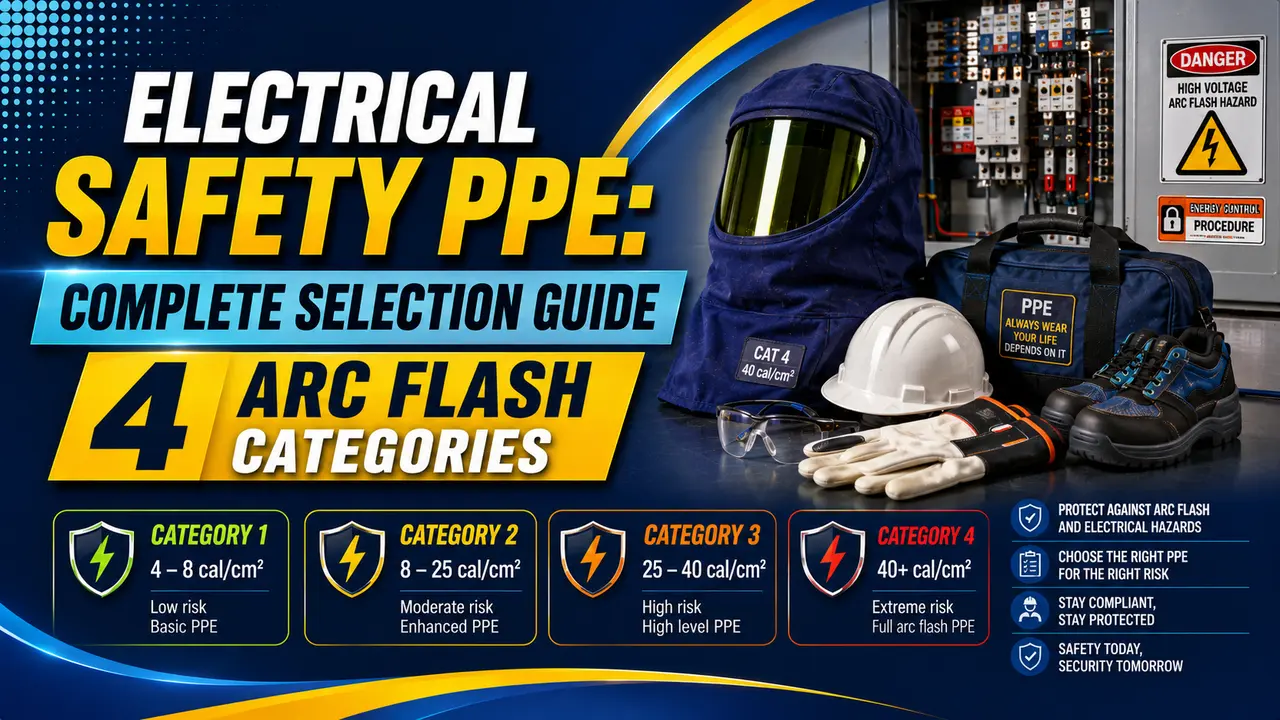
electrical safety PPE

These substitutions feel safe. They are not. This guide removes the guesswork.

2,000+
Arc flash injuries per year in the US alone
40 cal/cm²
Maximum arc energy Category 4 PPE must withstand
1.2 cal/cm²
Energy level at which bare skin gets a second degree burn
30 ms
Time for a 30 mA RCD to trip -- your PPE must survive until then
Advertisement
Advertisement

NFPA 70E Arc Flash PPE Categories: What Each Covers

NFPA 70E classifies electrical PPE into four categories based on the minimum arc thermal performance value (ATPV) required in cal/cm².

Higher category means higher energy hazard. You must match or exceed the required category -- going one level below is not acceptable.

Cat 1
Minimum 4 cal/cm²
  • Arc rated long sleeve shirt or coverall
  • Arc rated face shield or arc flash suit hood
  • Arc rated safety glasses underneath
  • Insulating gloves Class 00 minimum
  • Hard hat, leather safety boots
Cat 2
Minimum 8 cal/cm²
  • Arc rated clothing system: shirt plus pants
  • Arc rated face shield rated 8 cal/cm² or hood
  • Safety glasses underneath face shield
  • Insulating gloves Class 0 minimum
  • Hard hat, hearing protection, leather boots
Cat 3
Minimum 25 cal/cm²
  • Arc rated suit over arc-rated clothing
  • Arc rated balaclava under arc-rated hood
  • Arc flash suit hood rated 25 cal/cm²
  • Insulating gloves Class 1 minimum
  • Hard hat under hood, hearing protection
Cat 4
Minimum 40 cal/cm²
  • Heavy arc-rated suit with full coverage
  • Arc flash suit hood rated 40 cal/cm²
  • Arc rated balaclava, leather work gloves over insulating gloves
  • Insulating gloves Class 2 minimum
  • Leather safety boots rated to arc flash risk
⚠️ Critical Rule
Never wear synthetic fabrics (polyester, nylon, rayon) under arc-rated clothing. Synthetics melt onto skin during an arc flash, causing far worse burns than the arc itself. Only 100% cotton or wool undergarments are acceptable under FR gear.

Insulating Gloves: IEC 60900 Class Selection

Insulating gloves are the most important single item of electrical PPE. They are the last line of defence between your hands and a live conductor.

IEC 60900 defines six glove classes by maximum working voltage. Select the class that covers your system voltage with a comfortable margin -- never work at the upper limit of a class.

Class 00
500V AC
750V DC
Class 0
1,000V AC
1,500V DC
Class 1
7,500V AC
11,250V DC
Class 2
17,000V AC
25,500V DC
Class 3
26,500V AC
39,750V DC
Class 4
36,000V AC
54,000V DC
Leather Protector Gloves
Always wear leather protector gloves over insulating rubber gloves during live work. The leather protects the rubber from mechanical puncture, cuts, and abrasion. The rubber insulates. Both are always worn together -- never the leather alone.

Complete Electrical PPE: Every Item and Its Standard

🧤
Insulating Gloves
IEC 60900
Rubber gloves rated by voltage class. Test by inflation before every use. Replace immediately if cracked, punctured, or beyond the 6 month retest date stamped on the cuff.
🥽
Arc Rated Face Shield
ANSI Z87.1 / NFPA 70E
Must be rated in cal/cm² equal to or exceeding the arc flash category. A standard polycarbonate face shield shatters in an arc event. Only arc-rated shields are acceptable.
👕
Arc Rated (FR) Clothing
ASTM F1506
Flame resistant fabric self extinguishes after when the ignition source is removed. The ATPV rating in cal/cm² must match or exceed the task category. Ordinary workwear is not FR.
⛑️
Insulating Hard Hat
IEC 60900 / ANSI Z89.1
Class E electrical hard hats are rated to 20,000V. Class G is rated to 2,200V. Standard construction hard hats (Class C) offer no electrical protection whatsoever.
🦺
Insulating Safety Footwear
EN ISO 20345
EH rated (Electrical Hazard) boots provide resistance to live conductors at the sole. They must not be confused with anti static boots, which serve the opposite purpose.
🦯
Insulated Tools
IEC 60900
Individually rated to 1,000V AC. Look for the double triangle symbol and voltage rating on every handle. Multi piece composite handles can delaminate -- use factory insulated tools only.
🧯
Voltage Detector (Non Contact)
IEC 61243-3
Used to verify dead before touching any conductor. Test the detector on a known live source before and after every use to confirm it is working. A defective detector is worse than no detector.
🛑
Insulating Matting
IEC 61111
Placed under the operator's feet during live work to break the shock path through the legs to earth. Rated in voltage classes matching glove classes. Must be dry and free of cuts.
🔒
Lockout Tagout Devices
OSHA 1910.147
Padlocks, hasps, and tags that physically prevent re energisation of isolated equipment. Each worker applies their own lock. No lock can be removed except by its owner. See the LOTO guide for full procedure.
Advertisement
Advertisement

PPE Selection Tool: Match Your Task to the Right Equipment

🛡️
Electrical PPE Selection Tool
Select your voltage and task type to see the minimum required PPE
-
-

PPE Pre Use Inspection: What to Check Every Time

🔍 Before Every Use -- Check All Items
Insulating gloves: inflate by rolling cuff toward fingers and check for air leakage at pinholes or cracks
Gloves: confirm the retest date stamp on the cuff has not expired (IEC 60900 requires 6 monthly retesting)
FR clothing: check for holes, tears, contamination with flammable substances (oil, grease, solvent). Contaminated FR clothing must not be worn.
Arc rated face shield: check for scratches, cracks, or discolouration that could impair vision or arc protection
Hard hat: check for cracks, dents, and the manufacture date -- most electrical hard hats must be replaced within 5 years of manufacture
Voltage detector: test on a confirmed live source before use, and again after to confirm it still works
Insulating matting: check for cuts, punctures, or contamination. Dry and clean before placing underfoot.
Insulated tools: check that the insulating coating is intact with no chips, cracks, or exposed metal on handles

PPE Requirements by Voltage Level at a Glance

Voltage LevelMin Glove ClassMin Arc CatHard HatLive Work Permit?
Below 50V AC (SELV)Not required if SELV confirmedNot requiredStandardNo
50V to 1,000V AC (LV)Class 0 (1,000V)Cat 1 minimum, Cat 2 for live workClass G or EYes for live work
1 kV to 3.6 kV (LV/MV boundary)Class 1 (7,500V)Arc flash study requiredClass EYes -- always
3.6 kV to 17 kV (MV)Class 2 (17,000V)Arc flash study required, Cat 4 assumedClass EYes -- HV authorised person
Above 17 kV (HV)Class 3 or 4Site specific HV safety rules applyClass E with arc hoodYes -- formal HV permit

Watch: Electrical PPE Selection and Use

Advertisement
Advertisement

Electrical Safety PPE Questions Engineers Ask

What is the difference between arc-rated and flame resistant clothing?
All arc rated clothing is flame resistant, but not all FR clothing is arc rated. Arc rated clothing carries an ATPV value in cal/cm² showing the maximum arc energy the garment withstands before a second degree burn occurs.
How often must insulating gloves be tested?
IEC 60900 requires retesting every 6 months. The expiry date is stamped on the cuff. Gloves that have passed their retest date must not be used, regardless of how they look.
Can I use ordinary leather gloves for electrical work?
No. Leather gloves alone offer no electrical insulation. They are only worn over IEC 60900 insulating rubber gloves to protect the rubber from mechanical damage. Never use leather gloves as a substitute for insulating gloves.
What does cal/cm² mean on arc-rated PPE?
Calories per square centimetre (cal/cm²) is the unit of arc flash incident energy. PPE rated at 8 cal/cm² protects the wearer from up to 8 cal/cm² of arc energy before a second degree burn would occur.
What is the difference between Class E and Class G hard hats?
Class E hard hats are tested to 20,000V and are needed near high voltage. Class G is tested to 2,200V and suits low voltage work. Class C hard hats have zero electrical protection and must never be used near live equipment.
Is an arc flash study required before all live electrical work?
NFPA 70E recommends an arc flash study for systems above 240V. Without a study result, assume worst case Category 4 PPE. The study result must be shown on a label attached to the equipment.

External References

Advertisement
Advertisement

What We Learn Today

  • NFPA 70E defines 4 arc flash PPE categories: 4, 8, 25, and 40 cal/cm² minimum ATPV -- never go below the required category
  • IEC 60900 insulating gloves have 6 classes from Class 00 (500V AC) to Class 4 (36,000V AC) -- always match to system voltage
  • Leather gloves go over rubber insulating gloves for mechanical protection -- never as a substitute
  • Never wear synthetic fabrics under arc-rated clothing -- they melt onto skin and worsen burns
  • Class E hard hats (20,000V) are required for electrical work -- standard Class C hard hats offer zero electrical protection
  • Every PPE item must be inspected before each use -- especially insulating gloves, which must be inflation tested and within the 6 month retest date
  • An arc flash study per IEEE 1584 is required before live work above 240V -- without one, assume Category 4 as worst case
“PPE is the last line of defence, not the first. The first line is isolation. The second is guarding. PPE exists for when every other control has been considered and live work is the only remaining option.”

Leave a Reply

Your email address will not be published. Required fields are marked *