
A transformer core warms up even with no load connected, and two hidden magnetic effects explain almost all of that heat.
Iron or core loss is the power wasted inside the magnetic core of transformers and motors. It is made of hysteresis loss, from repeated magnetising, and eddy loss, from currents circulating inside the steel.
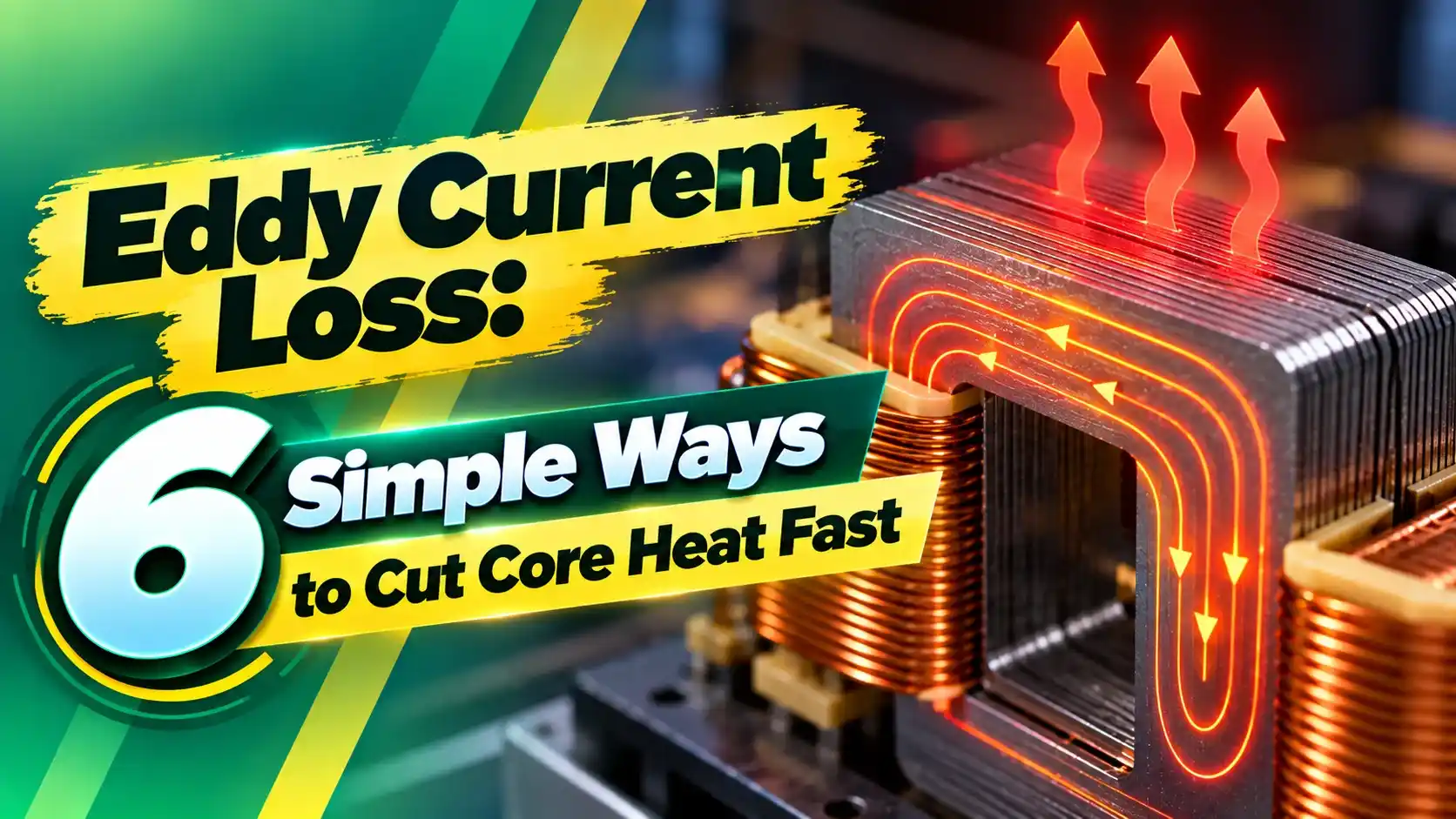
What Is Eddy Current Loss?
Eddy current loss is the heat produced when a changing magnetic flux induces small circulating currents inside a conducting core. These currents flow in closed loops through the steel resistance and waste power as I²R heat, following Ohm law.
The effect follows Faraday law, the same principle that makes a transformer work. Any conductor exposed to alternating flux will carry these unwanted loops.

Electrical4U explains that core losses stay almost constant with load, unlike copper losses in the windings. They depend on voltage and frequency, so they are present whenever the machine is energised.
That is why no load loss appears as a fixed term in transformer efficiency calculation. It is measured in the open circuit test.
What Is Hysteresis Loss?
Hysteresis loss comes from the magnetic domains in the steel reversing direction every half cycle. Some energy is needed to overcome the residual alignment each time, and it is lost as heat.
The area of the B H loop represents the energy lost per cycle per unit volume. Soft magnetic materials with narrow loops, such as silicon steel, keep this loss small.
Core Loss Formulas
Eddy loss Pe = Ke × Bm² × f² × t² × V
Bm = peak flux density, f = frequency, t = lamination thickness, V = core volume
Key effects:
Double the frequency: hysteresis doubles, eddy loss becomes 4 times
Halve the lamination thickness: eddy loss falls to one quarter
Thin laminations and low Bm give the biggest savings
The exponent 1.6 is the classic Steinmetz value, and modern steels use values between 1.5 and 2.5. The square of thickness is why every transformer core is built from thin insulated sheets.
At 60 Hz the eddy part grows faster than the hysteresis part. High frequency cores in switch mode supplies use ferrite, which has very high resistivity.
Eddy Current Loss vs Hysteresis Loss
| Feature | Hysteresis Loss | Eddy Loss |
|---|---|---|
| Cause | Domain reversal | Induced circulating currents |
| Frequency | Proportional to f | Proportional to f² |
| Thickness effect | None | Proportional to t² |
| Reduced by | Low loss steel, amorphous alloy | Thin laminations, high resistivity |
| Load dependence | Constant | Constant |
A study on a 15 kVA distribution transformer at NYU found the eddy share was about 61.5 percent of no load loss. This is higher than the old assumption of a 50 50 split.
Both losses are verified during transformer routine and type tests. Rising core loss over time can point to damaged lamination insulation.
6 Simple Ways to Cut Core Heat
Amorphous core transformers can cut no load loss by about two thirds compared with CRGO. They cost more but pay back in lightly loaded distribution networks.
Motors use the same lamination approach in stator and rotor cores. Better steel is one reason for higher IEC motor efficiency classes.
Where Eddy Currents Are Useful
The inductive proximity sensor is a good example, since its oscillator detects the eddy loss in a nearby metal target.
Loss Separation Calculator
The method works because P ÷ f = a + b × f when flux density is held constant. Plotting several points gives a straight line whose slope is the eddy term.
- Thin insulated laminations.
- Silicon or amorphous steel.
- Moderate flux density.
- Careful cutting and stacking.
- Overvoltage and overfluxing.
- Harmonics at higher frequency.
- Damaged lamination insulation.
- Burrs and core bolts shorting sheets.
NYU Core Loss Separation PDF
Core Losses Video
Eddy Current Loss FAQ
Related Articles
- Transformer Efficiency Calculation
- Transformer Routine and Type Tests
- Inductor Working Principle
- How an AC Induction Motor Works
- Current Transformer Working Principle
External References
- Separation of Core Losses, NYU
- Iron and Copper Loss in Transformer, Electrical4U
- Eddy Current, Wikipedia
What We Learn Today
- Core loss is hysteresis plus eddy heating and stays constant with load.
- Eddy current loss grows with frequency squared and lamination thickness squared.
- Thin silicon or amorphous steel keeps cores cool.