
A utility bill and a UPS nameplate almost never agree on what "power" means, and that mismatch is not a mistake.
Three different numbers, kW, kVAR, and kVA, are all correct at the same time, each describing a different slice of the same electrical system.
Active power (kW) is the real power that performs useful work, reactive power (kVAR) is the power that sustains magnetic and electric fields without doing work, and apparent power (kVA) is the vector sum of both, representing the total power a system's wiring and equipment must actually be rated to carry.
Every AC circuit with any inductance or capacitance splits the current it draws into two components that behave completely differently.
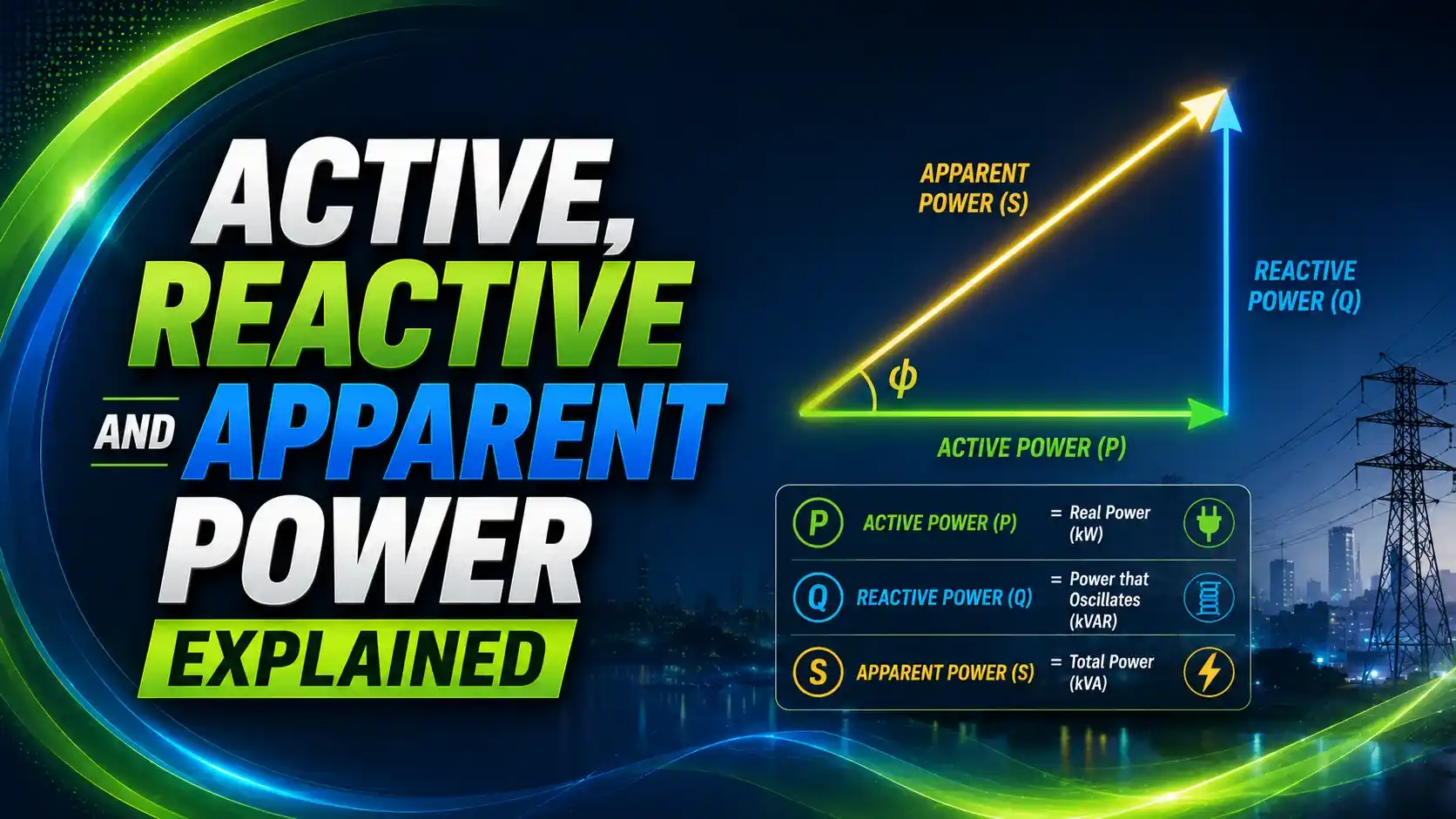
One component stays in phase with voltage and delivers energy that gets converted into heat, light, rotation, or any other useful output. The other component oscillates back and forth between the source and the load's magnetic or electric field, delivering zero net energy over a full cycle, but still flowing through every wire, breaker, and transformer in the circuit.
Per Circuit Globe's explanation of the power triangle, these three quantities, active, reactive, and apparent power, relate to each other through simple right-triangle trigonometry, the same triangle that shows up in power factor and phase angle calculations.
This guide breaks down what each type of power physically represents, the formulas that connect them, and why apparent power, not active power, is what actually determines equipment sizing.
The Three Types of Power, Defined
Active Power
Also called real or true power. The portion that performs actual work: turning a motor shaft, heating an element, lighting a bulb.
Reactive Power
The portion that sustains magnetic fields in inductors and electric fields in capacitors, doing no net work but still drawing current.
Apparent Power
The vector combination of both, and the actual total current-times-voltage the source, wiring, and transformers must be sized to deliver.
The Power Triangle
S² = P² + Q², so S (apparent power) is always equal to or greater than P (active power), and the gap between them is set entirely by the phase angle θ.
Power factor = P ÷ S = cos(θ). A power factor of 1.0 means the triangle collapses flat, all delivered power is active power. As power factor drops, the reactive leg grows and apparent power climbs well above what's actually being put to work.
A Beer Mug Analogy
This classic analogy, referenced across control.com's technical breakdown of power factor, sticks because it captures the core engineering problem directly: a glass full of foam still needs to be exactly as large as one full of beer, even though you only get to drink part of it.
Try It: Power Triangle Calculator
Enter any two known values, active power and power factor, to calculate reactive and apparent power.
A Real Worked Example
A workshop's motor load consumes 80 kW of active power at a power factor of 0.8.
Apparent power S = 80 ÷ 0.8 = 100 kVA. Reactive power Q = √(100² − 80²) = √(10,000 − 6,400) = √3,600 = 60 kVAR.
The utility transformer, service cable, and switchgear feeding this workshop all have to be rated for 100 kVA, even though only 80 kW of it ever does useful work. That extra 20 kVA of headroom is the direct cost of a 0.8 power factor, and it's exactly what a capacitor bank sized to correct power factor would claw back.
Apparent Power at Different Power Factors
The same 100 kW real load demands more and more apparent power capacity as power factor deteriorates. This is precisely why utilities penalize poor power factor: the infrastructure has to be sized for kVA, not kW, so a low power factor customer occupies more grid capacity than their useful energy consumption alone would suggest.
Where Each Power Type Actually Matters
Utility Billing
Energy charges are based on kWh (active power over time), while some tariffs add kVAR-based penalties.
Transformer Sizing
Transformers are rated in kVA, since their windings must carry the full apparent current regardless of power factor.
Cable & Breaker Sizing
Conductor ampacity and breaker ratings are based on the actual RMS current, which apparent power determines.
Generator Sizing
Standby generators are rated in kVA, and their real power output is limited by the connected load's power factor.
UPS Sizing
UPS capacity in kVA must exceed connected kW load by the inverse of the load's power factor.
Capacitor Bank Sizing
Capacitor banks are sized in kVAR specifically to cancel the reactive power component of the triangle.
Do's and Don'ts of Working With Power Types
✓ Do
- Size transformers, generators, and UPS units in kVA, not kW, since apparent power is what they must physically carry
- Remember that S² = P² + Q² describes a right triangle, not a simple sum
- Use power factor correction to reduce apparent power demand without changing active power delivered
- Check utility tariffs for kVAR-based or low power factor penalty charges separately from kWh billing
✗ Don't
- Assume kW and kVA are interchangeable for any load with a power factor below 1.0
- Add active and reactive power arithmetically instead of using the vector (Pythagorean) relationship
- Size equipment against active power alone and ignore the apparent power the source must deliver
- Forget that reactive power, while doing no net work, still consumes real current-carrying capacity
Reference Materials on the Power Triangle
FAQs on Active, Reactive, and Apparent Power
External References
- What is a Power Triangle? Active, Reactive & Apparent Power, Circuit Globe
- Active Power, Reactive Power, Apparent Power, and the Role of Power Factor, control.com
What we learn today
- Active power (kW) does useful work, reactive power (kVAR) sustains fields without doing work, and apparent power (kVA) is their vector sum.
- The relationship follows S² = P² + Q², the same right-triangle math used for phase angle and power factor.
- A worked example shows an 80 kW load at 0.8 power factor requiring 100 kVA of apparent power and 60 kVAR of reactive power.
- Equipment like transformers, generators, and UPS units must be sized in kVA because that reflects the true current they carry.
- Power factor correction reduces apparent power demand for the same active power output, which is why capacitor banks are sized in kVAR.