
Non-Dispersive Infrared (NDIR) is the most widely used technology for continuous measurement of CO, CO2, and CH4 in industrial process gases, flue gases, and environmental monitoring applications.
Unlike electrochemical sensors, an NDIR analyzer has no consumable electrolyte and does not degrade on exposure to the target gas. It provides continuous, stable measurement over years of operation with periodic calibration.
CO absorbs at 4.67 microns, CO2 at 4.26 microns, and CH4 at 3.31 microns. Each gas has a unique absorption fingerprint.
The NDIR analyzer uses these fingerprints without dispersing the infrared spectrum, hence the name non-dispersive.
We will cover how infrared absorption works, the Beer-Lambert Law that governs the signal, the difference between single-beam and dual-beam analyzer designs, cross-gas interference and how it is corrected, calibration procedure, and the main industrial applications of NDIR analyzers.
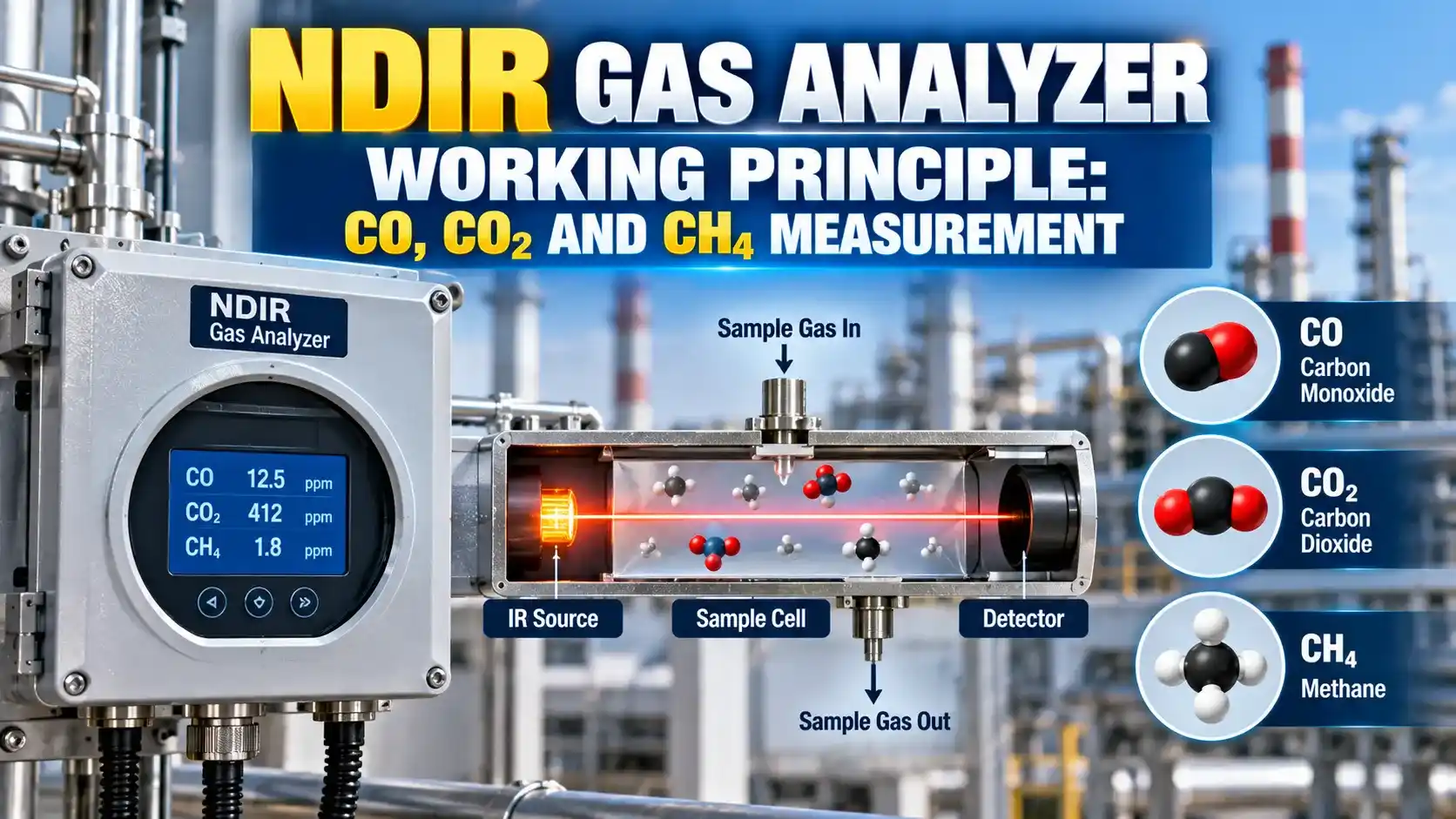
What Is NDIR and Why Is It Non-Dispersive?
Infrared spectroscopy separates light into wavelengths to analyse a gas. An NDIR analyzer does not use this approach.
It uses a broadband source and a bandpass filter to restrict detected wavelengths to the absorption band of the target gas.
The filter does all the wavelength selection. There is no prism, grating, or spectrometer. High selectivity is still achieved by choosing the correct filter for the target gas.
NDIR works only for gases that absorb infrared radiation. Symmetric diatomic molecules (N2, O2, H2) have no dipole moment change during vibration and do not absorb IR.
They are transparent to an NDIR analyzer. CO, CO2, CH4, NO, SO2, N2O, and H2O all absorb IR and can be measured.
Beer-Lambert Law: How NDIR Converts Absorption to Concentration
The NDIR analyzer measures how much infrared light the gas sample absorbs. The relationship between absorption and gas concentration follows the Beer-Lambert Law:
I = I0 x e^(minus kCL)
Where I0 is the initial infrared intensity, I is the detector intensity after passing through the gas, k is the absorption coefficient, C is the concentration, and L is the cell length.
When C is zero, I equals I0 and the detector reads maximum signal. As concentration rises, absorption increases and the detector signal falls. The transmitter converts I/I0 to a concentration reading.
Because the relationship is exponential, sensitivity is highest at low concentrations. This is why NDIR analyzers have a specified measurement range.
Infrared Absorption Bands for CO, CO2 and CH4
Primary absorption band: 4.67 microns
Used for combustion efficiency monitoring (CO in flue gas indicates incomplete combustion), safety monitoring in tunnels and car parks, and CEMS CO measurement.
Cross-interference: CO2 has a weak absorption at 4.67 microns. A compensation filter or correction algorithm is applied when both gases are present.
Primary absorption band: 4.26 microns
Used for combustion control (CO2 in flue gas correlates with air-to-fuel ratio), greenhouse gas monitoring, indoor air quality (IAQ) monitoring, and beverage carbonation control.
Strong absorption band. Water vapour (H2O) has a weak absorption near 4.26 microns moisture is the main interferent in CO2 measurement.
Primary absorption band: 3.31 microns
Used for natural gas leak detection, landfill gas monitoring, biogas quality measurement, and methane concentration in mining ventilation.
Total hydrocarbon analyzers measure a broader hydrocarbon band around 3.4 microns. A CH4-specific filter at 3.31 microns gives methane selectivity over other hydrocarbons.
NDIR Analyzer Design: Components and Signal Path
Single-Beam vs Dual-Beam NDIR Designs
| Parameter | Single-Beam NDIR | Dual-Beam NDIR |
|---|---|---|
| Beam paths | One IR beam passes through the sample cell to one measurement detector | One IR beam splits into two: one passes through the sample cell, one passes through a sealed reference cell (clean nitrogen or target gas) |
| Drift compensation | No built-in drift compensation. Relies on stable source and stable cell window. More frequent calibration needed. | Reference channel continuously corrects for source aging, window contamination, and temperature effects. More stable between calibrations. |
| Typical application | Lower-cost fixed installations where calibration is done frequently, or where short measurement cycles allow regular zeroing | CEMS, process gas measurement, any application requiring continuous unattended operation between periodic calibrations |
| Cost | Lower | Higher: additional detector, beam splitter, and reference cell |
| Sensitivity to window fouling | High: dirt on the cell windows reduces I0 and causes the reading to appear higher than actual (positive error) | Lower: the reference channel tracks the same window fouling and the ratio compensates for most of the error |
Cross-Gas Interference and How It Is Corrected
Cross-gas interference occurs when another gas absorbs infrared radiation near the measurement filter passband. The detector cannot distinguish this from the target gas and reports a reading higher than the actual concentration.
NDIR Analyzer Calibration Procedure
NDIR analyzers require two-point calibration: a zero calibration using a gas that contains no target gas, and a span calibration using a certified reference gas at a known concentration.
kCL: 1.2 x 0.0223 x 0.15 = 0.00401
I/I0: e^(minus 0.00401) = 0.9960
Absorption: 1 minus 0.9960 = 0.40% of incident IR absorbed
Interpretation: At 500 ppm CO in a 150 mm cell, only 0.4% of the IR energy is absorbed. The detector sees 99.6% of the original signal. This small change requires a high-sensitivity detector and a low-noise signal path. This is why NDIR analyzers with longer cells or longer path lengths (via gold-coated reflective cells) are used for low ppm CO measurement.
Industrial Applications of NDIR Gas Analyzers
Watch: Gas Analyzer Calibration Gases for NDIR and Paramagnetic Analyzers
NDIR Gas Analyzer Questions Engineers Ask
Related Articles on This Site
- Gas Analyzers Explained: Types and Working Principles
- Signal Conditioning in Instrumentation Explained
- Why 4-20 mA Is the Best Signal for Industrial Automation
- Hazardous Area Classification: Zone 0, 1 and 2 Explained
- Explosion-Proof vs Intrinsically Safe Instruments
External References
- Structure and Operating Principle of NDIR Gas Analyzer | HORIBA
- How Does an NDIR CO2 Sensor Work? | Forensics Detectors
What We Learn Today
- An NDIR analyzer uses an optical bandpass filter to select the specific infrared wavelength absorbed by the target gas. CO absorbs at 4.67 microns, CO2 at 4.26 microns, CH4 at 3.31 microns. Concentration follows the Beer-Lambert Law: I = I0 x e^(minus kCL).
- A dual-beam design adds a reference channel to compensate for source aging and window fouling by ratioing measurement to reference. Cross-gas interference (especially water vapour) is corrected by sample drying, narrow-bandpass filters, or a mathematical correction using the measured interfering gas concentration.
- NDIR is used for combustion CO and CO2 monitoring, CEMS, methane detection in pipelines and landfills, indoor CO2 air quality, and process gas purity. Calibration uses zero gas (high-purity N2) and a certified span gas at 80 to 90% of full scale at the sample inlet.