NDIR Gas Analyzer Working Principle: CO, CO2 and CH4 Measurement

Share:
Process Analyzers
NDIR Gas Analyzer Working Principle: CO, CO2 and CH4 Measurement

Non-Dispersive Infrared (NDIR) is the most widely used technology for continuous measurement of CO, CO2, and CH4 in industrial process gases, flue gases, and environmental monitoring applications.

Unlike electrochemical sensors, an NDIR analyzer has no consumable electrolyte and does not degrade on exposure to the target gas. It provides continuous, stable measurement over years of operation with periodic calibration.

Beer-Lambert Law IR Absorption Single Beam Dual Beam Cross-Interference

CO absorbs at 4.67 microns, CO2 at 4.26 microns, and CH4 at 3.31 microns. Each gas has a unique absorption fingerprint.

The NDIR analyzer uses these fingerprints without dispersing the infrared spectrum, hence the name non-dispersive.

Hello everyone, today we are going to learn about the NDIR gas analyzer working principle and how it measures CO, CO2 and CH4.

We will cover how infrared absorption works, the Beer-Lambert Law that governs the signal, the difference between single-beam and dual-beam analyzer designs, cross-gas interference and how it is corrected, calibration procedure, and the main industrial applications of NDIR analyzers.
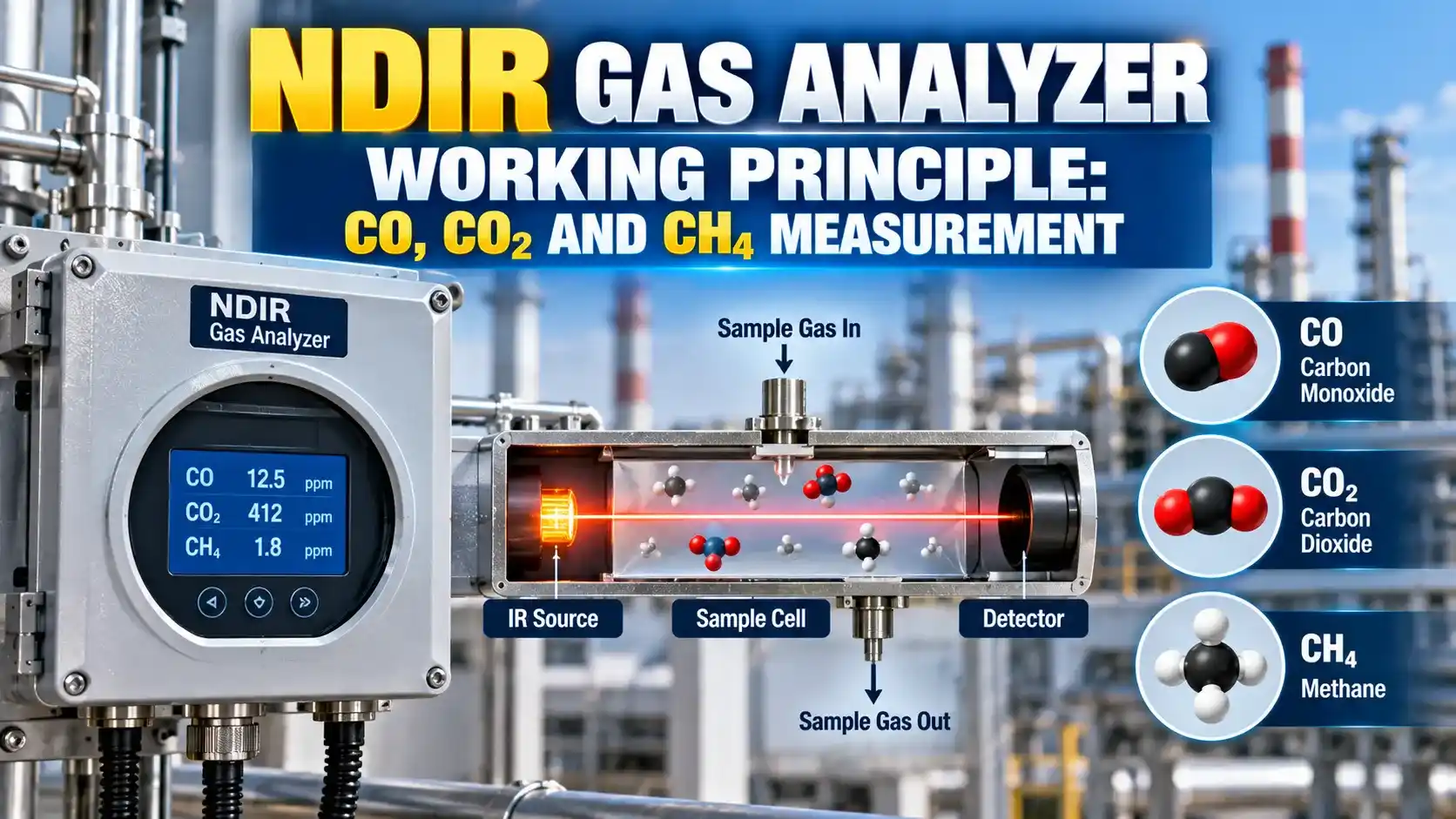
NDIR gas analyzer

What Is NDIR and Why Is It Non-Dispersive?

Infrared spectroscopy separates light into wavelengths to analyse a gas. An NDIR analyzer does not use this approach.

It uses a broadband source and a bandpass filter to restrict detected wavelengths to the absorption band of the target gas.

The filter does all the wavelength selection. There is no prism, grating, or spectrometer. High selectivity is still achieved by choosing the correct filter for the target gas.

NDIR works only for gases that absorb infrared radiation. Symmetric diatomic molecules (N2, O2, H2) have no dipole moment change during vibration and do not absorb IR.

They are transparent to an NDIR analyzer. CO, CO2, CH4, NO, SO2, N2O, and H2O all absorb IR and can be measured.

Advertisement

Beer-Lambert Law: How NDIR Converts Absorption to Concentration

The NDIR analyzer measures how much infrared light the gas sample absorbs. The relationship between absorption and gas concentration follows the Beer-Lambert Law:

I = I0 x e^(minus kCL)

Where I0 is the initial infrared intensity, I is the detector intensity after passing through the gas, k is the absorption coefficient, C is the concentration, and L is the cell length.

When C is zero, I equals I0 and the detector reads maximum signal. As concentration rises, absorption increases and the detector signal falls. The transmitter converts I/I0 to a concentration reading.

Because the relationship is exponential, sensitivity is highest at low concentrations. This is why NDIR analyzers have a specified measurement range.

Infrared Absorption Bands for CO, CO2 and CH4

CO (Carbon Monoxide)

Primary absorption band: 4.67 microns

Used for combustion efficiency monitoring (CO in flue gas indicates incomplete combustion), safety monitoring in tunnels and car parks, and CEMS CO measurement.

Cross-interference: CO2 has a weak absorption at 4.67 microns. A compensation filter or correction algorithm is applied when both gases are present.

CO2 (Carbon Dioxide)

Primary absorption band: 4.26 microns

Used for combustion control (CO2 in flue gas correlates with air-to-fuel ratio), greenhouse gas monitoring, indoor air quality (IAQ) monitoring, and beverage carbonation control.

Strong absorption band. Water vapour (H2O) has a weak absorption near 4.26 microns moisture is the main interferent in CO2 measurement.

CH4 (Methane)

Primary absorption band: 3.31 microns

Used for natural gas leak detection, landfill gas monitoring, biogas quality measurement, and methane concentration in mining ventilation.

Total hydrocarbon analyzers measure a broader hydrocarbon band around 3.4 microns. A CH4-specific filter at 3.31 microns gives methane selectivity over other hydrocarbons.

NDIR Analyzer Design: Components and Signal Path

IR source
A heated filament or pulsed IR LED emits broadband infrared radiation covering all the relevant absorption wavelengths. The source is often modulated (switched on and off at a fixed frequency, typically 2 to 10 Hz) so that the detector sees an AC signal. This allows the detector output to be AC-coupled and amplified, which removes DC drift and reduces noise significantly compared to a continuous-on source.
Sample cell
A tube through which the sample gas flows, typically 20 to 200 mm long depending on the measurement range and the gas absorption coefficient. The cell walls are polished or gold-coated to reflect infrared radiation and increase the effective path length. A longer cell gives higher sensitivity at low concentrations. A shorter cell extends the upper measurement range. Cell windows (sapphire, CaF2, or ZnSe) pass infrared light without absorbing it.
Optical bandpass filter
A narrow-bandpass interference filter placed in front of each detector channel. The filter transmits only the specific infrared wavelength band of the target gas and blocks all other wavelengths. For a CO analyzer, the filter passes 4.67 microns. For CO2, it passes 4.26 microns. For CH4, it passes 3.31 microns. A multi-gas analyzer uses multiple detectors, each with its own bandpass filter, in the same optical path.
Reference channel
In a dual-beam or dual-wavelength design, a second detector channel uses a filter at a wavelength where no target gas absorbs. This reference channel measures source intensity fluctuations (lamp aging, contamination of cell windows) independently of the gas concentration. The measurement signal is ratioed against the reference signal, cancelling common-mode variations and providing a stable, drift-compensated output.
Detector
A pyroelectric detector (lithium niobate or PVDF) or thermopile detects the transmitted infrared energy. Pyroelectric detectors respond to changes in temperature caused by pulsed infrared radiation, which is why source modulation is required. Thermopile detectors can work with continuous sources but have slower response. Both types produce a millivolt signal proportional to the detected infrared intensity.
Signal processor
The signal processor applies the Beer-Lambert conversion to the detector ratio (I/I0), applies cross-interference corrections, applies any temperature or pressure compensation, and outputs the gas concentration as a 4-20 mA signal. Modern NDIR analyzers also provide digital outputs via RS-485, HART, or Profibus. See the HART protocol guide for digital communication details.
Advertisement

Single-Beam vs Dual-Beam NDIR Designs

ParameterSingle-Beam NDIRDual-Beam NDIR
Beam pathsOne IR beam passes through the sample cell to one measurement detectorOne IR beam splits into two: one passes through the sample cell, one passes through a sealed reference cell (clean nitrogen or target gas)
Drift compensationNo built-in drift compensation. Relies on stable source and stable cell window. More frequent calibration needed.Reference channel continuously corrects for source aging, window contamination, and temperature effects. More stable between calibrations.
Typical applicationLower-cost fixed installations where calibration is done frequently, or where short measurement cycles allow regular zeroingCEMS, process gas measurement, any application requiring continuous unattended operation between periodic calibrations
CostLowerHigher: additional detector, beam splitter, and reference cell
Sensitivity to window foulingHigh: dirt on the cell windows reduces I0 and causes the reading to appear higher than actual (positive error)Lower: the reference channel tracks the same window fouling and the ratio compensates for most of the error

Cross-Gas Interference and How It Is Corrected

Cross-gas interference occurs when another gas absorbs infrared radiation near the measurement filter passband. The detector cannot distinguish this from the target gas and reports a reading higher than the actual concentration.

H2O interference
Water vapour is the most significant interferent in NDIR gas measurement. H2O has a broad absorption spectrum that overlaps with the CO2, CO, and CH4 absorption bands. In wet flue gas measurement, H2O content can be 5 to 20% by volume. If not corrected, this produces a significant positive error on CO and CO2 readings. Most process NDIR analyzers use a sample conditioning system to cool and dry the gas before it enters the cell, removing the moisture to below 2% relative humidity before measurement.
CO2 on CO channel
CO2 has a weak absorption overlap near the 4.67 micron CO filter passband. In a flue gas stream where CO2 concentration is 10 to 15% and CO is only 100 to 500 ppm, the CO2 overlap can produce a significant apparent CO reading. Modern analyzers apply a mathematical cross-interference correction: the measured CO2 concentration from the CO2 channel is used to calculate and subtract the expected CO2 contribution from the CO reading.
N2O on CO channel
Nitrous oxide (N2O) absorbs strongly near 4.5 to 4.6 microns, which is close to the CO absorption band at 4.67 microns. In combustion processes where N2O is present (municipal waste incinerators, biomass boilers), the N2O interference on CO must be corrected using a narrow-bandpass filter centred precisely on the CO absorption peak, or with a mathematical correction using the measured N2O concentration.
Pressure and temperature effects
The Beer-Lambert Law assumes constant temperature and pressure. Changes in sample temperature and pressure change the gas density and therefore the effective concentration in the cell. Process NDIR analyzers measure sample temperature and pressure and apply corrections. CEMS applications typically extract and condition the sample at a controlled temperature and pressure before measurement to eliminate these variables.
Window fouling causes a negative reading error in single-beam analyzers: If the cell windows become coated with dust, oil mist, or condensate, the transmitted intensity I decreases independently of any gas absorption. The single-beam analyzer cannot distinguish this from a real increase in gas concentration and reports a falsely high reading. In a dual-beam design, the reference channel tracks the same window fouling and the ratio compensates for most of the error. For single-beam analyzers in dirty environments, window cleaning or replacement frequency must be built into the maintenance schedule.

NDIR Analyzer Calibration Procedure

NDIR analyzers require two-point calibration: a zero calibration using a gas that contains no target gas, and a span calibration using a certified reference gas at a known concentration.

Zero gas
High-purity nitrogen (99.999%) or synthetic air (nitrogen plus 20.9% oxygen) is used as the zero gas. Zero gas must contain less than 1 ppm of the target gas. For CO measurement, the zero gas must also be CO2-free or at a known CO2 concentration, so the cross-interference correction can be properly zeroed. Connect zero gas to the sample inlet, wait for the reading to stabilise (typically 3 to 10 minutes depending on cell volume and flow rate), and adjust the zero trim.
Span gas
A certified reference gas mixture at 80 to 90% of the full-scale measurement range. For a CO analyzer with a 0 to 1000 ppm range, use an 800 to 900 ppm CO in N2 span gas. For a 0 to 20% CO2 range, use a 16 to 18% CO2 in N2 balance span gas. Connect span gas, wait for stabilisation, and adjust span trim. The certified concentration of the reference gas is traceable to a national standard (NIST in the USA, PTB in Germany, NPL in the UK).
Calibration frequency
Most process NDIR analyzers require calibration every 3 to 6 months in clean, conditioned sample gas. CEMS applications under regulatory oversight typically require calibration every 24 hours (zero check) and weekly or monthly full span calibration, with data recorded for the regulatory reporting system. See the signal conditioning guide for sample conditioning system design.
Linearity check
Because the Beer-Lambert relationship is exponential and the analyzer firmware applies a linearisation, a mid-range calibration check (at approximately 50% of full scale) verifies that the linearisation is correct. Any deviation at mid-range greater than the analyzer accuracy specification indicates a damaged cell, a contaminated filter, or a firmware linearisation error that must be corrected before the analyzer is returned to service.
Worked Example: Beer-Lambert Calculation for 500 ppm CO
Conditions: Cell length L = 150 mm = 0.15 m, k (CO at 4.67 microns) = 1.2 m2/mol approximate, C = 500 ppm = 0.0000223 mol/L = 0.0223 mol/m3 at 25 degrees C and 1 atm
kCL: 1.2 x 0.0223 x 0.15 = 0.00401
I/I0: e^(minus 0.00401) = 0.9960
Absorption: 1 minus 0.9960 = 0.40% of incident IR absorbed
Interpretation: At 500 ppm CO in a 150 mm cell, only 0.4% of the IR energy is absorbed. The detector sees 99.6% of the original signal. This small change requires a high-sensitivity detector and a low-noise signal path. This is why NDIR analyzers with longer cells or longer path lengths (via gold-coated reflective cells) are used for low ppm CO measurement.

Industrial Applications of NDIR Gas Analyzers

Combustion monitoring
CO measurement in boiler and fired heater flue gas detects incomplete combustion. Typical CO levels in well-tuned combustion are below 100 ppm. A rise above 200 to 500 ppm indicates a rich air-to-fuel ratio, potential sooting, or a burner fault. CO2 measurement in flue gas is a secondary indicator of combustion efficiency: higher CO2 means less excess air and better fuel utilisation. Both are typically measured simultaneously in a CEMS cabinet alongside an oxygen analyzer.
CEMS
Continuous Emissions Monitoring Systems (CEMS) in power plants, cement kilns, waste incinerators, and refineries use NDIR as the primary technology for CO, CO2, SO2, and NOx measurement. The CEMS extracts, conditions, and delivers a dry, cooled sample to the analyzer cabinet. Regulatory permits specify the measurement ranges, accuracy requirements, calibration frequency, and data availability standards that the CEMS must meet.
Natural gas and methane
CH4 measurement by NDIR is used in natural gas pipeline leak detection, LNG storage facilities, landfill gas quality monitoring (biogas is typically 50 to 65% CH4), and mining ventilation safety. In gas transmission, NDIR CH4 analyzers measure methane purity as part of the gas quality specification. A reading below specification triggers a gas quality alarm and may divert the gas to a different pipeline.
Indoor air quality
CO2 NDIR sensors are widely used in building HVAC control systems. CO2 concentration is a proxy for occupant density and ventilation adequacy. A reading above 1000 ppm in an occupied space indicates inadequate ventilation. The HVAC system increases fresh air supply in response. CO2 measurement by NDIR at this application does not require sample conditioning: the sensor is mounted in the room or the return air duct and samples room air directly.
Process gas purity
CO2 in hydrogen, nitrogen, or argon process gas streams is measured at low ppm levels by NDIR to verify gas purity for chemical reactions, semiconductor fabrication, and fuel cell applications. In the Haber-Bosch ammonia synthesis process, CO and CO2 in the synthesis gas must be below 1 ppm to protect the iron catalyst from poisoning. NDIR with a long-path cell or a cryogenically cooled cell can achieve measurement at sub-ppm levels.
Hazardous area installation
NDIR analyzers measuring flammable gases (CH4, other hydrocarbons) in hazardous area classified zones must be ATEX or IECEx certified. In-situ NDIR analyzers for Zone 1 and Zone 2 are available in Ex d or Ex ia protection. The analyzer cabinet itself requires area classification and either an Ex d enclosure or purging and pressurisation (Ex p) if installed in the classified area. See the explosion-proof vs intrinsically safe guide for selection rules.

Watch: Gas Analyzer Calibration Gases for NDIR and Paramagnetic Analyzers

Advertisement

NDIR Gas Analyzer Questions Engineers Ask

What does NDIR stand for and why is it non-dispersive?
NDIR stands for Non-Dispersive Infrared. It is non-dispersive because it does not use a prism or grating to separate infrared light into its component wavelengths. Instead, an optical bandpass filter in front of the detector selects only the specific wavelength absorbed by the target gas, providing selectivity without dispersion.
Why can an NDIR analyzer not measure O2 or N2?
Oxygen (O2) and nitrogen (N2) are symmetric diatomic molecules. Their molecular vibrations do not produce a change in dipole moment, so they do not absorb infrared radiation. NDIR requires infrared absorption to generate a signal. O2 is measured by paramagnetic, zirconia, or electrochemical methods instead.
What is cross-gas interference in an NDIR analyzer and how is it corrected?
Cross-gas interference occurs when another gas absorbs near the measurement filter passband. The analyzer reports a false reading. Correction uses a narrow-bandpass filter, a mathematical correction using the measured interfering gas concentration, or sample conditioning to remove the interferent.
What are the infrared absorption wavelengths for CO, CO2 and CH4?
CO absorbs at 4.67 microns. CO2 absorbs at 4.26 microns. CH4 absorbs at 3.31 microns. These are the primary absorption bands used for NDIR measurement of each gas. Each wavelength is unique enough to allow selective measurement with a narrow optical bandpass filter at that wavelength.
What is the advantage of a dual-beam NDIR design over a single-beam design?
A dual-beam design adds a reference channel that monitors source intensity independently of gas absorption, compensating for source aging and window fouling by ratioing measurement to reference. A single-beam design has no drift compensation and requires more frequent calibration.

Related Articles on This Site

External References

Advertisement

What We Learn Today

  • An NDIR analyzer uses an optical bandpass filter to select the specific infrared wavelength absorbed by the target gas. CO absorbs at 4.67 microns, CO2 at 4.26 microns, CH4 at 3.31 microns. Concentration follows the Beer-Lambert Law: I = I0 x e^(minus kCL).
  • A dual-beam design adds a reference channel to compensate for source aging and window fouling by ratioing measurement to reference. Cross-gas interference (especially water vapour) is corrected by sample drying, narrow-bandpass filters, or a mathematical correction using the measured interfering gas concentration.
  • NDIR is used for combustion CO and CO2 monitoring, CEMS, methane detection in pipelines and landfills, indoor CO2 air quality, and process gas purity. Calibration uses zero gas (high-purity N2) and a certified span gas at 80 to 90% of full scale at the sample inlet.
I hope you like above blog. There is no cost associated in sharing the article in your social media. Thanks for reading!! Happy Learning!!

Leave a Reply

Your email address will not be published. Required fields are marked *