Zirconia Oxygen Analyzer Working Principle and Industrial Applications

Share:
Process Analyzers
Zirconia Oxygen Analyzer Working Principle and Industrial Applications

A zirconia oxygen analyzer measures flue gas oxygen concentration using a heated zirconium dioxide ceramic cell that conducts oxygen ions at temperatures between 600 and 850 degrees C.

It is the most widely used online oxygen measurement technology in combustion control, replacing manual flue gas sampling with a continuous, real-time signal that allows the air-to-fuel ratio to be optimised automatically.

Nernst Equation In-Situ Probe Combustion Control Reference Air Calibration

The zirconia cell output follows a logarithmic relationship with oxygen concentration. At 2% flue gas oxygen at 650 degrees C, the output is approximately 47 mV.

At 5% oxygen it falls to approximately 28 mV.

The transmitter applies the Nernst equation to convert millivolts to a percentage oxygen reading.

Hello everyone, today we are going to learn about the zirconia oxygen analyzer working principle and its industrial applications.

We will cover how the zirconia cell generates a voltage proportional to the oxygen concentration difference between two sides of the ceramic, how the Nernst equation converts this voltage to a percentage reading, the difference between in-situ and extractive analyzer types, calibration procedure, and the main applications in combustion control and process gas monitoring.
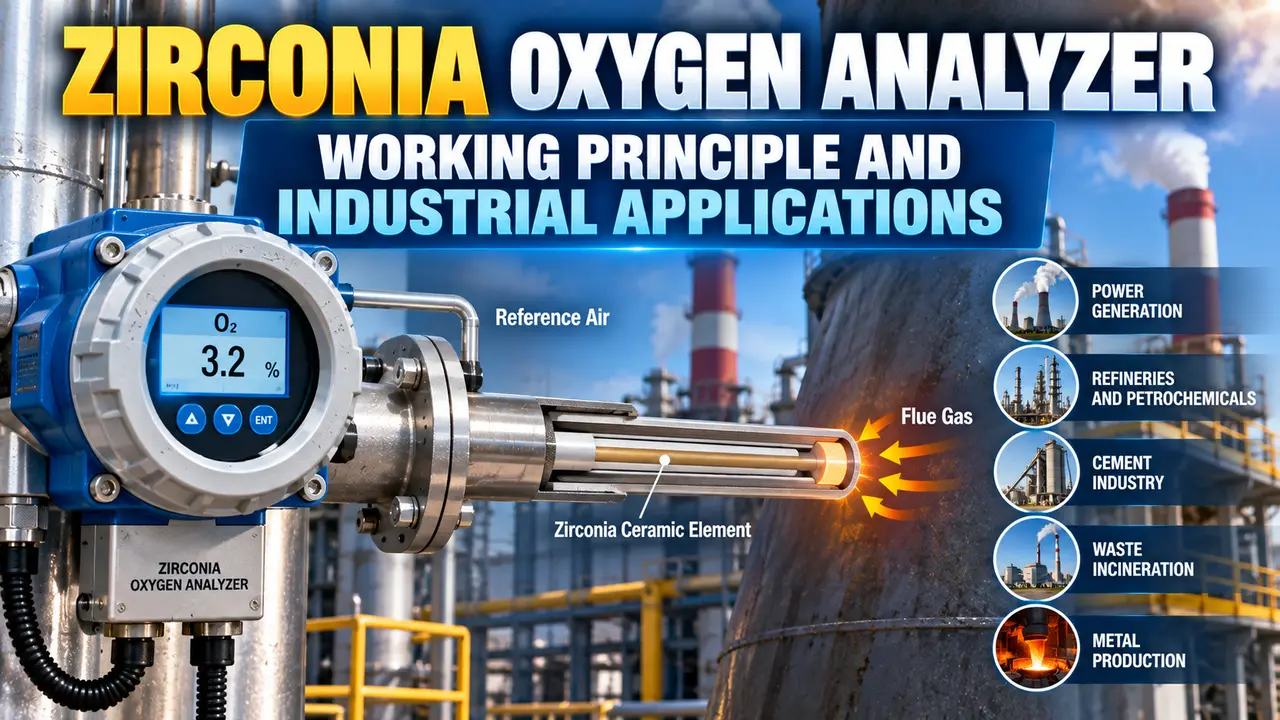
zirconia oxygen analyzer

Zirconia Oxygen Analyzer Working Principle

The zirconia oxygen analyzer uses a solid electrolyte cell made from zirconium dioxide (ZrO2) stabilised with yttrium oxide.

Above 600 degrees C, the crystal lattice allows oxygen ions to migrate from a region of high to low oxygen partial pressure.

The cell has two platinum electrodes, one on each face of the ceramic. One side is exposed to the flue gas. The other is exposed to reference air at 20.9% oxygen.

When the oxygen concentration on the measurement side differs from the reference side, ions migrate through the ceramic and generate a potential difference between the two electrodes.

This voltage is described by the Nernst equation:

EMF (mV) = 0.0496 x T x log (P_ref / P_sample)

Where T is the cell temperature in Kelvin, P_ref is the reference side oxygen partial pressure (20.9% for air), and P_sample is the measurement side oxygen partial pressure.

The cell temperature is controlled by an internal heater to a setpoint (typically 650 to 750 degrees C) so that T is known accurately.
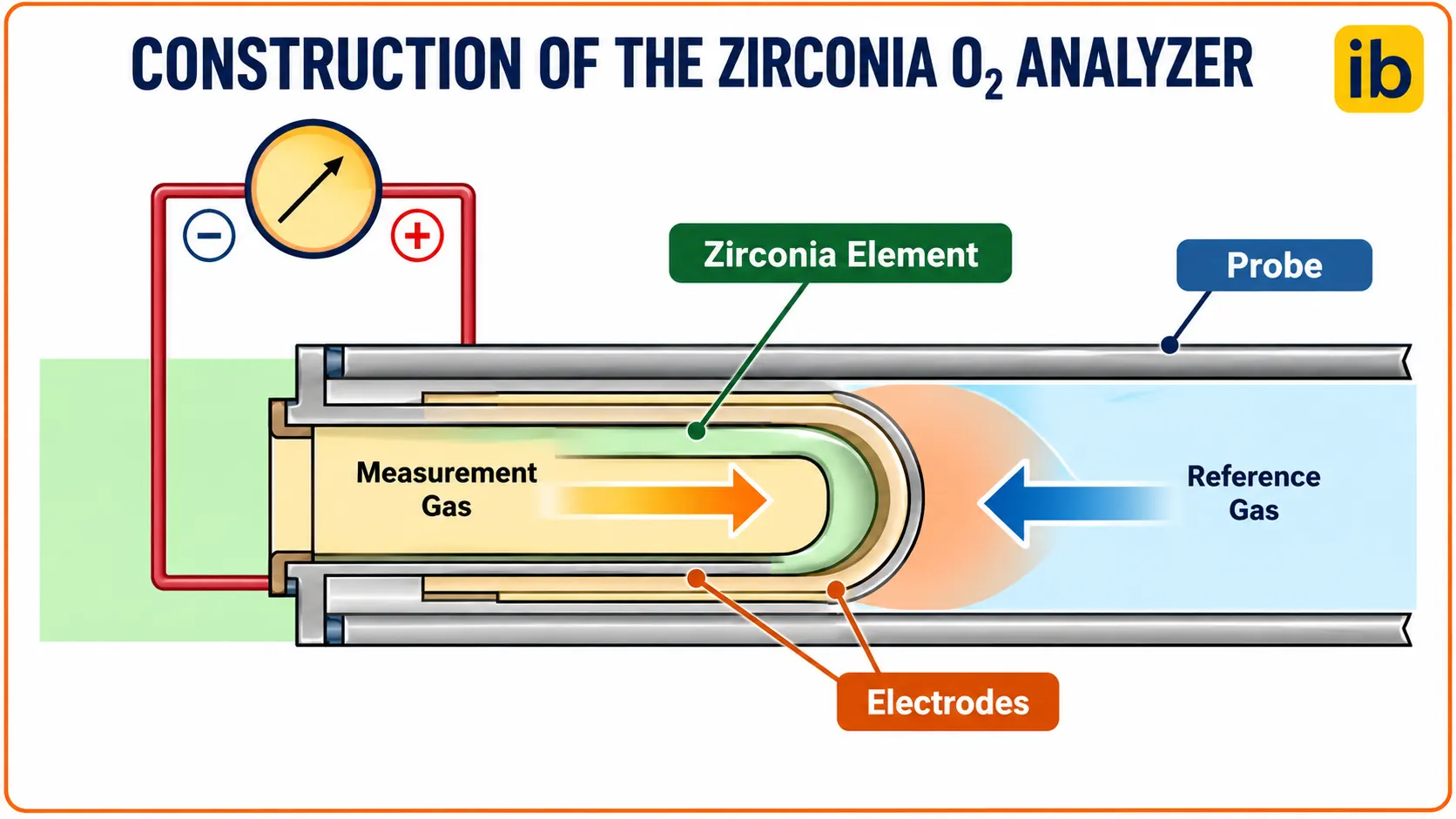
zirconia oxygen analyzer working principle
Advertisement

Nernst Equation: Worked Examples

Understanding the Nernst equation helps explain why the zirconia analyzer output is logarithmic and why calibration is important at both the high and low end of the measurement range.

Worked Example 1: 2% Flue Gas Oxygen
Cell temperature: 650 degrees C = 923 K
Reference oxygen: 20.9% (air)
Sample oxygen: 2.0%
P_ref / P_sample: 20.9 / 2.0 = 10.45
log (10.45): 1.019
EMF: 0.0496 x 923 x 1.019 = 46.7 mV
Interpretation: 46.7 mV at 923 K corresponds to 2.0% O2. The DCS receives a 4-20 mA signal scaled by the transmitter to this reading.
Worked Example 2: 5% Flue Gas Oxygen
Cell temperature: 650 degrees C = 923 K
Reference oxygen: 20.9% (air)
Sample oxygen: 5.0%
P_ref / P_sample: 20.9 / 5.0 = 4.18
log (4.18): 0.621
EMF: 0.0496 x 923 x 0.621 = 28.4 mV
Interpretation: 28.4 mV at 923 K corresponds to 5.0% O2. A furnace targeting 3% excess O2 would use a setpoint between these two values.

In-Situ vs Extractive Zirconia Analyzers

In-Situ Probe Analyzer

The zirconia cell is mounted on a probe inserted directly into the flue gas duct through a flanged nozzle. No sample conditioning system is required.

Fast response (typically 5 to 15 seconds). No sample pump, no sample line, no moisture separator. The most common type in boiler, furnace, and fired heater service.

Extractive (Ex-Situ) Analyzer

A sample is withdrawn from the duct through a probe, conditioned (cooled, dried, filtered) by a sample conditioning system, and then passed through the zirconia cell in an analyser cabinet.

Slower response due to sample transport time. Used where the gas must be conditioned (very wet or corrosive), or where multiple gas components are measured in the same cabinet.

In-Situ Probe Construction and Installation

Probe tube
A stainless steel or Inconel tube, typically 300 to 1200 mm insertion length, protects the zirconia cell from mechanical damage and allows the probe to reach the centre of the gas flow. The probe is installed through a flanged nozzle (typically DN50 or DN80) welded to the duct wall. The cell is at the probe tip.
Filter at tip
A sintered ceramic or metal filter at the probe tip prevents fly ash, particulates, and condensed moisture from reaching the cell. The filter must be inspected and cleaned at regular intervals because blinding of the filter increases the lag between a change in flue gas oxygen and the analyzer reading. A blocked filter is one of the most common causes of slow analyzer response.
Cell heater
An electric resistance heater inside the probe maintains the ZrO2 cell at the rated operating temperature (typically 650 to 750 degrees C). A thermocouple inside the probe monitors the cell temperature. If the heater fails or the cell temperature drops out of range, the analyzer output is invalid. The heater control loop is a critical diagnostic check during commissioning and routine maintenance.
Reference air
A small flow of clean, dry instrument air is piped to the inside of the probe as the reference gas. This air contacts the reference electrode of the ZrO2 cell. The reference air flow is typically 0.5 to 2 L/min. The reference air must be free of oil, moisture, and combustible gases. Contamination of the reference air side with combustible gases will cause the cell to read low.
Transmitter head
The transmitter electronics are housed in a weatherproof or Ex-rated enclosure mounted at the top of the probe or on an adjacent stand. The transmitter converts the millivolt cell output and the cell temperature to a percentage O2 reading using the Nernst equation, and outputs a 4-20 mA signal to the DCS. See the 4-20 mA signal guide for loop wiring details.
Combustible gas interference: The zirconia cell reads low when combustible gases (CO, H2, unburned hydrocarbons) are present in the flue gas. At high temperatures, these gases react with oxygen at the measurement electrode surface, consuming some of the oxygen before it is measured. This makes the reading appear lower than the true flue gas oxygen level. When the combustion system is running rich (insufficient air), or during startup and shutdown transients, the analyzer reading should be interpreted with this in mind. Some analyser types add a catalytic combustor ahead of the cell to convert combustibles to CO2 and H2O before measurement, producing a more accurate reading in these conditions.
Advertisement

Calibration Procedure for a Zirconia Oxygen Analyzer

Zirconia analyzers use two-point calibration: a zero gas (0 or 2% O2 in nitrogen) and a span gas (8% or 21% O2). Both gases connect to the sample port of the probe.

Zero gas
Typically nitrogen with 0% oxygen or a certified 2% O2 / N2 balance mixture. Connected to the sample port of the probe or cell. The analyzer output should read the certified gas concentration within the analyzer accuracy specification (typically plus or minus 0.1 to 0.5% O2 absolute).
Span gas
Typically 8% O2 / N2 balance or clean dry air at 20.9% O2. The span gas is connected after the zero has been confirmed. The analyzer output should match the certified span gas concentration. The transmitter span adjustment is made if the reading differs from the certified value.
Calibration interval
Most plant standards specify calibration every 3 to 6 months for in-situ probes in clean flue gas, or every 1 to 3 months where the filter is prone to blinding or the process has significant combustion upsets. A calibration should always be performed after any maintenance work on the probe or transmitter, and after the heater has been replaced.
Cell condition check
During calibration, note the cell impedance (resistance). A new ZrO2 cell has an impedance of a few ohms at operating temperature. An aged or cracked cell has an impedance of hundreds of ohms to kiloohms. High cell impedance is a sign that the cell is near end of life. Most modern transmitters measure and display cell impedance as a diagnostic parameter.
Calibration gas handling: Never apply zero calibration gas (0% O2 in nitrogen) to the reference air port of the probe. The reference air port must always remain connected to clean instrument air. Connecting zero gas to the reference port will cause the cell to read a false high oxygen concentration because the oxygen partial pressure ratio is inverted. Connect calibration gas to the sample gas port only, following the manufacturer's calibration procedure for the specific probe type.

Industrial Applications of Zirconia Oxygen Analyzers

Combustion control
The primary application. Boilers, fired heaters, kilns, and furnaces use flue gas O2 measurement to trim the air-to-fuel ratio in a closed loop. Typical setpoints are 2 to 3% O2 for gas-fired boilers and 3 to 6% for oil-fired boilers and kilns. Running below the setpoint risks incomplete combustion and CO emission. Running above wastes fuel by heating excess air. A 1% reduction in excess O2 typically reduces fuel consumption by 0.5 to 1%.
Fired heaters
Refinery and petrochemical fired heaters use zirconia O2 analyzers at the arch of the radiant section or at the convection section outlet. The O2 reading feeds a cross-limiting air-fuel control scheme that prevents the air flow from falling below a safe minimum before the fuel flow is increased, protecting the heater from a rich atmosphere in the firebox.
Power plant boilers
Multiple O2 probes are installed around the circumference of large utility boilers to detect uneven air distribution across the burner array. The O2 reading interacts with boiler drum level and steam flow control loops in the overall boiler automation hierarchy. An average of multiple probe readings feeds the main combustion control loop. Individual probe readings are used to detect burner faults where one zone reads significantly different from the others.
Cement and glass kilns
High-temperature rotary kilns in cement and glass manufacturing use zirconia probes rated for operating temperatures up to 1400 degrees C at the kiln outlet. Controlling kiln O2 ensures complete combustion of fuel while limiting excess air that reduces kiln temperature and productivity.
Gas purity monitoring
In inert gas blanketing systems, nitrogen generators, and gas storage vessels, zirconia analyzers monitor oxygen at low ppm levels to verify that inert atmosphere quality is maintained. A typical purity monitoring application measures 0 to 1000 ppm O2 in a nitrogen or argon stream.
Environmental monitoring
Stack emissions monitoring systems use zirconia O2 measurement as one channel of a Continuous Emissions Monitoring System (CEMS). The O2 reading is used to correct other emissions concentrations (NOx, SO2, CO) from measured to a standardised reference oxygen level (typically 3% or 6% O2 reference, as required by the applicable emission regulation).

Zirconia Analyzer vs Other Oxygen Measurement Technologies

TechnologyMeasurement PrincipleTypical RangeBest Application
Zirconia (in-situ)Nernst electrochemical cell, solid electrolyte O2 ion conduction at 650 to 750 degrees C0.1% to 25% O2High-temperature flue gas, combustion control, direct duct installation
ParamagneticOxygen is strongly paramagnetic; dumbbell suspended in magnetic field deflects proportional to O2 content0 to 100% O2High-accuracy laboratory and process O2, clean dry gas only, no high temperature
Electrochemical cell (galvanic)Oxygen reacts at a cathode in an electrolyte, generating a current proportional to O2 concentration0 to 25% O2Portable safety monitors, ambient air O2 measurement, lower-cost fixed installations
Optical (tunable diode laser)Laser beam crosses the gas path; O2 absorption at a specific wavelength is measured0 to 25% O2Cross-stack measurement in large ducts, non-contact, no sample conditioning
Fluorescence quenchingO2 quenches the fluorescence of a dye excited by UV light; quenching rate proportional to O20 to 100 ppm to 25%Dissolved oxygen in water, low-concentration O2 in liquids

Watch: How to Calibrate a Zirconia Oxygen Analyzer

Advertisement

Zirconia Oxygen Analyzer Questions Engineers Ask

How does a zirconia oxygen analyzer measure oxygen concentration?
The ZrO2 ceramic cell conducts oxygen ions from the high-oxygen reference side (air at 20.9%) to the low-oxygen flue gas side when heated to 650 to 750 degrees C. This generates a voltage described by the Nernst equation. The transmitter converts this voltage and cell temperature to a percentage oxygen reading.
What is the purpose of reference air in a zirconia probe?
The reference air (instrument air at 20.9% O2) provides a known fixed oxygen partial pressure on one face of the ZrO2 cell. The cell voltage is generated by the ratio of this reference to the flue gas oxygen. Without a stable reference, the Nernst equation cannot produce an accurate reading. Reference air contamination causes systematic errors.
Why does a zirconia oxygen analyzer read low in the presence of CO or unburned hydrocarbons?
CO and unburned hydrocarbons react with oxygen at the hot measurement electrode, consuming some O2 before it is measured. The cell sees less oxygen than is in the flue gas and reports a lower reading. A catalytic combustor ahead of the cell converts combustibles to CO2 and water, eliminating this error.
What does a high cell impedance reading indicate on a zirconia analyzer?
A new ZrO2 cell has low impedance (a few ohms) at operating temperature. As the cell ages, cracks develop and impedance rises to hundreds of ohms or more. High impedance means the cell is approaching end of life and should be replaced. Most transmitters display cell impedance as a diagnostic.
What is a typical flue gas oxygen setpoint for combustion control?
Gas-fired boilers typically target 2 to 3% excess O2 in the flue gas. Oil-fired boilers and kilns target 3 to 6%. Running below the setpoint risks incomplete combustion and CO emission. Running above wastes fuel. Each 1% reduction in excess O2 typically reduces fuel consumption by 0.5 to 1%.

Related Articles on This Site

External References

Advertisement

What We Learn Today

  • The zirconia analyzer uses a ZrO2 cell heated to 650 to 750 degrees C. Oxygen ions migrate from the reference side (20.9% O2) to the flue gas side, generating a voltage per the Nernst equation (EMF = 0.0496 x T x log P_ref/P_sample). The transmitter converts this to a percentage O2 reading.
  • In-situ probes insert directly into the flue gas duct with no sample conditioning system, giving fast response (5 to 15 seconds). The probe filter, cell heater, reference air supply, and cell impedance are the four key maintenance checks for in-situ probes.
  • Zirconia analyzers serve combustion control, fired heater air-fuel trimming, cement and glass kilns, gas purity monitoring, and CEMS O2 correction. Cell impedance is the main aging indicator. Calibration uses zero gas (0 to 2% O2) and span gas (8% or 20.9% O2) at the sample port.
I hope you like above blog. There is no cost associated in sharing the article in your social media. Thanks for reading!! Happy Learning!!

Leave a Reply

Your email address will not be published. Required fields are marked *