
The location and orientation of a pressure transmitter relative to the process tap is the single biggest factor affecting measurement accuracy in the field.
A correctly specified transmitter can still produce errors of 0.5 to 2% if the impulse lines are routed incorrectly or the tap position is wrong.
Installation best practices for pressure transmitters differ depending on whether the fluid is a gas, liquid, or steam.
Each service requires a different transmitter position, impulse line slope, and ancillary equipment to get a reliable reading.
We will cover the correct transmitter position and impulse line orientation for each fluid type, the role of condensate pots in steam service, common installation mistakes, and a comparison of the key rules across all three services.
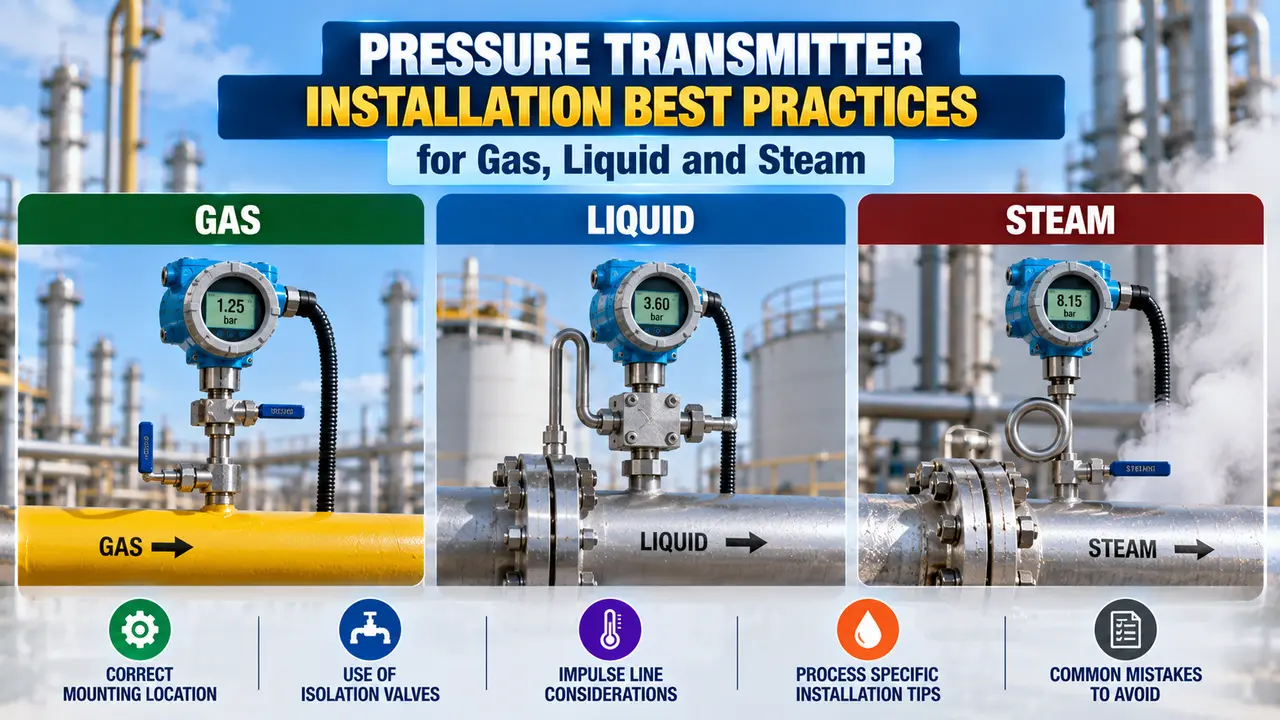
Pressure Transmitter Installation Best Practices: The Three Service Types
Mount transmitter above the tap. Impulse line slopes downward toward the tap. Condensate drains back to the process, not into the transmitter.
Mount transmitter below the tap. Impulse line slopes upward toward the tap. Air bubbles rise back to the process, keeping the line full of liquid.
Mount transmitter below the tap. Use a condensate pot to buffer steam from the sensor. Impulse line slopes downward toward the pot, then to the transmitter.
Gas Service Installation Rules
For gas pressure measurement, the transmitter must be installed above the process tap. The tap itself should be on the top or upper side of the pipe.
Any condensate that enters the line drains back toward the tap and away from the transmitter. If mounted below the tap, condensate would collect and create a false liquid head error.
Liquid Service Installation Rules
For liquid pressure measurement, the transmitter must be installed below the process tap. The tap should be on the side of the pipe, not the top or bottom.
The impulse line slopes upward from the transmitter to the tap, keeping it full of liquid. Any gas bubble that enters rises back to the process.
Steam Service Installation Rules
Steam service has the most demanding installation requirements. Steam must never contact the transmitter sensing element directly.
A condensate pot is installed between the steam tap and the transmitter. It fills with condensate and forms a liquid buffer, keeping steam away from the diaphragm.
Comparison: Gas vs Liquid vs Steam Installation Rules
| Rule | Gas Service | Liquid Service | Steam Service |
|---|---|---|---|
| Tap position | Top or upper side of pipe | Side of pipe | Upper half of pipe |
| Transmitter position | Above the tap | Below the tap | Below the condensate pot |
| Impulse line slope | Downward toward tap (1:10 min) | Upward toward tap (1:10 min) | Downward to pot, then to transmitter |
| Main risk to avoid | Condensate pooling in low points | Gas bubble trapped in high points | Steam reaching the transmitter directly |
| Special equipment | Drain trap if moisture is high | None for standard service | Condensate pot required |
| Temperature concern | Usually not an issue | Cool transmitter away from hot liquid | Never heat trace impulse lines |
| Commissioning step | Drain any test water before startup | Vent air from impulse line at startup | Pre-fill condensate pot with water |
Other Common Installation Mistakes to Avoid
Watch: Pressure Transmitter Installation for Gas, Liquid and Steam
Pressure Transmitter Installation Questions Engineers Ask
Related Articles on This Site
- Condensate Pot in Steam Applications Explained
- Differential Pressure Transmitter Working Principle
- Pressure Transmitter Temperature Effect on Accuracy
- Pressure Transmitter Loop Check Procedure
- Basics of Differential Pressure Transmitter
External References
- Best Practices to Extend the Life of Pressure Transmitters | AIChE CEP
- Pressure Transmitter Installation Guide | Sino-Inst
What We Learn Today
- Gas service: transmitter above the tap, impulse line sloping down. Liquid service: transmitter below the tap, impulse line sloping up. Steam service: condensate pot required, transmitter below the pot.
- Impulse lines must slope at minimum 1:10. No high points in liquid service (traps gas). No low points in gas service (traps liquid). Steam service: slope toward the condensate pot.
- In steam service, pre-fill the condensate pot before opening the process valve. Never heat trace steam impulse lines. Always mount on a vibration-free stand and use shielded signal cable.