
Low pressure transmitter selection presents challenges that high pressure applications rarely face. At pressures below 100 mbar, small errors from temperature changes, mounting position, or incorrect zero calibration become large percentages of the measured span.
This guide covers the five key factors for selecting a low pressure transmitter, with a worked example, comparison table, and an interactive selection advisor.
Low pressure transmitter selection requires careful attention to zero stability, sensor technology, and the effect of mounting orientation -- errors that are negligible at high pressure become dominant at spans below 10 mbar.
Why Low Pressure Transmitter Selection Demands Extra Care
A low pressure transmitter working at 5 mbar span faces different problems than a 100 bar unit.
A mounting position change of just 5 cm creates a hydrostatic head of roughly 0.5 mbar -- which is 10% of that span. That same tilt is invisible on a high pressure installation.
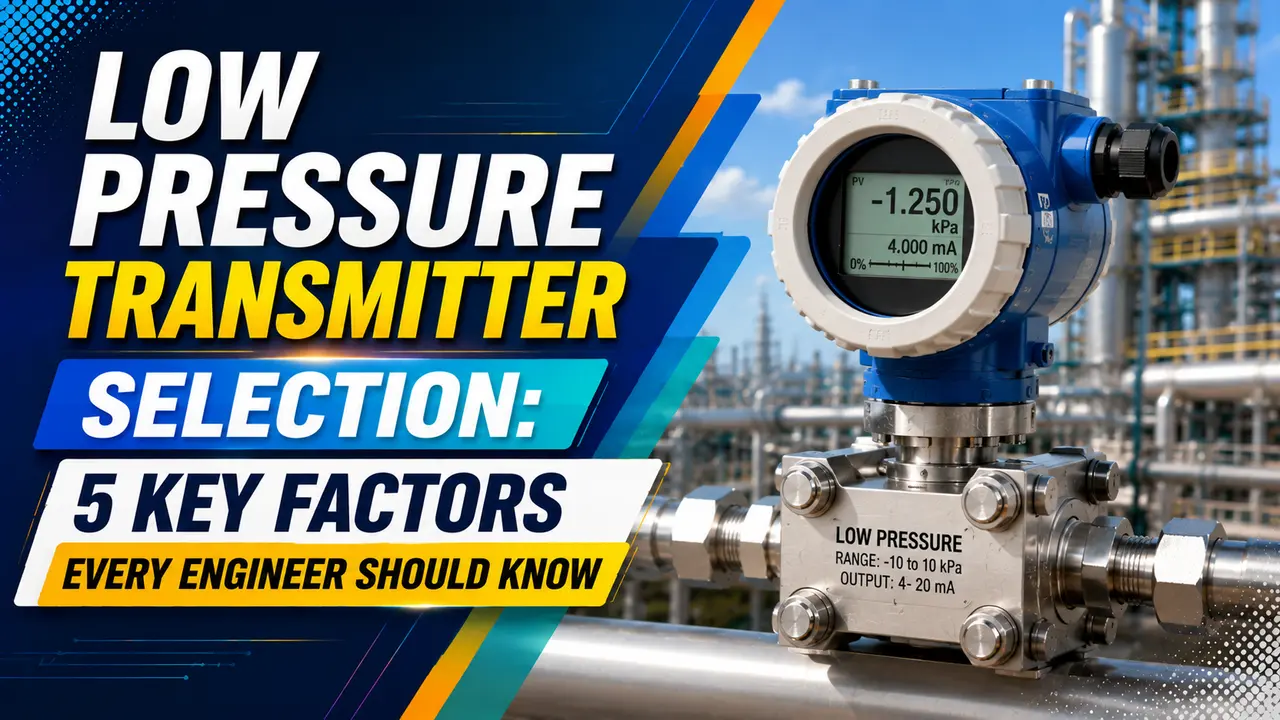
Three factors define whether a zero drift is tolerable, whether the chosen sensor technology survives the process, and whether the pressure range and direction match the actual duty. Click any term to expand.
5 Key Factors in Low Pressure Transmitter Selection
Factor 1: Measurement Type and Pressure Direction
The first step is defining whether the measurement is gauge, differential, absolute, or bidirectional.
Gauge pressure is measured relative to local atmosphere. Differential pressure measures the difference between two process points. Absolute pressure references true zero (vacuum).
Bidirectional pressure swings between positive and negative gauge values -- common in HVAC duct monitoring.
Choosing the wrong type produces readings that are systematically wrong by the full atmospheric offset (~1013 mbar) -- a common commissioning error. See the pressure transmitter types guide for the full classification.
Factor 2: Sensor Technology for Low Pressure Spans
Capacitive Ceramic
The most common choice in the 1 to 100 mbar range. The ceramic diaphragm deflects under small pressures and changes capacitance measurably. Excellent chemical resistance and good long term stability. Not suitable below 1 mbar.
MEMS Capacitive (Micro machined)
Silicon micro machined diaphragm with on chip electronics. Suitable for very low pressure measurement -- ranges from 0.1 mbar down to a few Pa. Very small, fast response, low power. Temperature sensitivity higher than ceramic types -- ensure adequate compensation is included.
Piezoresistive Silicon
Standard for process transmitters across a wide range. Suitable above about 10 mbar. Below this, temperature effects on the silicon gauge factor become a significant percentage of span. Requires careful temperature compensation circuitry.
Thermal Conductivity Sensor
Measures pressure indirectly via the thermal conductivity of the gas -- used only for very low absolute pressures (below 1 mbar absolute, vacuum applications). Gas type dependent -- calibrated for a specific gas. Not suitable for differential or gauge measurement in standard process applications.
Factor 3: Zero Stability and Temperature Effect
Zero stability is the most critical specification at low pressure spans.
At a span of 10 mbar, a zero drift of 0.1 mbar represents 1% of reading.
The same drift on a 1,000 mbar span is 0.01% -- invisible. Always check the zero drift specification in mbar or Pa, not as a percentage of URL.
Example 2: Drift = 0.1 mbar, Span = 100 mbar → Error = 0.1% of reading
Example 3: Drift = 0.5 mbar, Span = 5 mbar → Error = 10% of reading -- unacceptable
Also check: temperature effect on zero (mbar/°C) and temperature effect on span (% of reading/°C)
Temperature effect on zero is particularly critical for outdoor low pressure installations or for transmitters mounted in areas with significant temperature swing. See the temperature effect guide for how ambient temperature change translates to measurement error at low spans.
Factor 4: Mounting Position and Hydrostatic Error
At low pressure spans, mounting position is a selection factor, not just an installation detail.
A 10 cm height difference creates a hydrostatic head of roughly 1 mbar in air filled impulse lines, or up to 10 mbar in water filled lines.
On a 5 mbar span, 1 mbar is 20% of the reading. This error can be trimmed at commissioning but must be understood first.
Mount the transmitter as close to the process tap as possible, at the same height, with sensing ports horizontal.
See the installation tips guide and the zero elevation and suppression article for trimming position errors.
Factor 5: Overpressure Rating
Overpressure specification must account for process upsets -- often overlooked at small pressure spans.
A unit on a 10 mbar span may see full line pressure if an upstream valve opens unexpectedly.
Most manufacturers specify overpressure of 10x to 50x the span. Verify this covers the actual line pressure -- a mismatch destroys the sensing element permanently.
For filter monitoring, the maximum dirty filter differential pressure can briefly spike well above the normal operating range when a filter is bypassed or backflushed. Specify the overpressure rating accordingly. See the span drift article for how overpressure events cause permanent span shift.
Low Pressure Error Budget Calculator
Low Pressure Transmitter Selection: Comparison Table
| Parameter | Below 10 mbar | 10 to 100 mbar | 100 mbar to 1 bar |
|---|---|---|---|
| Sensor technology | MEMS capacitive, thermal (for vacuum) | Capacitive ceramic, MEMS piezoresistive | Piezoresistive silicon, capacitive ceramic |
| Zero drift concern | Critical -- dominates error budget | Significant -- specify in mbar, not % URL | Moderate -- standard process transmitter acceptable |
| Mounting position effect | Critical -- mount at tap height, eliminate impulse lines where possible | Significant -- horizontal ports, short impulse lines | Minor -- standard installation acceptable |
| Bidirectional range needed? | Often yes (HVAC, cleanroom) | Often yes (HVAC, building pressurisation) | Usually no -- positive gauge or differential only |
| Overpressure ratio | Minimum 50x span -- process upsets are catastrophic at this scale | Minimum 10 to 20x span | Standard 2 to 5x URL |
| Typical applications | Cleanroom monitoring, airflow measurement, laboratory pressure control | HVAC duct pressure, filter differential, building pressurisation | Low pressure vessels, fermenters, sanitary DP measurement |
Common Applications for Low Pressure Transmitters
HVAC Duct Static Pressure
Variable air volume (VAV) systems use duct static pressure to control fan speed. Typical span: 5 to 50 mbar. Bidirectional range is often needed. Transmitter must be stable over a wide ambient temperature range and tolerant of vibration from nearby fans and ductwork.
Cleanroom Differential Pressure
Pharmaceutical cleanrooms must maintain differential pressure relative to adjacent areas to control contamination. Typical span: 5 to 15 Pa.
This is the most demanding low pressure application -- MEMS sensors and direct wall mounting are required. See the signal conditioning guide.
Filter Differential Pressure Monitoring
Monitoring the differential pressure across a filter indicates fouling. Clean filter DP is typically 2 to 5 mbar; high alarm triggers at 20 to 50 mbar.
A wide URL (up to 100 mbar) with good low-end accuracy covers the full filter service life. See the DP transmitter basics.
Bioreactor and Fermenter Pressure
Fermentation vessels operate at low positive gauge pressure (20 to 200 mbar) to prevent contamination ingress.
Sanitary flush diaphragm transmitters with Tri Clamp connections and CIP/SIP rated seals are required. FDA and EHEDG surface finish requirements also apply to wetted parts.
Watch: Pressure Transmitter Selection Guide
Low Pressure Transmitter Selection Questions
External References
- Low Differential Pressure Transmitters for HVAC and Building -- Dwyer Instruments
- Low Pressure Transmitter Selection Guide -- Setra Systems
What We Learn Today
- Low pressure transmitter selection must specify zero drift in mbar or Pa, not just as % of URL -- the percentage of reading is what matters at small spans
- Sensor technology: capacitive ceramic for 1 to 100 mbar, MEMS capacitive for below 1 mbar, piezoresistive above 10 mbar only
- Mounting position error: 1 cm height in water filled line = 0.1 mbar error -- critical below 10 mbar span
- Bidirectional range is essential for HVAC and cleanroom applications where pressure can be positive or negative
- Overpressure rating must cover the maximum possible line pressure, not just the measurement span times 10
- Eliminate impulse lines below 10 mbar where possible -- mount the transmitter directly at the process tap