
A standard thermocouple or RTD installed in a hazardous area without the correct protection concept is a potential ignition source for a flammable atmosphere.
The two most common protection concepts are Ex d (flameproof) and Ex ia (intrinsically safe). Each controls the ignition risk differently and imposes different constraints on the sensor, wiring, and associated transmitter.
Selecting the wrong protection concept for a hazardous area temperature sensor is a safety failure, not just a compliance issue.
Understanding Ex d and Ex ia is essential for any instrument engineer in oil, gas, and chemical industries.
We will cover what each protection concept means, how it applies to thermocouple and RTD assemblies, the zone classifications where each is used, the temperature class marking system, and a full comparison table to help you specify the right sensor for your application.
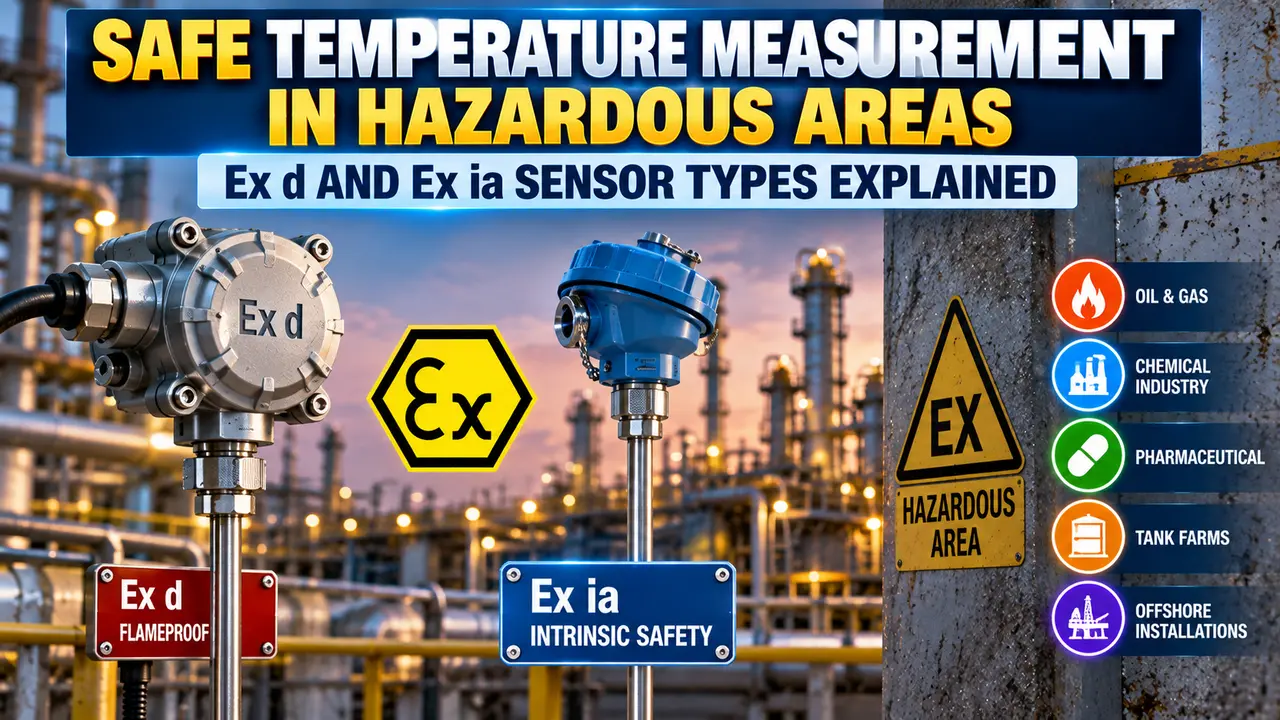
Why Hazardous Area Temperature Sensors Need Special Protection
A hazardous area contains, or may contain, a flammable atmosphere: a mixture of flammable gas, vapour, or dust with air in a proportion that can ignite.
Three elements are needed for ignition: a flammable substance, oxygen, and an ignition source.
Electrical equipment is a potential ignition source through two mechanisms: a spark from an electrical fault, or a hot surface exceeding the ignition temperature of the surrounding atmosphere.
Temperature sensors introduce both risks. The connection head contains terminals that can arc under fault. A sensor on a hot process can transfer heat to its external surfaces.
The IEC 60079 series defines the protection concepts, equipment groups, zones, and temperature classes governing all electrical equipment in hazardous areas.
ATEX is the European directive that mandates IEC 60079 compliance. IECEx is the international certification scheme.
Zone Classification and What It Means for Sensor Selection
The hazardous area zone classification determines what protection concepts are permitted for equipment in that location.
| Zone | Definition | Frequency of Hazardous Atmosphere | Equipment Categories Permitted |
|---|---|---|---|
| Zone 0 | Flammable gas or vapour present continuously or for long periods | Greater than 1000 hours per year | Category 1G only (e.g. Ex ia, Ex ma) |
| Zone 1 | Flammable gas or vapour likely to be present under normal operation | 10 to 1000 hours per year | Category 1G or 2G (e.g. Ex ia, Ex d, Ex e) |
| Zone 2 | Flammable gas or vapour not likely in normal operation; only in abnormal conditions | Less than 10 hours per year | Category 1G, 2G or 3G (e.g. Ex ia, Ex d, Ex e, Ex n) |
| Zone 20 | Flammable dust present continuously or for long periods | Greater than 1000 hours per year | Category 1D only |
| Zone 21 | Flammable dust likely under normal operation | 10 to 1000 hours per year | Category 1D or 2D |
| Zone 22 | Flammable dust not likely in normal operation; only in abnormal conditions | Less than 10 hours per year | Category 1D, 2D or 3D |
Zone 0 is the most demanding and permits only a small set of protection concepts. Ex d is not permitted in Zone 0 because sparks may escape during head opening.
Ex ia prevents energy from ever reaching an ignition level and is therefore Zone 0 permissible.
Ex d (Flameproof) Temperature Sensors
The Ex d protection concept works by containment. If a flammable mixture enters the connection head and ignites, the head is designed to contain the explosion without rupturing.
The enclosure achieves this through thick walls with precise flame path geometries at every joint and cable entry.
The flame path is a narrow gap long enough to cool any escaping hot gases below the ignition temperature before they reach the outside.
How Ex d Applies to Thermocouple and RTD Assemblies
Ex ia (Intrinsically Safe) Temperature Sensors
The Ex ia concept works by energy limitation. The electrical energy in the circuit is kept below the ignition level for the most sensitive gas group mixture.
This limit holds under normal operation and under up to two simultaneous faults.
Unlike Ex d, which contains ignition after it occurs, Ex ia prevents ignition from occurring. This makes Ex ia the safest common protection concept and the only one permitted in Zone 0.
How Ex ia Applies to Thermocouple and RTD Assemblies
Temperature Class (T-Class) and Why It Matters
The temperature class specifies the maximum surface temperature of equipment under the worst normal operating conditions. The surrounding flammable atmosphere must have an auto-ignition temperature above this T-class value.
| Temperature Class | Maximum Surface Temperature | Example Gases at Risk |
|---|---|---|
| T1 | 450 degrees C maximum | Methane (537 degrees C AIT). T1 equipment is safe for most common gases. |
| T2 | 300 degrees C maximum | Ethyl alcohol (365 degrees C AIT). Covers most hydrocarbons safely. |
| T3 | 200 degrees C maximum | Petrol (246 degrees C AIT). The most common T-class in oil and gas plants. |
| T4 | 135 degrees C maximum | Acetaldehyde (175 degrees C AIT). Used where lower AIT gases may be present. |
| T5 | 100 degrees C maximum | Carbon disulfide (90 degrees C AIT T5 not sufficient for CS2). |
| T6 | 85 degrees C maximum | Diethyl ether (160 degrees C AIT). T6 covers nearly all common flammable gases. |
The T-class applies to the connection head, not to the sensor element.
A thermocouple at 800 degrees C process temperature may have a T6 Ex d head if the head is thermally isolated by sufficient sheath length.
Where the head temperature cannot be guaranteed to stay within the T-class limit, an extended neck assembly or thermal barrier between the head and the process must be specified.
Ex d vs Ex ia for Temperature Sensors: Full Comparison
Heavy-walled certified head. Zone 1 and Zone 2 only. Not permitted in Zone 0. No IS barrier required. Cannot be opened while energised. Certified cable glands and conduit seals required.
Sensor is simple apparatus requiring no individual cert. Zone 0, 1 and 2 permitted. IS barrier mandatory in the safe area. Dedicated IS wiring required. Can be opened live in zone.
| Parameter | Ex d Flameproof | Ex ia Intrinsically Safe |
|---|---|---|
| Protection method | Contains ignition inside the enclosure | Prevents ignition by limiting energy |
| Zone 0 permitted? | No | Yes (Ex ia only, not Ex ib or Ex ic) |
| Zone 1 permitted? | Yes | Yes |
| Zone 2 permitted? | Yes | Yes |
| Sensor certification | Head must be ATEX/IECEx certified | Sensor is simple apparatus (no individual cert needed) |
| Safe area barrier required? | No | Yes: Zener barrier or galvanic isolator |
| Can be opened live? | No: must de-energise before opening | Yes: live maintenance permitted |
| Cable type required | Standard multicore with certified Ex d glands | IS cable (typically blue), segregated from non-IS circuits |
| Conduit seal required? | Yes, within 450 mm of entry | Not required for IS circuits |
| Entity parameter check? | Not required | Required: barrier Co/Lo must exceed cable + sensor Ci/Li |
| Typical application | Zone 1 and 2 process plants where live maintenance is not required | Zone 0 locations, offshore applications, and sites requiring live maintenance access |
How to Read the ATEX Marking on a Temperature Sensor
Every ATEX-certified temperature sensor carries a marking that encodes the protection concept, equipment group, category, gas group, and temperature class. Reading it correctly is essential for verifying suitability for the installed zone.
Watch: Flameproof (Ex d) Solutions in Hazardous Areas Explained
Hazardous Area Temperature Sensor Questions Engineers Ask
Related Articles on This Site
- Hazardous Area Classification: Zone 0, 1 and 2 Explained
- ATEX vs IECEx: Key Differences Explained
- Temperature Classes in Hazardous Areas Explained
- Basics of Thermocouples and RTD Explained
- Thermocouple Grounded vs Ungrounded Junction
External References
- RTD and Thermocouple Certification for Hazardous Locations | Ashcroft
- Hazardous Area Temperature Sensors: Ex d and Ex ia | Pyrosales
What We Learn Today
- Ex d temperature sensors use a certified heavy-walled head to contain internal ignition. Permitted in Zone 1 and Zone 2 only. The head must not be opened while energised. Certified Ex d cable glands and conduit seals are required at every cable entry.
- Ex ia temperature sensors are simple apparatus requiring no individual certification. A certified IS barrier in the safe area is mandatory. Ex ia is permitted in Zone 0, 1 and 2, and the sensor can be opened live without de-energising.
- The ATEX marking encodes the equipment group, category, protection concept, gas group, and temperature class. All must be verified against the zone classification, the process gas AIT, and the site hazardous area classification before installation.