
Product quality is often known only when a lab sample comes back hours later, long after the process has drifted. A model built from temperatures, pressures and flows can estimate that quality every few seconds instead.
Some key variables, such as composition, viscosity or melt index, are expensive or slow to measure. Virtual sensors calculate them from easy measurements that the DCS already collects.

What Is a Soft Sensor?
A soft sensor, also called a virtual sensor or inferential measurement, is a software model that estimates a hard to measure process variable in real time from other measured variables. It combines process data from the process historian with statistical or machine learning methods.
Automation World, citing TrendMiner, notes that most designs rely on five regression methods: linear regression, decision trees, random forests, gradient boosting and neural networks. There is no single best model for every process.
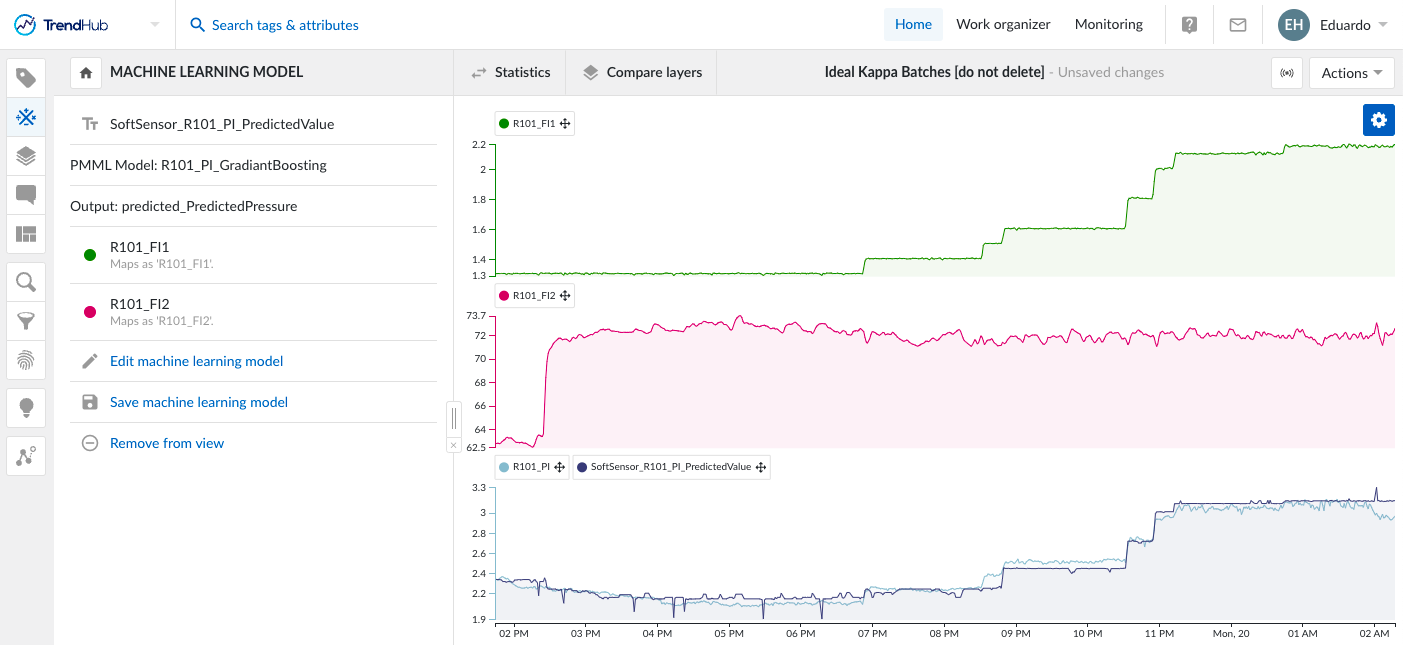
The soft sensor output becomes a normal DCS tag that operators can trend and alarm. It can also feed control loops, as long as its quality is monitored.
Kadlec, Gabrys and Strandt describe data driven soft sensor models as a major tool for online prediction, process monitoring and sensor fault detection.
Why Plants Use Them
Automation World highlights estimating lab properties when staff are short, and backing up fouled physical sensors. Both give quick returns.
Estimates in the loop allow quality control through cascade control, where the model output drives a temperature or flow set point.
6 Smart Steps to Build a Soft Sensor
Time alignment is the most common pitfall. A lab sample reflects conditions minutes or hours before it was taken.
Input selection benefits from engineering judgement, not only algorithms. Consider sensor linearity and reliability of each input.
Model Types Compared
| Model | Strength | Weakness |
|---|---|---|
| Linear or PLS regression | Simple, explainable | Misses strong nonlinearity |
| Decision trees and random forests | Handle nonlinearity | Step like outputs |
| Gradient boosting | High accuracy | Needs careful tuning |
| Neural networks | Complex relationships | Needs lots of data, less transparent |
| First principles hybrid | Uses physics | More engineering effort |
Start with a simple soft sensor and move to complex models only if accuracy demands it. Operators trust models they can understand, and simple models are also easier to maintain when the plant changes.
Hybrid models combine physics with data, a step toward a digital twin.
Keeping the Estimate Accurate
Bias updating with a filter prevents one bad lab result from jumping the estimate. Large, lasting errors mean the process has changed and the model needs retraining.
Linear Model Example
Example, column top impurity in percent:
a = 12.4, b1 = minus 0.085 per °C, b2 = 0.9 per bar
Tray temperature x1 = 128 °C, pressure x2 = 1.8 bar
Estimate = 12.4 minus 10.88 + 1.62 = 3.14 percent
Lab result 3.00 percent, error 0.14 percent
Even this simple model can guide operators between lab samples. Confidence limits help them know when to trust it.
Estimate Calculator
Enter negative coefficients with the minus key in the input box. Replace the values with your own regression results.
- Continuous quality estimates.
- Lower analyzer costs.
- Backup for failed instruments.
- Enables tighter control.
- Drift after process changes.
- Poor data alignment.
- Overfitted models.
- Operator mistrust.
Running models at the edge or in the cloud is compared in edge AI vs cloud AI.
Kadlec Review PDF on Data Driven Models
Virtual Sensor Video
Soft Sensor FAQ
Related Articles
- AI and Machine Learning
- AI in PLC, SCADA and DCS
- Digital Twin in Automation
- What Is a Process Historian
- Edge AI vs Cloud AI
External References
- Data Driven Models in the Process Industry, Bournemouth University
- Virtual Sensors and Machine Learning Models, Automation World
- Virtual Sensing, Wikipedia
What We Learn Today
- A soft sensor estimates hard to measure variables from process data.
- Clean, time aligned data matters more than complex algorithms.
- Bias updates and monitoring keep estimates trustworthy.