Skin Temperature Measurement: Thermocouple Pad vs Surface Sensor

Share:
Temperature Measurement
Skin Temperature Measurement: Thermocouple Pad vs Surface Sensor

Skin temperature measurement reads the outer surface of a pipe, vessel, or tube without penetrating the wall or contacting the process fluid.

Two sensor types dominate this application: the welded thermocouple pad used in high-temperature furnace and boiler tube service, and the clamp-on or adhesive surface sensor used for portable monitoring and HVAC applications.

Skin Thermocouple Weld Pad Surface Sensor Pipe Clamp Tube Temperature

Skin temperature differs from process fluid temperature depending on pipe wall thickness, insulation, fluid velocity, and heat flux. Understanding this difference is essential before interpreting any surface measurement result.

Hello everyone, today we are going to learn about skin temperature measurement and the difference between a thermocouple pad sensor and a clamp-on or adhesive surface sensor.

We will cover how each sensor type works, what it measures, where each is the better choice, the main sources of error in surface temperature measurement, and a full comparison table to help you select the right sensor for your application.
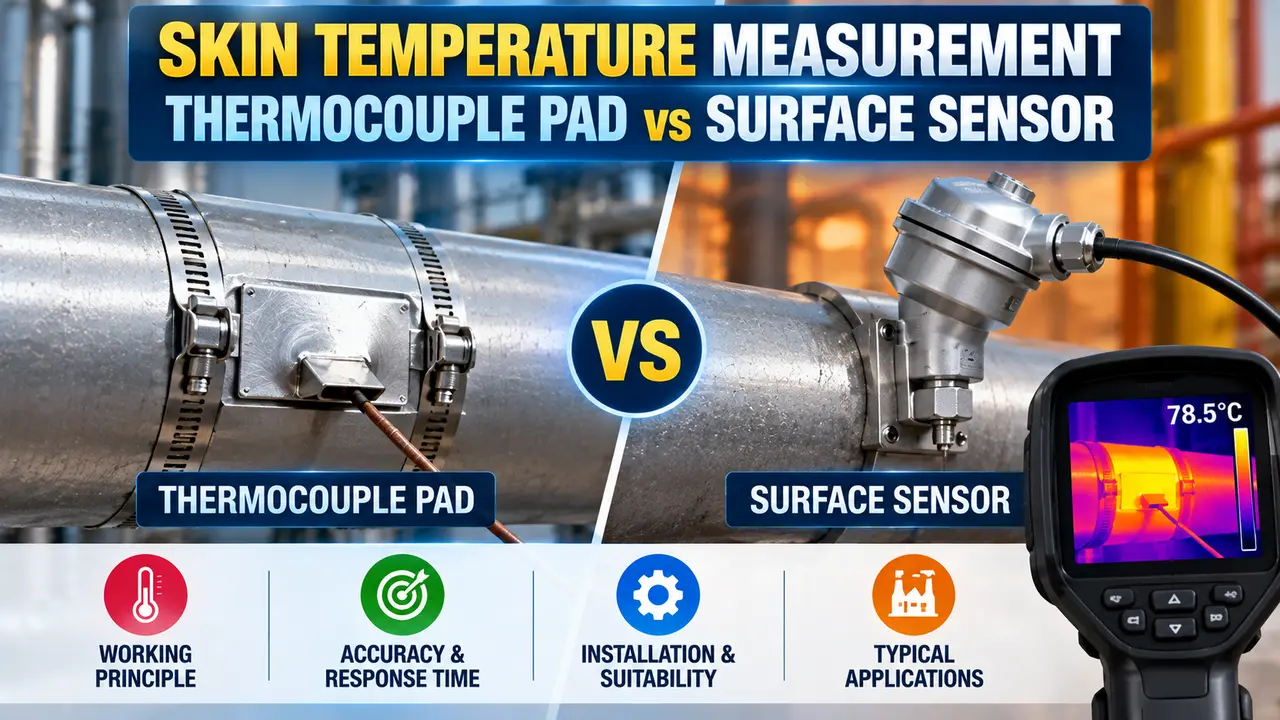
skin temperature measurement

What Is Skin Temperature Measurement?

Skin temperature is the temperature at the outer surface of a pipe, vessel wall, tube, or any other solid object. It is not the same as the temperature of the fluid inside.

The difference depends on the wall material, thickness, heat flux, and any insulation on the outside.

In a well-insulated pipe carrying hot fluid, the outer skin may be near ambient temperature even when the fluid inside is at 300 degrees C.

Skin temperature measurement is used mainly for monitoring furnace tube integrity, detecting heat tracing faults on cold-service lines, energy auditing to quantify heat loss, and detecting blocked process lines.

Advertisement

Two Sensor Types: Thermocouple Pad vs Surface Sensor

Thermocouple Pad (Skin Thermocouple)

A welded assembly where the thermocouple hot junction is held against the tube surface by a metal pad. The pad is welded to the tube and is not removable without cutting.

Used in high-temperature furnace tubes, boiler superheater tubes, reactor tubes, and any application where a permanent, high-accuracy surface measurement is required at temperatures up to 1200 degrees C.

Clamp-On or Adhesive Surface Sensor

A surface thermocouple or RTD held against the pipe by a spring clamp, worm-gear clamp, cable tie, or adhesive tape. The sensor is removable and reusable. No welding is required.

Used in HVAC monitoring, heat tracing verification, energy audits, and temporary measurement on process lines where welding is not permitted or practical.

Thermocouple Pad (Skin Thermocouple): Construction and Installation

A thermocouple pad sensor consists of a mineral insulated (MI) thermocouple cable with a flat or V-shaped metal pad welded to the sheath at the hot junction end.

The pad is designed to be welded directly to the tube or pipe surface so the thermocouple hot junction is in intimate metallic contact with the metal being monitored.

The MI cable runs from the pad along the tube surface to a head enclosure or terminal block, protected by mounting clamps welded at intervals along the tube.

An expansion loop or coil is formed in the cable to absorb the thermal movement of the tube as it heats and cools during operation.

Pad Design Types

Flat weld pad
A flat rectangular metal pad welded to the sheath. The pad is pressed against a flat surface or a large-diameter pipe where the surface curvature is small relative to the pad dimensions. The most common pad type for vessel walls and flat surfaces. A thin layer of high-temperature cement or thermal paste fills any gap between the pad and the surface.
V-pad (knife pad)
A machined V-shaped block welded to the sheath. The V-shape matches the curvature of a cylindrical tube, creating a line contact weld between the pad and the tube without requiring the pad to be machined to the tube radius. Suitable for any tube diameter. Provides full penetration welding contact and eliminates the air gap at the junction that reduces accuracy in flat pad designs.
Weld button pad
A small circular pad welded at a single point to the tube. Simpler and lower-cost than the V-pad. Less accurate because the contact area is smaller and the heat flux path from the tube to the junction is longer. Used in lower-accuracy monitoring applications on large tubes where cost per measurement point is important.
Heat shield
A curved metal shield placed over the pad and junction area. The shield prevents convective heat from the furnace flame or flue gas from adding to the measured temperature. Without a heat shield, the thermocouple junction reads a combination of the tube surface temperature and the radiant and convective heat from the flame, giving a reading higher than the true tube metal temperature. In fired heater applications, a heat shield is mandatory for accurate tube skin monitoring.
Expansion loop
A formed loop or coil in the MI cable between the pad and the first mounting clamp. As the tube heats up and elongates, the loop flexes and absorbs the movement without pulling the pad off the tube or stressing the MI cable. Without an expansion loop, thermal growth pulls the cable tight and eventually lifts the pad from the tube surface, breaking the thermal contact and causing the reading to drift low.
Mounting clamps
Small metal clamps welded to the tube at regular intervals (typically every 300 to 600 mm). The MI cable passes through or under these clamps, which hold the cable close to the tube surface. Keeping the cable close to the tube reduces the temperature gradient along the cable and minimises the conduction error caused by heat flowing from the junction toward the cooler cable.
Skin thermocouple TC type selection for high-temperature service: For furnace tubes above 600 degrees C, specify Type N or Type K thermocouple. Type N (Nickel-Chromium-Silicon) has significantly better drift stability than Type K at high temperatures, particularly above 800 degrees C where Type K is susceptible to the 'short-range order' phenomenon that causes irreversible drift of 1 to 3 degrees C per 100 hours of service. For tube skin temperatures above 1000 degrees C, specify Type S or Type R (platinum-rhodium) in a refractory-packed assembly. See the thermocouple transmitter configuration guide for TC type selection and transmitter setup.
Advertisement

Clamp-On and Adhesive Surface Sensors: Types and Installation

A clamp-on surface sensor uses contact pressure to hold a sensing element against the pipe outer wall.

The element is typically a Type K thermocouple probe, a PT100 RTD, or a spring-loaded thermocouple strip.

Contact quality is the critical variable in clamp-on measurement. Any air gap between the element and the surface causes the sensor to read closer to ambient than to the pipe surface.

Thermal paste applied between the sensor and the surface significantly reduces this gap error.

Clamp-On Surface Sensor Types

Pipe clamp (worm-gear)
A thermocouple probe held against the pipe by a stainless steel worm-gear band clamp. The clamp tightens to apply continuous contact pressure. Removable without tools. Used for permanent monitoring on HVAC lines, heat traced freeze protection lines, and energy audit points. Available for pipe diameters from 15 mm to over 200 mm.
Spring-loaded strip probe
A flat spring-steel strip probe that conforms to the pipe surface when clamped. The spring provides consistent contact pressure regardless of pipe diameter variations. Fast response time (typically 3 to 10 seconds for a small pipe). Common in refrigeration line monitoring and HVAC commissioning where multiple pipe temperatures must be checked quickly.
Adhesive patch thermocouple
A very thin flat thermocouple foil bonded to a flexible adhesive backing. The patch is pressed onto the surface and held by adhesive contact. Extremely low mass, giving fast response times. Used in electronics thermal testing, PCB hot-spot detection, and low-temperature surface monitoring where clamping is not practical. Adhesive limits maximum temperature to approximately 150 degrees C for standard patches.
Magnetic surface probe
A thermocouple or RTD probe with a neodymium magnet base. The magnet holds the probe firmly against ferromagnetic pipe surfaces without clamps or adhesive. Used for spot checks and temporary monitoring on carbon steel pipes. Quick to attach and remove. Not suitable for austenitic stainless steel or non-ferromagnetic alloy pipes because the magnet will not hold.

Measurement Error Sources in Skin Temperature Measurement

Surface temperature measurement always has higher uncertainty than an immersion thermocouple measuring the same medium directly. Understanding the error sources allows the correct mounting technique to be applied.

Contact resistance
Any air gap or contamination between the sensor and the surface acts as a thermal insulator. The sensor temperature drops toward ambient. Apply a thin film of high-temperature thermal paste or conductive cement between the sensing element and the surface. For welded pad sensors, ensure the weld is continuous around the full pad perimeter with no voids.
Conduction error (stem effect)
Heat conducts from the hot junction along the thermocouple cable or sensor body toward the cooler ambient environment. This reduces the junction temperature below the true surface temperature. Minimised by routing the cable along the surface (parallel to the surface, not perpendicular) and using MI cable with the smallest practical diameter. Mounting clamps keep the cable close to the tube in skin thermocouple installations.
Radiation error
In high-temperature environments such as fired heaters, the thermocouple junction absorbs radiant heat from the flame, hot gas, and refractory walls, adding to the measured temperature. This causes the sensor to read higher than the true tube metal temperature. A heat shield placed over the junction reflects radiant heat and allows only the conducted heat from the tube surface to reach the sensor.
Convection error
Ambient air movement across the sensor cools it toward ambient temperature regardless of the surface temperature. Insulate the sensor and the immediate pipe surface area around it to reduce convective cooling. For outdoor installations on hot pipes, even moderate wind significantly reduces the measured skin temperature below the true pipe surface temperature.
Thermal mass lag
A heavy sensor assembly takes longer to reach thermal equilibrium with the surface than a light one. Always allow sufficient time for the sensor to stabilise before recording a reading. For a worm-gear pipe clamp on a hot pipe, allow a minimum of 5 minutes for thermal equilibrium. For a welded pad sensor in steady service, equilibrium is continuous and no wait is required.
Surface temperature is not process fluid temperature. In a bare uninsulated pipe carrying fluid at 200 degrees C, the outer skin temperature may be 185 to 195 degrees C depending on fluid velocity, pipe wall thickness, and ambient conditions. In an insulated pipe, the skin temperature may be only 30 to 60 degrees C for the same fluid. Never use surface temperature as a direct substitute for process fluid temperature in control or safety calculations unless the relationship between them has been established empirically for the specific installation.

Thermocouple Pad vs Clamp-On Surface Sensor: Full Comparison

ParameterThermocouple Pad (Skin TC)Clamp-On / Adhesive Surface Sensor
Installation methodWelded pad permanently bonded to the surfaceClamped, adhesive, or magnetic contact. Removable.
Temperature rangeUp to 1200 degrees C with MI cable and correct TC typeTypically up to 600 degrees C for clamp types; 150 degrees C for adhesive patches
AccuracyBetter: metallic contact eliminates gap error. Typical error 2 to 5 degrees C with heat shieldLower: contact quality is variable. Typical error 5 to 20 degrees C without thermal paste
Response timeFast (welded contact, no gap)Varies: spring strip is fast (5 to 10 s); heavy clamp assemblies are slow (2 to 5 min)
Removable?No: welded to the surface. Cutting required to removeYes: remove without tools or with a screwdriver
Requires pipe shutdown?Yes for initial installation (welding). Removal requires shutdownNo: can be installed and removed on a live line
Heat shield required?Yes in fired heater and radiant furnace serviceNot typically used; insulation wrap over the sensor reduces convection error
Expansion loop needed?Yes for high-temperature tube applicationsNot applicable
Typical applicationsFurnace tubes, boiler superheater tubes, reactor coils, fired heater monitoringHVAC lines, heat tracing verification, energy audits, portable spot checks
CostHigher: bespoke welded assembly per measurement pointLower: standard commercial product, reusable

Selection Guide: Which Sensor Type to Use

Furnace or boiler tubes
Always use welded thermocouple pad sensors. The combination of high temperature, high heat flux, and radiant heat from the flame makes a clamp-on sensor unreliable. Specify a V-pad or knife-pad design with a heat shield, expansion loop, and MI cable in Inconel sheath for temperatures above 800 degrees C. Type N thermocouple is recommended for long-term drift stability above 600 degrees C.
Heat tracing monitoring
Use a pipe clamp surface sensor. Heat traced lines are at moderate temperatures (typically 50 to 150 degrees C). A removable clamp sensor with a Type K thermocouple and a 4-20 mA transmitter mounted on each critical point is practical and cost-effective. Apply thermal paste between the sensor tip and the pipe surface and wrap insulation over the sensor to reduce ambient cooling error.
Energy audit or spot checks
Use a portable spring-loaded probe with a handheld thermocouple indicator. A magnetic base probe is the fastest option on carbon steel pipes. Apply thermal paste, hold the probe firmly against the surface, and wait for the reading to stabilise before recording. Take readings on the top of insulated pipes rather than the side or bottom, as moisture ingress to insulation causes the side and bottom readings to be systematically lower.
Reactor tube monitoring
Use welded skin thermocouples with V-pad design. In reformer reactor tubes, the tube skin temperature is a direct indicator of catalyst activity and tube remaining life. Multiple measurement points per tube (typically three to five along the tube length) are monitored continuously. Route the MI cable to a field junction box and connect to a temperature transmitter for each channel.
Cryogenic pipes
For cold service lines (LNG, liquid nitrogen, refrigerant lines), use adhesive patch thermocouples or spring clamp sensors with Type T thermocouple (copper-copper/nickel), which has the best accuracy at sub-zero temperatures. Ensure the sensor and cable are rated for the minimum line temperature before installation. Allow additional equilibration time because the thermal mass of the clamp assembly is large relative to the small temperature difference being measured.

Watch: Thermocouple Flat Surface Contact Measurement

Advertisement

Skin Temperature Measurement Questions Engineers Ask

What is the difference between skin temperature and process temperature?
Skin temperature is the temperature at the outer surface of a pipe or vessel wall. Process temperature is the fluid inside. They differ based on wall thickness, fluid velocity, heat flux, and insulation on the outside. In a well-insulated pipe the difference can exceed 100 degrees C.
Why is a heat shield used on a skin thermocouple in a furnace?
In a fired furnace, the thermocouple junction is exposed to radiant heat from the flame and hot gases, adding to the measured temperature above the true tube metal temperature. A heat shield placed over the junction reflects this radiant heat, leaving only conducted tube surface heat to reach the sensor.
Why is an expansion loop needed in a skin thermocouple installation?
Process tubes expand significantly when heated. Without an expansion loop, the MI cable is pulled tight as the tube grows, eventually lifting the pad from the surface. The loop absorbs thermal movement by flexing, keeping the pad in firm contact throughout the operating range.
How do I reduce error in a clamp-on pipe surface temperature measurement?
Apply thermal paste between the sensor tip and the pipe surface to eliminate the air gap error. Wrap insulation over the sensor to reduce convective cooling. Allow at least 5 minutes for the sensor to reach thermal equilibrium before recording the reading.
What thermocouple type is recommended for high-temperature skin thermocouple service?
Type N is preferred for 600 to 1000 degrees C because of better drift stability than Type K at high temperatures. Above 1000 degrees C, use Type S or Type R (platinum-rhodium). Type K is acceptable below 600 degrees C but drifts above 800 degrees C in long-term service.

Related Articles on This Site

External References

Advertisement

What We Learn Today

  • Skin temperature is the outer surface temperature of a pipe, not the process fluid temperature. Thermocouple pad sensors are welded permanently for high-temperature furnace and boiler tube monitoring. Clamp-on sensors are removable and used for HVAC and heat tracing verification.
  • The main error sources are contact resistance from air gaps, conduction along the sensor cable, radiation from flames, and convective cooling by ambient air. A heat shield is mandatory in furnace service. Thermal paste and insulation wrap reduce clamp-on sensor errors.
  • For furnace tubes above 600 degrees C, use Type N with V-pad design, heat shield, and expansion loop. For heat tracing and HVAC, a pipe clamp sensor with Type K thermocouple is practical. Apply thermal paste and insulation over the sensor for reliable readings.
I hope you like above blog. There is no cost associated in sharing the article in your social media. Thanks for reading!! Happy Learning!!

Leave a Reply

Your email address will not be published. Required fields are marked *