
Silica is invisible in water, yet a few parts per billion carried over with steam can glaze turbine blades and cut output. Power plants therefore watch it continuously at the demineraliser, boiler and steam points using automatic colorimetric instruments.
Dissolved silica becomes volatile in high pressure steam and deposits where the steam expands and cools. Online colorimetric instruments detect it at parts per billion so operators can act before scale forms.

What Is a Silica Analyzer?
A silica analyzer is an online colorimetric instrument that measures dissolved reactive silica, usually in parts per billion, in boiler feed water, boiler water, steam and demineralised water. It is one of the key analytical measurements in the water and steam cycle.
The silica analyzer automatically mixes the sample with reagents, develops a coloured complex and measures how much light the solution absorbs. The absorbance is proportional to the silica concentration.
Why Silica Matters in Power Plants
Veolia Water Technologies explains that silica can vaporise into steam at pressures as low as 400 psig, and that deposits are rarely a problem when steam silica stays below 0.02 ppm. Some turbine vendors demand less than 0.01 ppm.
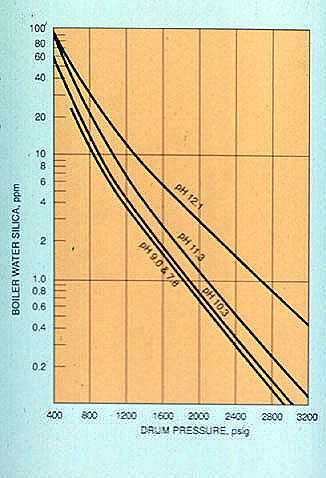
As steam expands through the turbine, silica solubility falls and glassy deposits form, mainly in the intermediate and low pressure stages. These deposits are very hard to remove and reduce efficiency and capacity.
Engineer Live, quoting Hach, notes that at 180 bar the boiler water should hold no more than 100 ppb of silica to keep steam below 5 ppb. The allowable boiler water limit falls sharply as pressure rises.
| Sample Point | Purpose | What a Rise Means |
|---|---|---|
| Anion or mixed bed outlet | Detect resin exhaustion | Regenerate the bed |
| Feed water | Confirm makeup quality | Check makeup and condensate |
| Boiler drum water | Control blowdown | Increase blowdown |
| Saturated or main steam | Protect the turbine | Check carryover and drum level |
Drum level swings and foaming increase mechanical carryover, which is why stable boiler drum level control supports steam purity.
6 Essential Steps of the Molybdenum Blue Method
Metrohm describes this as differential photometry with the molybdenum blue method, with ranges of 0 to 50 µg/L or 0 to 1 mg/L. The blue form is far more sensitive than the yellow one, which is why ppb work relies on it.
The sample is read before and after colour development, so natural colour and turbidity cancel out. Temperature control of the silica analyzer reaction cell keeps the reaction time and colour stable.
Beer Lambert Law in a Silica Analyzer
c sample = (A sample minus A blank) ÷ (A standard minus A blank) × c standard
Example:
A blank = 0.010, A standard = 0.260 for 50 ppb
A sample = 0.052
c = 0.042 ÷ 0.250 × 50 = 8.40 ppb
Below a 20 ppb steam limit
With the same cell length and reagent chemistry, absorbance rises linearly with concentration over the working range. A one point silica analyzer calibration against a known standard is therefore enough for routine checks.
Silica Concentration Calculator
Sampling, Reagents and Calibration
Steam samples are condensed and cooled in a sample panel before reaching the silica analyzer. Grab samples for checking the silica analyzer must use plastic bottles, since glass itself releases silica.
Engineer Live reports that the Hach POLYMETRON 9210 has a 0.5 ppb detection limit, allowing early detection of resin saturation. Hach also cites savings of 10 to 12 percent in steam related costs from preventing silica scale.
- Detects silica at low ppb levels.
- Continuous, automatic operation.
- Early warning of resin exhaustion.
- Protects turbines and boiler tubes.
- Needs regular reagent replenishment.
- Measures reactive silica only.
- Batch cycle, not instant response.
- Sensitive to sample temperature.
Related Water Chemistry Measurements
A silica analyzer works alongside cation conductivity sensors and online pH sensors on the steam and water sampling panel. Conductivity reacts quickly to salts, but it barely responds to weakly ionised silica.
Organic contamination is tracked with a TOC analyzer, while pretreatment uses turbidity measurement and residual chlorine analyzers.
Redox control of feed water is monitored through ORP measurement. For analyzer interview practice, see analytical instruments questions and answers, and for stack monitoring read gas analyzers explained.
Metrohm Boiler Feed Water PDF
Online Silica Instrument Video
Silica Analyzer FAQ
Silica carried over with steam deposits on turbine blades as hard, glassy scale. These deposits lower efficiency and output and are very difficult to remove later.
Continuous measurement warns operators well before chemistry limits are crossed. It also shows when demineraliser resin is nearing exhaustion and needs regeneration.
Most online instruments use the molybdenum blue colorimetric method, also called heteropoly blue. Silica reacts with acid molybdate and is then reduced to an intense blue complex.
The absorbance of that blue colour is measured with a built in photometer. ASTM D7126 is the standard that covers online colorimetric silica measurement in water.
Veolia notes that turbine deposits are rarely a problem when steam silica stays below 0.02 ppm, which is 20 ppb. Some turbine suppliers require less than 0.01 ppm for their machines.
Always follow the specific limits set by the boiler and turbine makers. High pressure units need much tighter boiler water control than low pressure boilers.
Phosphate also forms a yellow molybdate complex that the photometer would read as silica. That interference would give a false high result in treated boiler water.
Adding citric or oxalic acid destroys the phosphate complex selectively before reduction. The silica complex survives this step and is then reduced to the blue form.
Glass slowly releases silica into the water it holds, especially over hours of storage. At ppb levels this contamination is large compared with the true value in the sample.
Use clean plastic bottles that are rinsed several times with the sample itself. Analyse grab samples as quickly as possible to avoid any other pickup.
Many units run an automatic zero and a span check with a known standard on a fixed schedule. The interval depends on the model, the range and the plant procedure.
Reagent condition strongly affects accuracy, so ageing reagents cause drift. Replace reagents on time and log every calibration result for later trend review.
Yes, many instruments have multiple channels served by an internal stream sequencer. Each stream is flushed through the cell before it is measured.
This lowers the cost per sample point but lengthens the time between readings on each stream. Critical main steam points may justify a dedicated single channel instrument.
Related Articles
- Conductivity Sensor Working
- TOC Analyzer Working Principle
- Boiler Drum Level Control
- What Is a pH Sensor
- Analytical Instruments Questions and Answers
External References
- Online Analysis of Silica in Boiler Feed Water, Metrohm
- Optimising Power Plant Efficiency by Measuring Silica, Engineer Live
- Beer Lambert Law, Wikipedia
What We Learn Today
- A silica analyzer uses the molybdenum blue colorimetric method to measure dissolved silica at parts per billion in feed water, boiler water and steam.
- Silica volatilises in high pressure steam and forms glassy deposits in turbine stages, so steam is typically held below about 20 ppb.
- Absorbance is proportional to concentration, so blank and standard readings give an accurate result when reagents and sample handling are well maintained.