
ORP (Oxidation-Reduction Potential) Measurement Explained
Chlorine doesn't disinfect water by making it acidic or sterile in some vague sense. It disinfects by stripping electrons from bacteria, and ORP is the single number that tells you exactly how aggressively that's happening.
ORP measures a solution's tendency to gain or lose electrons in redox reactions, making it a key indicator for disinfection control in water and wastewater treatment. This guide explains the working principle, the ORP scale, its relationship to pH, and real industrial applications.
What is ORP Measurement?
Oxidation-Reduction Potential (ORP), also called redox potential, measures a solution's capacity for electron transfer, expressed in millivolts (mV). Oxidizing agents, like chlorine, ozone, and dissolved oxygen, pull electrons from other substances and produce a positive ORP reading. Reducing agents, like hydrogen sulfide or sulfite, donate electrons and produce a negative ORP reading. A higher, more positive ORP generally indicates a more sanitized, oxidizing environment, which is exactly why ORP has become a standard control parameter for disinfection processes.
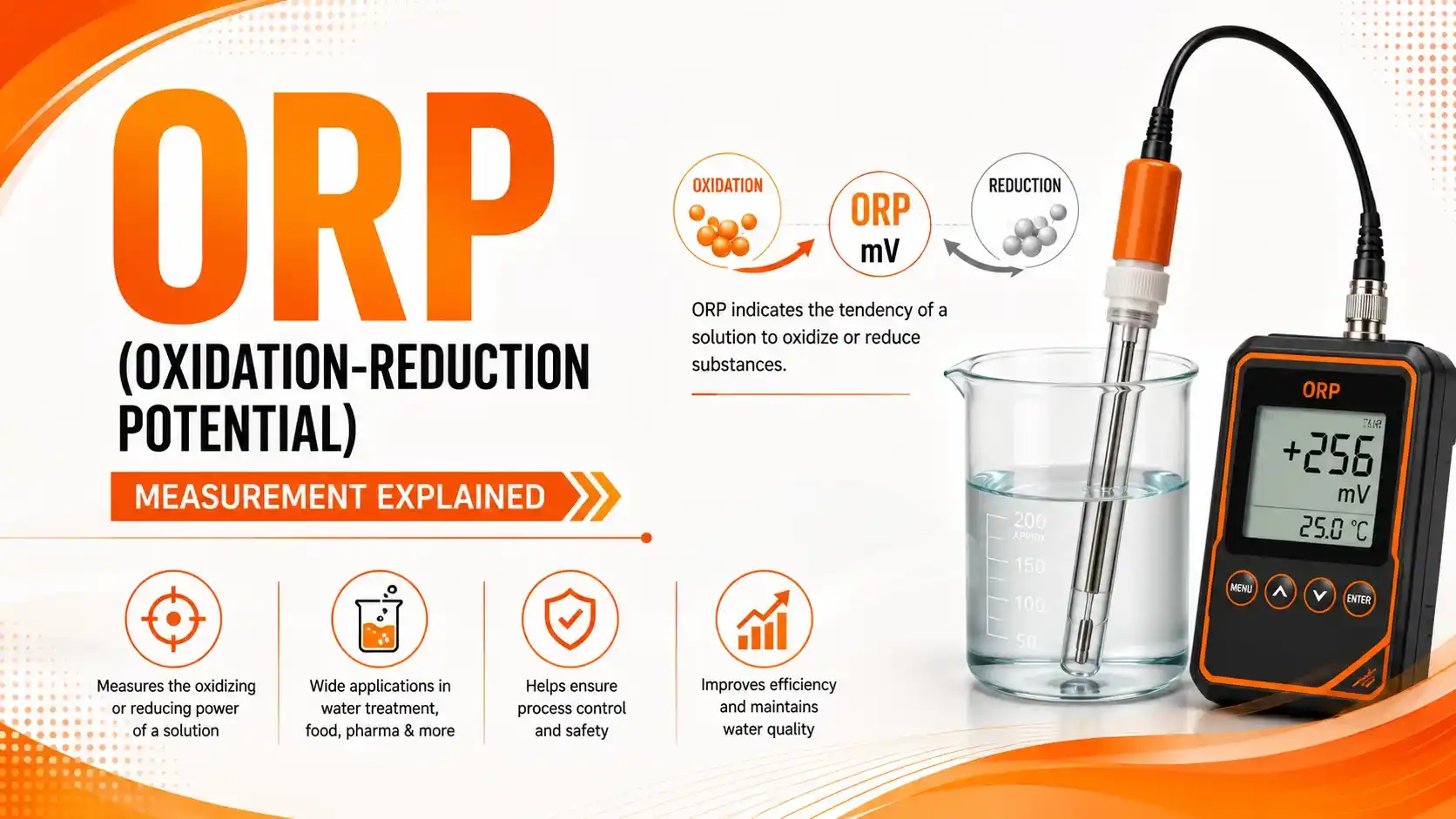
Unlike pH, which specifically measures hydrogen ion activity, ORP reflects the combined effect of every oxidizing and reducing species present in a solution at once. This makes ORP a non-selective but very cost-effective indicator: it can't tell you which specific chemical is responsible for a reading, but it reliably signals the overall oxidative state of the water.
Real Life Example
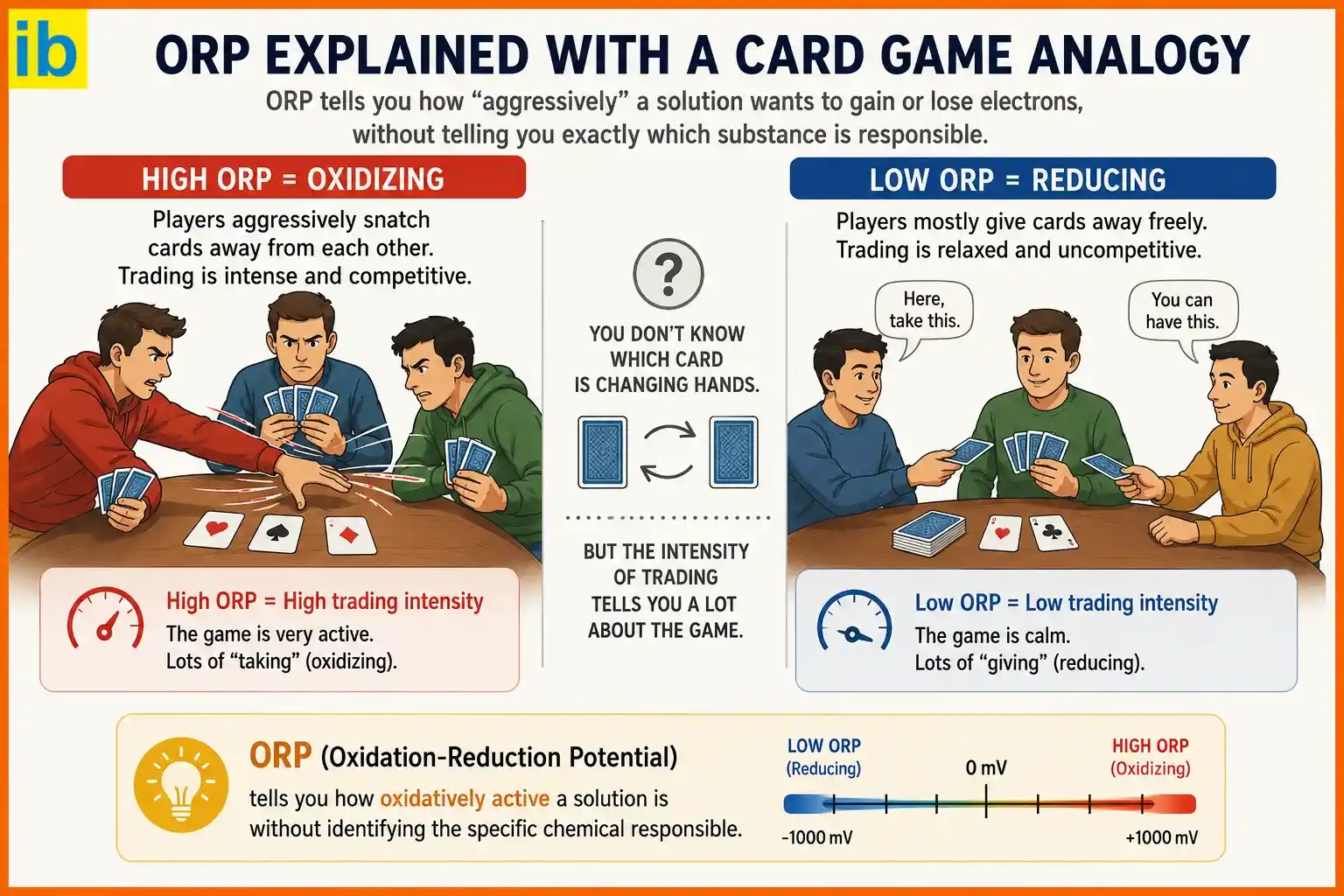
Think of ORP like judging how competitive a card game's trading is, without knowing exactly which cards are on the table. If players are aggressively snatching cards away from each other, that's a high, "oxidizing" ORP.
If players are mostly giving cards away freely, that's a low, "reducing" ORP. You can't tell from that overall trading intensity alone which specific card is changing hands, but the intensity itself tells you a lot about how active the game currently is, exactly like ORP tells you how oxidatively active a solution is without identifying the specific chemical responsible.
The ORP Scale
(negative mV) Neutral
(near 0 mV) Strongly Oxidizing
(positive mV)
In practice, drinking water disinfection commonly targets an ORP in the range of 650 to 800 mV, considered effective for controlling bacterial contamination. Values well below this range suggest inadequate disinfection, while wastewater treatment processes like nitrification and denitrification are monitored using ORP ranges specific to the biological process being controlled.
ORP vs pH
| Aspect | ORP | pH |
|---|---|---|
| What It Measures | Electron transfer capacity (oxidation/reduction) | Hydrogen ion (H+) activity |
| Electrode | Noble metal (platinum/gold) vs Ag/AgCl reference | Glass membrane vs Ag/AgCl reference |
| Selectivity | Non-selective, reflects all redox species combined | Selective for hydrogen ion concentration |
| Temperature Compensation | Not compensated during measurement | Compensated during measurement |
| Common Use | Disinfection control, wastewater process control | Acidity/alkalinity control, neutralization |
Applications of ORP Measurement
Drinking Water Disinfection
ORP monitors and controls chlorine or ozone dosing to ensure effective pathogen removal.
Swimming Pools and Spas
ORP-based disinfectant control keeps chlorine levels effective without manual guesswork.
Wastewater Treatment
ORP monitors biological nitrification and denitrification stages for process efficiency.
Chrome Reduction
ORP controls the reduction of hazardous hexavalent chromium in industrial wastewater.
Fermentation Monitoring
Wine and beverage fermentation tracks ORP alongside temperature and Brix for process insight.
Cooling Towers and Boilers
ORP helps prevent corrosion, scaling, and biofouling through oxidant dosing control.
ORP Measurement: Video Walkthrough
Frequently Asked Questions About ORP
- Yokogawa, Basics of ORP
- Sensorex, Oxidation Reduction Potential (ORP)
- Vernier, Why You Want an Oxidation-Reduction Potential (ORP) Sensor
What We Learn Today
- ORP measures a solution's electron transfer capacity, in millivolts, using a metal electrode against a reference electrode
- Positive ORP indicates an oxidizing environment, negative ORP indicates a reducing environment
- ORP is non-selective, reflecting the combined effect of all redox species rather than any single chemical
- Unlike pH, ORP is not temperature-compensated during measurement, only during calibration
- ORP is widely used to control disinfection, wastewater treatment, and various industrial redox processes