
Clean-in-Place (CIP) Systems Explained: Stages, Instrumentation, and GMP Validation
A tank that processed yesterday's batch has to be spotless before today's begins, without ever being opened up or touched by hand. CIP is the entire discipline built around making that happen, automatically, every single cycle.
Clean-in-Place (CIP) is an automated method for cleaning the interior of tanks, pipes, and process equipment without disassembly. This guide explains the CIP cycle stages, the instrumentation that verifies cleaning effectiveness, and how CIP differs from SIP under GMP validation requirements.
What is Clean-in-Place?
Clean in Place (CIP) is an automated cleaning process that circulates water, detergents, and sometimes sanitizers through the interior surfaces of tanks, pipelines, and process equipment, removing product residue without requiring the equipment to be dismantled. This is essential in food, beverage, dairy, and pharmaceutical manufacturing, where hygiene, safety, and product integrity depend on thorough, repeatable, and documented cleaning between batches or product changeovers.
CIP relies fundamentally on hygienic equipment design: full drainability, short flow paths, and minimal dead legs (stagnant pockets where soil can persist and evade cleaning flow). Standards bodies including 3-A Sanitary Standards and the European Hygienic Engineering and Design Group (EHEDG) define much of the equipment and piping guidance that makes effective CIP possible in the first place, tying closely into good process instrumentation practice for verifying cycle parameters.
Real Life Example
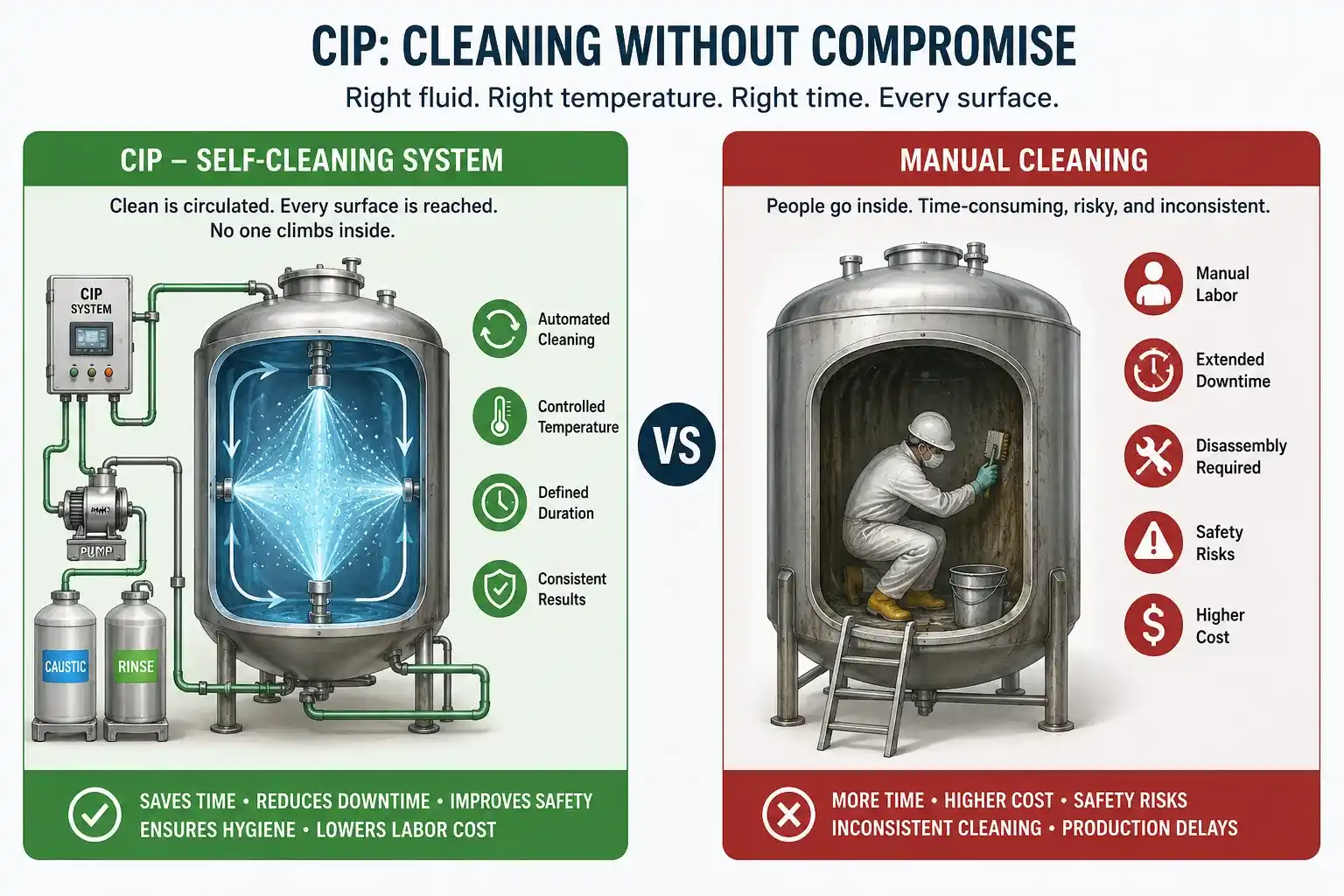
Think of CIP like a self-cleaning oven versus manually scrubbing every surface by hand. Manual cleaning requires physically getting inside, which for a large process tank means disassembly, extended downtime, and real labor cost. CIP instead circulates the right cleaning fluid, at the right temperature, for the right duration, automatically, reaching every interior surface a properly designed system was built to expose, all without a single person ever climbing inside.
The CIP Cycle Stages
Pre-Rinse
Removes bulk product residue with water before chemical cleaning begins.
Detergent Wash
Circulates heated alkaline or acid detergent to dissolve remaining soils and films.
Intermediate Rinse
Flushes out detergent residue before the next chemical stage begins.
Sanitizing Rinse
Applies a sanitizing agent to reduce microbial load to an acceptable level.
Final Rinse
Clears all remaining chemical residue with clean water before production resumes.
CIP vs SIP
| Aspect | CIP (Clean-in-Place) | SIP (Sterilize-in-Place) |
|---|---|---|
| Purpose | Removes product residue and soil from surfaces | Eliminates viable microorganisms after cleaning |
| Method | Circulating water, detergents, sanitizers | Saturated steam at controlled temperature and time |
| Sequence | Performed first | Performed after CIP is complete |
| Typical Industries | Food, beverage, dairy, pharma, biotech | Primarily pharmaceutical and biotech |
| Validation | IQ/OQ/PQ protocols under GMP | IQ/OQ/PQ protocols under GMP |
CIP and SIP are complementary, not interchangeable: CIP is an automated cleaning process, while SIP is an automated sterilization process. In pharmaceutical and biotech environments, both are typically required in sequence, and both must be validated under the same GMP framework, including Installation Qualification (IQ), Operational Qualification (OQ), and Performance Qualification (PQ) protocols.
Applications
Dairy Processing
Dairy facilities run CIP every 24 to 48 hours, among the most frequent cycles in food manufacturing.
Breweries
Multi-stage CIP cleans boiling kettles, fermentation tanks, and filling lines of beerstone and yeast deposits.
Pharmaceutical Manufacturing
CIP paired with SIP supports GMP-compliant reactor and vessel cleaning for API synthesis.
Meat Processing
CIP sanitizes sausage stuffers, grinders, and mixers to ensure microbiological safety.
Cosmetics and Personal Care
Lower hygiene requirements often permit simpler single-step hot water CIP cycles.
Biopharmaceutical Processes
Precise CIP cleaning and validation supports biologic drug substance manufacturing.
Frequently Asked Questions
- Eupry, CIP vs SIP: Differences and GMP Uses in Pharma
- Eupry, How to Design CIP Systems for Pharma and Biotech
- Laminar, Clean in Place (CIP): The Complete Guide
What We Learn Today
- CIP automatically cleans process equipment interiors without disassembly, using circulating water, detergents, and sanitizers
- A typical CIP cycle flows through pre-rinse, detergent wash, intermediate rinse, sanitizing rinse, and final rinse
- Flow, temperature, conductivity, and cycle-time instrumentation verify and document each stage's effectiveness
- CIP and SIP are complementary: CIP cleans, SIP sterilizes, typically performed in that sequence
- Dead legs and poor hygienic design can defeat even a perfectly executed CIP cycle if fluid never reaches a surface