Lube Oil Console Guide: 5 Critical API 614 Requirements

Share:
Instrumentation
Lube Oil Console Explained: API 614 Design and Instrumentation Guide

A pump, compressor or turbine cannot run for long without proper lubrication. That job is handled by one packaged skid.

This guide covers its components, its API 614 heater requirements and the instrumentation that keeps it running safely.

Lube Oil Console API 614 Standard Immersion Heaters Level Interlocks Rotating Equipment

A lube oil console does more than store oil. It filters it, cools it, heats it and monitors it, all from one packaged skid.

Hello everyone, today we are going to learn about the lube oil console used on pumps, compressors and turbines.

We will cover its main components, the API 614 immersion heater rules, the difference between a control thermostat and a protection thermostat, and the wiring practices around level interlocks.
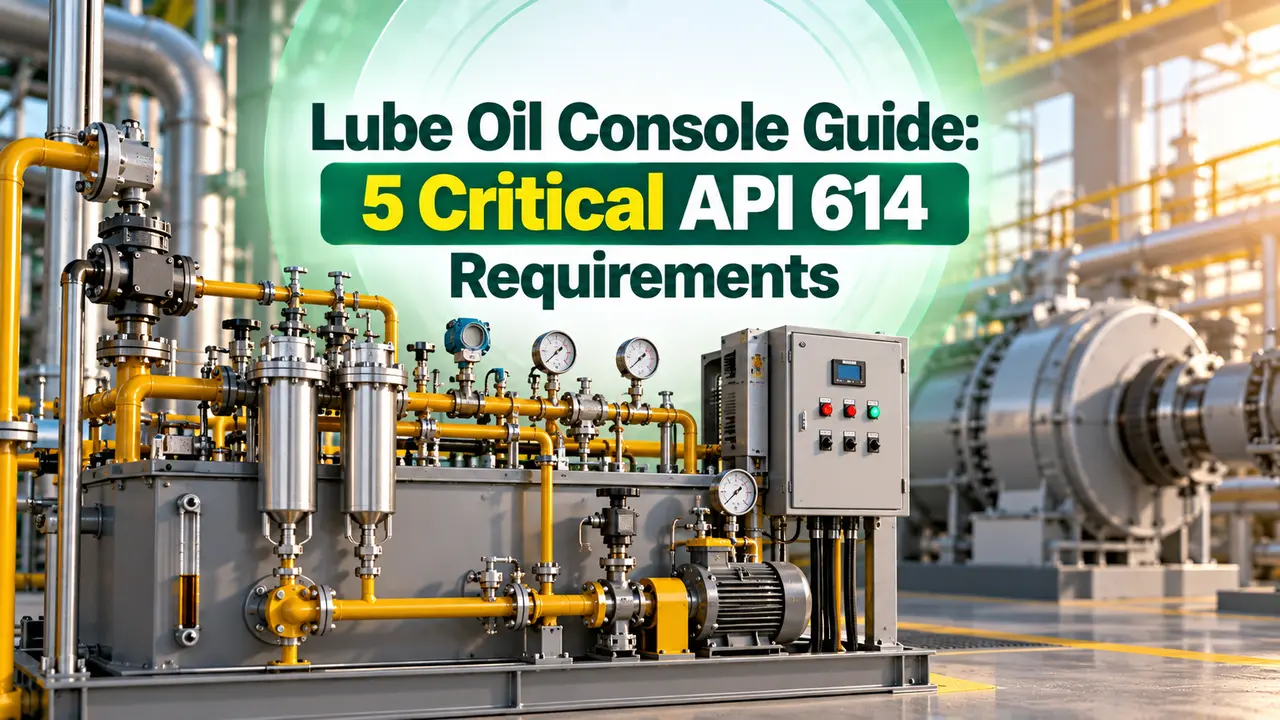
lube oil console

What Is a Lube Oil Console in Rotating Equipment?

A lube oil console is a complete lubrication system built as one packaged unit on a single baseplate.

It supplies oil to bearings, gears and seals on pumps, compressors and turbines, reducing friction during normal running.

Many consoles also provide hydraulic control oil for governors and actuators, alongside the pure lubrication duty.

Most vendors build these skids to the API 614 Standard, titled Lubrication, Shaft Sealing and Oil Control Systems and Auxiliaries.

The standard still allows flexibility. A vendor may offer, and a purchaser may accept, an alternative engineering solution where it makes sense.

Advertisement

Core Components Inside the Console

Every console shares the same basic building blocks, whichever vendor supplies it.

1
Oil Reservoir
The tank holds the working oil charge and lets entrained air and water settle out before the oil is drawn back into circulation.
2
Circulating Pumps
A main pump and a standby pump, often a centrifugal or positive displacement type, push oil through the whole loop.
3
Oil Coolers
A shell and tube or plate heat exchanger removes the heat that the oil picks up from bearings and gears.
4
Duplex Filters
A duplex filter arrangement lets one filter be cleaned while the other stays in service, so flow never stops.
5
Immersion Heaters
Electric heaters warm the oil before startup in cold climates, so the pump never has to push oil that is too thick to flow.
6
Instrumentation
Level, temperature and pressure devices monitor the console continuously and protect the connected machine from oil starvation.

5 Critical API 614 Immersion Heater Requirements

API 614 Section 6.6.8 requires heating whenever the minimum site temperature falls below the oil's minimum startup temperature. Five rules then apply.

Maximum Watt Density
The heating element is limited to 2.3 watts per square centimetre, about 15 watts per square inch, so the oil film next to it never scorches.
Removable Design
The heater bundle must be removable from the reservoir for cleaning and replacement without draining or dismantling the whole console.
Minimum Submergence
The hot section of the element must sit at least 50 mm below the reservoir's minimum operating level at all times.
Level Interlock
The heater must be de energized the moment oil level drops below minimum, so the element is never left heating dry air.
Dual Temperature Devices
Every heater needs two separate integral temperature devices, one for control and one for overtemperature protection, never merged into one.
Merging the control and protection devices into a single sensor goes against API 614. The standard treats this as a real failure mode, one that can damage or destroy the heater element.
Advertisement

Control Thermostat vs Protection Thermostat

These two devices look similar but do very different jobs on the same heater.

AspectControl ThermostatProtection Thermostat
MeasuresActual bulk oil temperatureHeater element sheath temperature
JobSwitches the heater on and off during normal operationTrips the heater off only during an abnormal overtemperature event
LocationCan be remote, away from the heater bundleMust be integral to the heater element itself
Reset BehaviourCycles automatically, no manual reset neededOften needs a manual reset after it trips

A remote temperature transmitter reading the bulk oil gives a truer picture than a thermostat sitting on the element itself.

Level Interlock and Instrumentation Wiring Practices

Getting the signal wiring right matters as much as picking the right hardware. Check these points before the console ships.

1
Dual level setpoints. One level switch setpoint permits the oil pump to start, and a second, lower setpoint de energizes the heater.
2
Thermostat contact ratings. Simple thermostat contacts are usually rated for 220 VAC or 110 VAC, wired directly into a control circuit.
3
Digital signal isolation. Digital systems instead use 24 VDC through a relay or isolator, keeping the field contact separate from the logic system.
4
MCC routing. Heater power and control circuits are usually routed to the Motor Control Center for the electrical team to operate.
5
Signal destination clarity. State plainly whether a thermostat signal lands on the electrical system, the DCS, the PLC, the ESD, or the package panel.
6
Documented heater type. Vendor documents should record whether the heater is three phase or single phase, alongside its wiring diagram.
Advertisement

Where This Type of Console Gets Used

The same basic skid design shows up across almost every rotating equipment package on a process plant.

1
Centrifugal Pumps
Larger process pumps use a console to lubricate bearings that plain grease cannot serve reliably at high speed.
2
Compressors
Centrifugal and reciprocating compressors depend on a console for bearing lubrication and, on many designs, seal oil too.
3
Steam and Gas Turbines
Turbines add hydraulic governor oil to the same console, sharing the reservoir, pumps and coolers with the lubrication duty.
4
Gearboxes
High speed gearboxes between a driver and a driven machine need continuous, filtered, cooled oil to survive their duty cycle.

Watch: API 614 Lube Oil System Explained

Lube Oil Console Questions Engineers Ask

What is a lube oil console?
It is a packaged lubrication skid on one baseplate, supplying filtered, cooled oil to pumps, compressors, turbines and gearboxes.
Why does API 614 limit the immersion heater watt density?
A high watt density can scorch the oil film next to the element, forming carbon deposits that damage the heater and the oil.
Why does a heater need two separate thermostats?
One controls normal heating cycles from bulk oil temperature. The other protects the element itself from a genuine overtemperature fault.
What happens if oil level drops below minimum on a console?
The level interlock must de energize the immersion heater immediately, since an exposed element can overheat and fail within minutes.
Does every console need immersion heaters?
Only when the minimum site temperature is below the oil's required startup temperature, as set out in API 614 Section 6.6.8.

Related Articles on This Site

External References

Advertisement

What We Learn Today

  • A lube oil console is a packaged skid, built to API 614, that lubricates and sometimes hydraulically controls pumps, compressors and turbines.
  • Immersion heaters follow five API 614 rules: limited watt density, removable design, minimum submergence, a level interlock, and two separate temperature devices.
  • The control thermostat manages normal heating cycles, while the protection thermostat guards against a genuine overtemperature fault and often needs a manual reset.
I hope you like above blog. There is no cost associated in sharing the article in your social media. Thanks for reading!! Happy Learning!!

Leave a Reply

Your email address will not be published. Required fields are marked *