Every flow meter drifts, gets repaired or gets moved, and only a proper comparison against a known reference tells you how much it is really reading. This guide walks through the methods, the numbers on the certificate and a calculator for meter error and K factor.
Flow meter calibration tells you how far a meter reads from a traceable reference and how to correct it. Learn the lab and field methods, test points, K factor updates, uncertainty and intervals with a solved example.
What Is Flow Meter Calibration?
Flow meter calibration is the process of passing a known quantity of fluid through a meter and comparing its reading with a traceable reference standard, such as a weigh scale, a calibrated tank, a prover or a master meter. The difference is recorded as error at several flow rates, and the meter is adjusted with a new K factor or meter factor if it falls outside its accuracy limit.
- Main methods are gravimetric, volumetric tank, master meter and pipe prover
- Error % = (meter reading minus reference) ÷ reference × 100
- The reference should be clearly more accurate than the meter, ideally 4 to 10 times
- Results are recorded as found and as left at 3 to 5 flow rates
- In situ verification checks meter health but is not a full wet calibration
Wet calibration on a rig is different from the electronic checks some meters allow, and our comparison of wet vs dry flow meter calibration explains where each one fits. Here we focus on wet methods and certificate numbers.
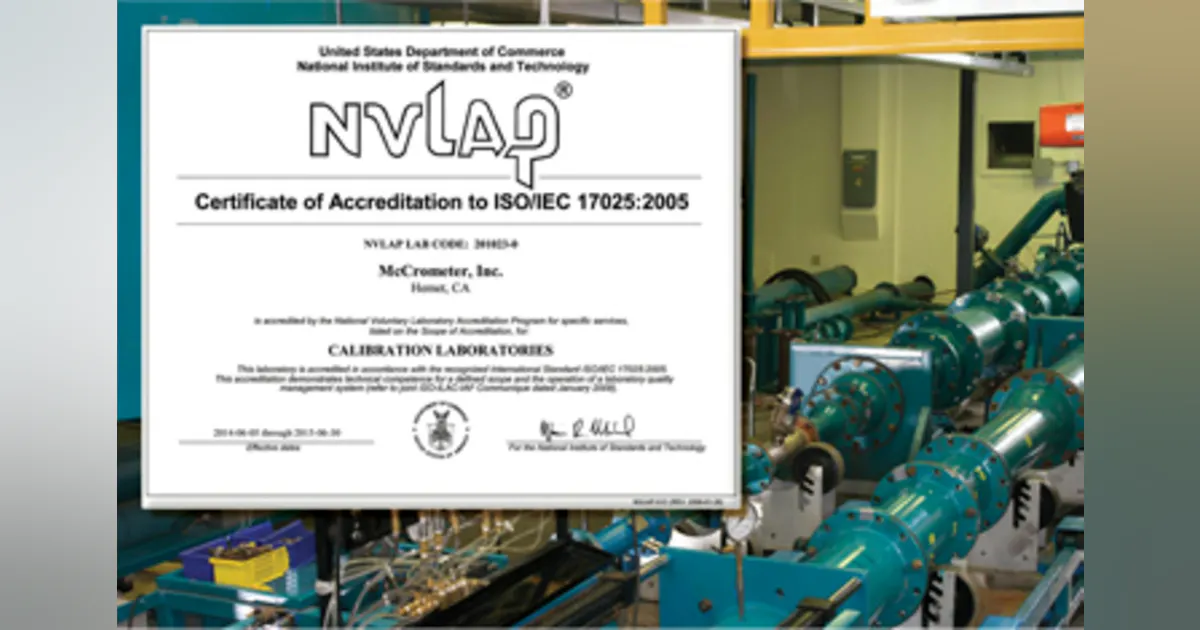
Processing Magazine reports that this McCrometer lab in Hemet, California runs three gravimetric and two volumetric systems and holds ISO/IEC 17025 accreditation through NVLAP.
How Do You Calibrate a Flow Meter?
Every flow meter calibration follows the same sequence, whether the meter is a magnetic flow meter, a turbine or a Coriolis unit.
The as found and as left results matter because they show whether the meter drifted in service. Our guide to the as found and as left calibration certificate shows how auditors read these two columns.
Never adjust a meter before you record its as found readings. Without that data you cannot judge drift, extend the interval or check whether product measured since the last calibration was billed correctly.
Flow Meter Calibration Methods
Liquid is diverted into a tank on a scale and mass is divided by time.
A calibrated tank with a neck scale gives a known volume per run.
The unit under test is compared in series with a more accurate calibrated meter.
A displacer sweeps a known volume between detectors while pulses are counted.
The UNIDO calibration guide for flow meters lists volumetric, static and dynamic gravimetric, prover and master meter methods as the main options. It notes that air buoyancy changes the weighed mass of water by about 0.1 %.
A prover is a volumetric standard built into a pipeline, and our article on meter provers and flow meter proving covers ball, piston and compact designs. For gas meters the references change to bell provers, sonic nozzles and transfer meters, as described in calibrating flow meters with gases.
KROHNE states that its water flow calibration facility in Pune is accredited by NABL and handles meter sizes from 10 mm to 2000 mm across its five water and air setups.
| Method | Reference | Typical Use | Main Limitation |
|---|---|---|---|
| Gravimetric | Weigh scale + timer | Lab, highest accuracy | Meter must be removed |
| Volumetric tank | Certified volume | Water and fuel meters | Slow at high flow |
| Master meter | Calibrated meter | On site, mobile rigs | Uncertainty adds up |
| Pipe prover | Swept volume | Crude and product lines | Large and costly |
| In situ verification | Internal references | Health check in place | Not a flow comparison |
What Is the K Factor in Flow Meter Calibration?
The K factor is the number of pulses a meter produces per unit of volume or mass, such as pulses per litre. The UNIDO guide calculates it as K = N ÷ V, where N is pulses counted and V is the reference volume for the run.
The meter factor is a dimensionless ratio between reference and indicated quantity, and it is multiplied by the reading to give the true value. Our detailed page on flow meter K factor calculations shows how a turbine curve is built from several of these runs.
Meter factor MF = Vs ÷ Vi
New K = pulses N ÷ Vs
N = Vi × K old
Here Vs is the reference volume and Vi is the volume the meter showed. If you want to check your numbers from a phone, the online K factor tool does the same sum.
Reference Vs = 500 L, meter Vi = 501.6 L
Old K = 50 pulses/L, so N = 25080 pulses
Error = 1.6 ÷ 500 × 100 = 0.32 %
MF = 500 ÷ 501.6 = 0.99681
New K = 25080 ÷ 500 = 50.16 pulses/L
The meter read high by 0.32 %, so raising the K factor to 50.16 pulses per litre brings its total back to the reference. This is the most common adjustment after flow meter calibration on pulse output meters.
Always check the result against the meter tolerance before writing anything to the transmitter. You can also confirm percentage error with our calibration error calculator when you are filling in a field record.
Test Points, Repeats and Uncertainty
Most flow meter calibration procedures test at three to five flow rates, such as 10, 25, 50, 75 and 100 % of maximum flow. The UNIDO guide gives an example client request of three runs at each of five flow rates and shows a turbine data sheet with an average K factor and repeatability of ±0.004 %.
Test points should cover the flows the meter actually sees, and our article on turndown ratio in flow meters explains why error grows at low velocity.
Transcat states that its liquid flow calibrators reach a total system uncertainty of ±0.05 % at k = 2 or better. Flow Technology notes that calibration standards are normally chosen to meet a 4 to 1 accuracy ratio over the meter under test, which our page on test uncertainty ratio explains.
A flow meter calibration certificate should quote uncertainty at k = 2 for about 95 % confidence, so read measurement uncertainty in calibration before comparing labs on price.
In Situ Verification of Magmeters and Coriolis Meters
Modern magnetic and Coriolis meters can check their own sensor and electronics in place. Endress+Hauser explains in Water and Wastes Digest that its Heartbeat verification compares secondary parameters with traceable, redundant internal references and gives a pass or fail report in seconds to about 10 minutes.
Verification passes no reference flow, so it cannot replace flow meter calibration when the K factor must be proven. Plants use it to stretch the time between wet checks on Coriolis flow meters and magmeters.
- Direct comparison with a traceable flow reference
- Gives a new K factor and full error curve
- Accepted for custody transfer and audits
- Can be accredited to ISO/IEC 17025
- No removal and almost no downtime
- Checks coils, electrodes, tubes and electronics
- Pass or fail result, not a new K factor
- Best used between wet calibrations
How Often Should a Flow Meter Be Calibrated?
There is no single legal interval for flow meter calibration, so most plants start with the maker's advice or one year and then adjust based on as found drift. Our guide to calibration interval determination under ISO 9001 shows a practical method for doing this.
Plotting as found error over several years is a simple way to see whether a meter is stable. A control chart of those values makes it clear when drift starts to approach the tolerance.
KROHNE says its mobile calibration station uses Coriolis reference meters with 0.05 % of measured value mass flow uncertainty, calibrated in an ISO 17025 accredited lab.
When a meter passes three cycles in a row with tiny drift, extend the interval. When it fails as found, shorten it.
Choosing an ISO 17025 Flow Lab
An accredited lab has its method, uncertainty budget and staff assessed by a body such as NABL in India. The requirements are explained in our page on ISO 17025 calibration laboratory requirements, and the link back to national standards is shown in the calibration traceability chain.
Check that the lab scope for flow meter calibration covers your meter size, fluid and flow range. A lab that tests on water may not suit a meter used on viscous oil.
- Scope covers meter type, size and flow range
- Uncertainty stated at k = 2 for each test point
- Test fluid close to your process fluid
- As found and as left data on the certificate
- Traceability to NPL India, NIST or PTB
- Straight run and installation similar to site
Troubleshooting Bad Calibration Results
| Symptom | Likely Cause | Field Fix |
|---|---|---|
| Poor repeatability | Air in line, unstable flow | Vent fully, steady pump speed |
| Error grows at low flow | Below meter turndown | Add low flow points, check cutoff |
| Constant offset at all flows | Wrong K factor or units | Check configuration and totaliser |
| Error changes with orientation | Poor straight run, swirl | Add flow conditioner |
Installation effects are a common reason why a meter that passed in the lab reads differently on site. Review flow conditioners and straight run and the guide to magnetic flow meter troubleshooting before blaming the lab.
Also confirm whether accuracy is stated as percent of reading or of full scale, because it changes what passes at low flow.
The Siemens video below shows flow meter calibration in a large facility, with the reference, diverter and meter under test working together.
Flow Meter Calibration FAQ
Pass a known quantity of fluid through the meter and compare its total with a traceable reference such as a weigh tank, prover or master meter. Repeat this at three to five flow rates and work out the error at each point.
If the error is outside tolerance, enter a new K factor or meter factor in the transmitter. Then repeat the runs and record the as left results on the certificate.
The main methods are gravimetric weighing, volumetric standard tanks, master meter comparison and pipe or compact provers. Gas meters also use bell provers and critical flow nozzles as references.
Gravimetric and volumetric rigs are primary methods used in labs. Master meters and provers are popular in the field because the meter can stay close to its real installation.
Many plants start with one year or the interval suggested by the manufacturer. Custody transfer meters are usually checked much more often, sometimes monthly or at every batch.
After a few cycles, look at the as found drift to decide whether the interval can be extended. A meter that fails as found should get a shorter interval and a review of past data.
The K factor is the number of pulses the meter gives for each unit of volume or mass, such as pulses per litre. It is set in the transmitter or flow computer that turns pulses into flow.
The meter factor is a ratio of reference quantity to indicated quantity found during proving. You multiply the indicated reading by it to get the corrected value.
A magmeter can be checked on site with a master meter rig or a portable reference, and many models also offer built in verification. The verification tests coils, electrodes and electronics against internal references.
Verification gives a pass or fail result but does not compare actual flow. For a new K factor or an accredited result, the meter still needs a wet calibration.
A good lab rig often has a total uncertainty around ±0.05 % of reading at about 95 % confidence. Field master meter rigs are usually less accurate because their own uncertainty adds up.
The reference should normally be at least four times better than the meter being tested. Check the uncertainty on the certificate for each test point before you accept the result.
Related Articles
- Flow Meter Wet vs Dry Calibration
- Flow Meter K Factor Calculations
- Meter Prover and Flow Meter Proving
- Calibration Certificate As Found and As Left
- ISO 17025 Calibration Laboratory Requirements
External References
- UNIDO ECOMET Calibration Guide G CAL 005: Flow Meters
- Water and Wastes Digest: How To Perform In Situ Verification of a Flowmeter
- Wikipedia: Flow Measurement
What We Learn Today
- Flow meter calibration compares a meter with a traceable weigh tank, volume tank, prover or master meter at several flow rates and records the error.
- The K factor gives pulses per unit volume, while the meter factor is a ratio that corrects the indicated value to match the reference standard.
- In situ verification checks sensor and electronics health between wet calibrations, but only a real flow comparison can confirm or change the K factor.