
Flow Measurement · Mass Flow · Coriolis Effect · Phase Shift · Density
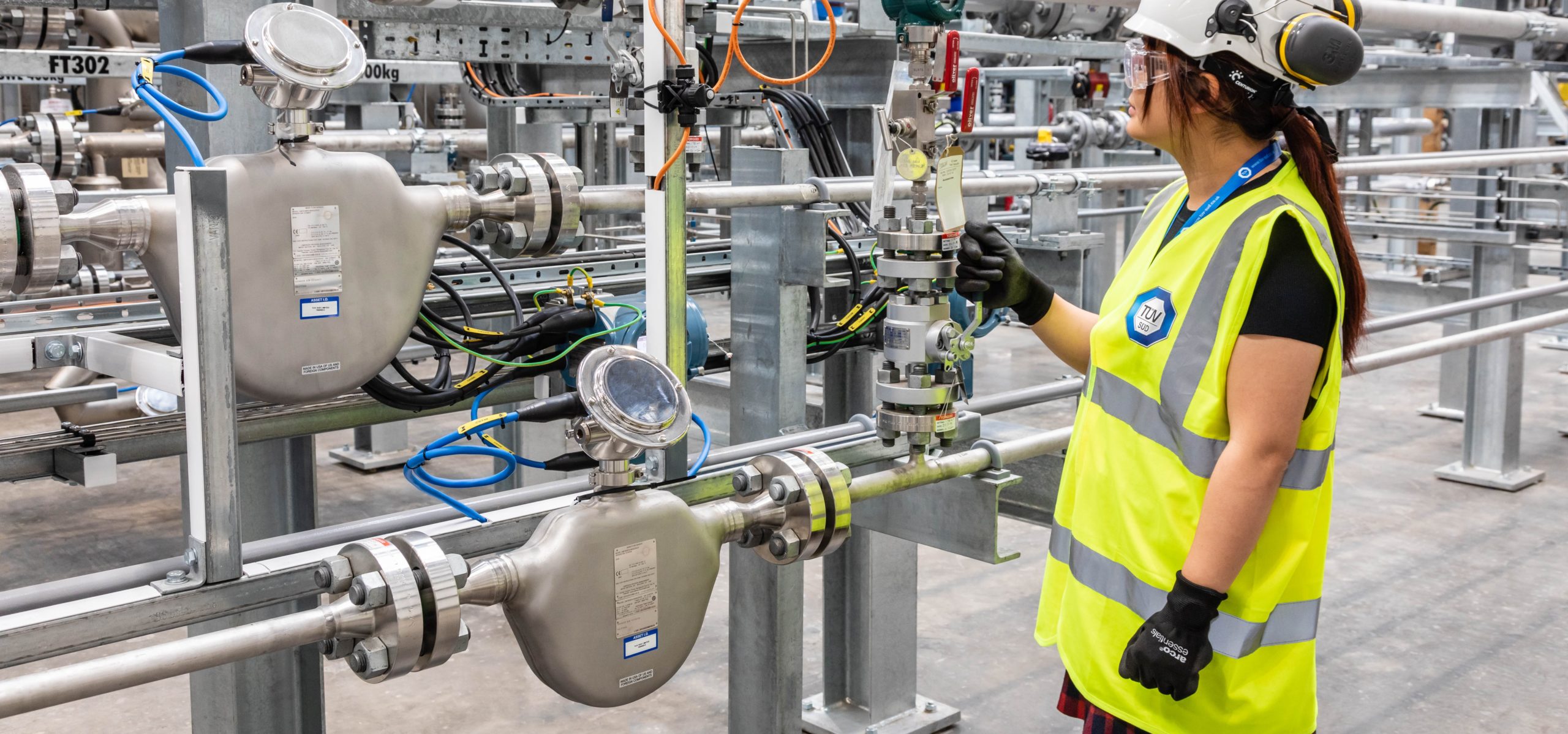
The only flow meter that directly measures mass flow, density, temperature and viscosity simultaneously from a single vibrating tube , with no moving parts and no straight-run requirements.
Named after the French physicist Gaspard-Gustave de Coriolis (1792-1843), the Coriolis flow meter works by measuring how much a vibrating tube twists when mass flows through it. The twist is directly proportional to mass flow rate. No corrections needed for temperature, pressure, density or viscosity.
What a Coriolis Flow Meter Measures: Four Variables from One Instrument
Coriolis Flow Meter Working Principle: Step by Step
A driver coil vibrates the flow tube (or pair of tubes) at its natural resonant frequency , typically 80 to 1000 Hz depending on meter size. The amplitude of vibration is tiny (less than 1 mm) and cannot be seen, but can be felt by touch. When there is no flow, both inlet and outlet sensors register identical sine wave signals , perfectly in phase.
When fluid flows through the vibrating tube, the fluid mass carries inertia. As the tube moves upward on one side, the fluid flowing into the meter resists being pushed up (it pushes down on the tube). On the other side, fluid flowing out resists having its upward motion reduced (it pushes up on the tube). This creates opposing Coriolis forces on each arm of the tube.
The Coriolis forces cause the tube to twist: the inlet arm lags slightly behind the overall vibration while the outlet arm leads slightly. This is a phase shift between the inlet and outlet sensor signals. The two sensors still detect the same frequency, but one signal arrives slightly earlier than the other.
The time difference (delta-t) between the inlet and outlet sensor signals is directly proportional to the mass flow rate. More mass flowing = more Coriolis force = greater twist = larger phase shift. The transmitter measures this time difference with picosecond precision and converts it to a mass flow reading. Zero flow = zero phase shift. It is that elegant.
A tube filled with dense fluid vibrates more slowly than a tube filled with light fluid , exactly like a heavy pendulum swings more slowly than a light one. The transmitter continuously monitors the oscillation frequency and converts it to fluid density. Mass flow divided by density gives volumetric flow rate as a secondary output.
Video: Coriolis Flow Meter Working Principle Explained
Coriolis Flow Meter Formula: Phase Shift to Mass Flow Rate
In simpler terms for field understanding:
m_dot proportional to delta_t (time lag between inlet and outlet sensors)
Where:
m_dot = mass flow rate (kg/s)
Ku = temperature-dependent stiffness of the tube
d = tube width (geometry factor)
delta_t = measured time lag between inlet and outlet sensor signals (microseconds)
K = shape-dependent geometry factor
omega = vibration angular frequency (rad/s)
Iu = inertia of the tube
Key relationship: delta_t is DIRECTLY proportional to mass flow rate. Double the flow = double the time lag. Zero flow = zero time lag. The meter is factory calibrated so the transmitter outputs mass flow directly. In the field, you see kg/h or t/h , the phase shift calculation is done internally.
Where:
rho = fluid density (kg/m³)
f = measured oscillation frequency of the flow tube (Hz)
A,B = meter-specific calibration constants (determined during factory calibration)
Higher density fluid (e.g. honey) = lower frequency Lower density fluid (e.g. water) = higher frequency Air / gas at low pressure = very high frequency (meter limitations apply)
Coriolis Flow Meter Calculator: Mass Flow, Density and Volumetric Flow
Enter measured values from your Coriolis transmitter to calculate related parameters. All Coriolis transmitters output 4-20 mA proportional to mass flow rate as the primary signal.
Coriolis Flow Meter Tube Designs: Curved vs Straight
| Design | Sensitivity | Pressure drop | Draining / CIP | Best for |
|---|---|---|---|---|
| U-tube (curved, dual) | High , more twist for same flow | Higher , flow splits and bends | Fluid may trap in bends , difficult CIP | Clean liquids, high accuracy, standard process service |
| Straight tube (single or dual) | Lower , less mechanical advantage | Lower , no bends in flow path | Self-draining , ideal for hygienic and slurry service | Pharmaceuticals, food, dirty/abrasive liquids, slurries |
| Omega / looped tube | High sensitivity | Moderate | Moderate , larger loop geometry | High-pressure pipeline applications, custody transfer |
Coriolis Flow Meter Advantages That Make It Unique
- Direct mass flow: No separate density compensation needed. Mass is mass , unaffected by fluid temperature, pressure, viscosity or composition changes.
- No straight-run requirement: Can be installed in any orientation, directly after elbows or valves. No 10D upstream / 5D downstream straight pipe needed.
- Simultaneously measures density: One meter gives you mass flow and density , replacing two instruments. Concentration of solutions can be derived from density.
- Very high accuracy: Typically ±0.1% of reading for liquids. ±0.5% for gases. Premium calibration options achieve ±0.05%.
- Wide turndown ratio: Typically 100:1 or greater. Accurate from 1% to 100% of full-scale flow without recalibration.
- No moving parts in contact with fluid: The tube itself vibrates but nothing rotates or slides. Very reliable in clean service with minimal maintenance.
Coriolis Flow Meter Limitations: When NOT to Use It
- Low-pressure gas (below 10 bar): Gas has very low density. The Coriolis force is too small to produce a reliable phase shift. Minimum gas density for most meters is 4.5 kg/m³. Below this, measurement becomes unreliable.
- Two-phase flow (gas + liquid): Entrained gas bubbles in liquid disrupt the tube vibration and cause errors or complete measurement failure. Not suitable for slugging flow.
- Large pipe sizes: Coriolis meters are commercially available up to DN300 (12 inch) but become very expensive and heavy above DN100. Venturi meters or ultrasonic meters are preferred for large diameter pipelines.
- High pressure drop: The U-tube design causes significant pressure drop. On fluids near their boiling point, this can cause cavitation inside the meter.
- External vibration: Strong external vibrations at or near the tube resonant frequency can interfere with the phase shift measurement. Dual-tube designs with counter-phase vibration largely solve this.
- High cost: Significantly more expensive than orifice plates, venturi tubes or vortex meters. The cost is justified by accuracy and multi-variable output but not always by the application requirements.
Industrial Applications of the Coriolis Flow Meter
| Industry | Application | Why Coriolis is chosen |
|---|---|---|
| Oil and gas | Custody transfer of crude oil, condensate, LPG, LNG loading | Direct mass measurement eliminates density correction errors. Accuracy class required for fiscal metering. |
| Chemical | Reagent dosing, blending, batch filling, acid and alkali metering | Corrosive fluid service. Mass-based batching ensures exact amounts regardless of temperature. |
| Pharmaceutical | API dosing, solvent metering, buffer preparation, CIP verification | Sanitary straight-tube designs. FDA validation. GMP compliance. Mass precision for active ingredients. |
| Food and beverage | Sugar syrup, edible oil, alcohol, dairy product metering | Self-draining straight tube for hygienic service. Brix/concentration measurement via density output. |
| Refining | Additive injection, blending, catalyst dosing | Low flow accuracy for expensive additives. Density output monitors product specification simultaneously. |
| Semiconductor | Ultra-pure chemical delivery, slurry metering for CMP processes | Micro-scale Coriolis meters for very low flow rates (grams per minute) with high accuracy. |
Quick FAQs: Coriolis Flow Meter
- Venturi Tube Flow Meter: Differential Pressure vs Coriolis for Large Pipes
- Turbidity Measurement: Used Alongside Coriolis in Food and Pharma Plants
- 4-20 mA Current Loop: How Coriolis Transmitter Connects to Your DCS
- Turndown Ratio in Flow Meters: Why Coriolis Leads with 100:1
- How to Calibrate Flow Meters: Gravimetric Method for Coriolis Verification
External References
- Endress+Hauser: Coriolis Flow Measuring Principle
- Bronkhorst: Coriolis Flow Meter Working Principle
- Wikipedia: Mass Flow Meter , Coriolis Principle
What we learn today
- A Coriolis flow meter vibrates a tube and measures how much it twists when fluid flows through. The twist (phase shift between inlet and outlet sensors) is directly proportional to mass flow rate. The tube oscillation frequency gives fluid density. One meter, four measurements: mass flow, density, temperature and viscosity.
- No corrections needed for temperature, pressure or fluid properties. No straight-pipe run requirements. Accuracy of ±0.1% makes it the gold standard for custody transfer and pharmaceutical dosing. Not suitable for low-pressure gas or two-phase flow.
- Two main designs: curved U-tube (higher sensitivity, higher pressure drop, harder to clean) and straight tube (lower sensitivity, self-draining, ideal for hygienic and slurry service). Coriolis meters are available up to DN300 but become expensive above DN100.