
Wet calibration passes actual fluid through the meter and compares output against a reference standard. Dry calibration simulates the flow signal electronically without any fluid flowing through the meter body.
Knowing when to use each method saves time and cost while ensuring the right level of accuracy for the application.
Choosing the wrong calibration method can leave a meter out of tolerance without knowing it. Wet calibration catches errors in the full measurement chain. Dry calibration verifies electronics only.
We will cover what each method involves, what equipment is used, and what accuracy each method achieves.
We will also look at which meter types use which method, a full comparison table, and a practical guide to help you decide which calibration method to specify for your application.
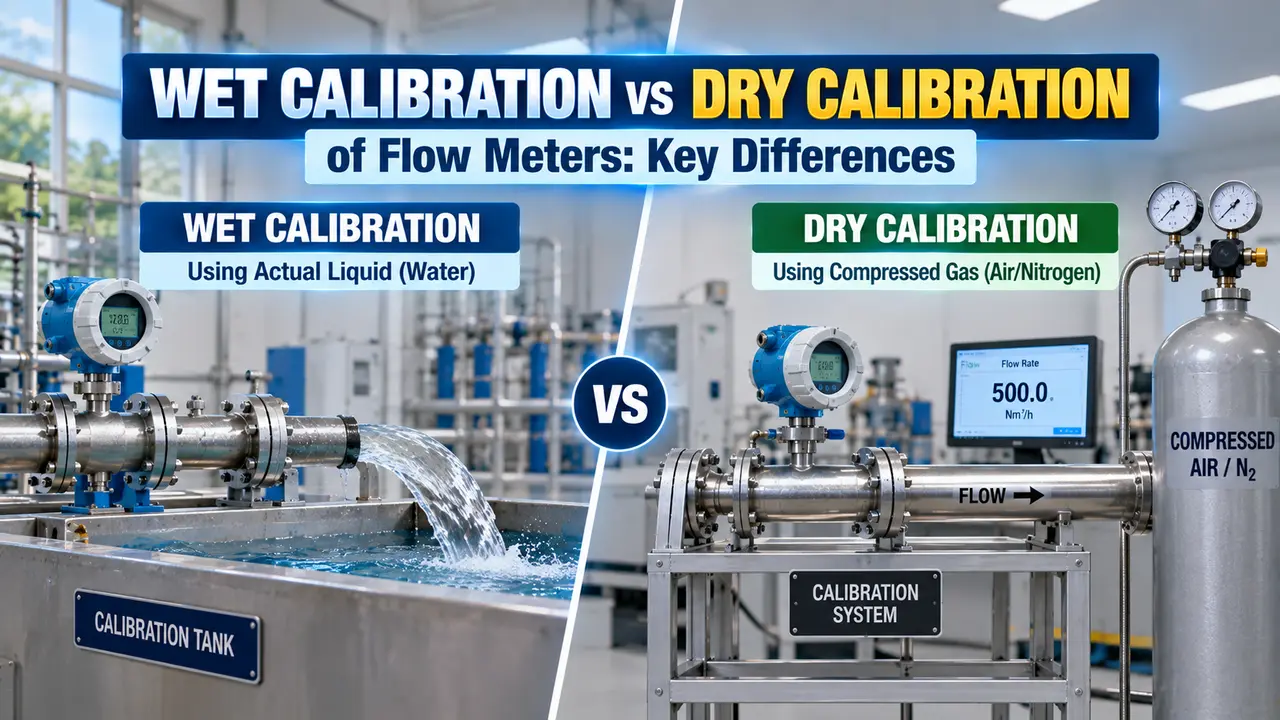
Wet Calibration vs Dry Calibration: What Each Method Means
Actual fluid flows through the meter under controlled conditions. The meter output is compared against a reference standard of known higher accuracy.
The full measurement chain is tested: primary sensor, transmitter, signal processing, and output signal. Any error in any part is captured.
Used for custody transfer, fiscal metering, and any application where accuracy better than 1% of reading is required.
No fluid flows through the meter. A simulated signal (electrical, magnetic or mechanical) is injected into the transmitter or electronics to check the secondary measurement chain.
The primary sensor, pipe coupling, and flow profile are bypassed. Only the signal processing and output are tested.
Used for routine checks, loop calibration of the transmitter and indicator, and pre-commissioning verification of the electronic section.
Wet Calibration: Methods and Equipment Used
Wet calibration is done using one or more of four standard reference methods. Each has a different uncertainty level and is suited to different flow ranges and fluid types.
Dry Calibration: Methods and What Is Actually Tested
Dry calibration covers only the secondary part of the meter: transmitter, signal conditioning, and output electronics. It does not test the primary sensor or the effect of the fluid.
When a magnetic flow meter is dry-calibrated using coil injection, the coil tests the electrode circuit and the transmitter. It does not verify the lining condition, the electrode fouling, the flow tube geometry, or the effect of the process fluid conductivity. A meter can pass a dry calibration check and still read incorrectly in service if the liner is damaged or the electrodes are coated. Wet calibration with actual fluid is the only way to verify total system accuracy.
Full Comparison: Wet Calibration vs Dry Calibration
| Parameter | Wet Calibration | Dry Calibration |
|---|---|---|
| Fluid required? | Yes, actual fluid flows through the meter | No, signal is simulated |
| What is tested? | Full measurement chain: sensor, transmitter, output | Transmitter and output electronics only |
| Accuracy achievable | 0.02 to 0.5% of reading depending on method | Cannot confirm total system accuracy |
| Where it is done | Calibration lab, flow rig, or on-site with a portable prover | On-site, in workshop, or during pre-commissioning |
| Cost | High: requires flow rig, reference standard, certified lab | Low: signal generator or loop calibrator only |
| Time required | Hours to days including fluid handling and certificates | Minutes to one hour |
| Meter must be removed? | Usually yes, for lab calibration; on-site prover keeps it in line | No, done in place with the meter installed |
| Used for custody transfer? | Yes, required by AGA, API and ISO standards | No, not accepted for fiscal or custody transfer |
| Detects primary sensor faults? | Yes | No |
| Detects transmitter faults? | Yes | Yes |
| Suitable for routine checks? | Overkill for simple loop checks | Yes, fast and practical |
Which Method to Use and When
Use wet calibration for custody transfer, fiscal metering, or when accuracy better than 1% is required.
Also use it after sensor repair, after service in a fouling fluid, or when an unexplained shift in readings is suspected.
Use dry calibration for routine transmitter checks, pre-commissioning loop checks, and utility meters where 1 to 2% accuracy is acceptable.
It is also a quick field check to rule out transmitter faults before deciding whether to arrange a full wet calibration.
Watch: Flow Meters Explained
Flow Meter Wet vs Dry Calibration Questions
Related Articles on This Site
- Flow Meter K-Factor Calculations Explained
- Orifice Plate Flow Measurement Explained
- Coriolis Flow Meter Working Principle
- Types of Flow Meters and Their Applications
- How to Select the Right Flow Meter for Any Application
External References
- Flow Meter Calibration Methods Explained | Instrumentation Tools
- Electromagnetic Flow Meter Calibration Guide | Tameson
What We Learn Today
- Wet calibration passes actual fluid through the meter and compares output against a reference standard. It tests the full chain: sensor, transmitter and output. Gravimetric wet calibration achieves 0.02 to 0.05% uncertainty.
- Dry calibration injects a simulated signal into the transmitter without fluid flow. It checks only the electronics and output. It cannot detect sensor faults, liner damage or electrode fouling.
- Both methods are often used together. After any primary sensor repair, wet calibration must be repeated. Dry calibration alone is not accepted for custody transfer by AGA, API or ISO standards.