
On a long line with little load, the far end voltage can climb above the source, the opposite of what most people expect.
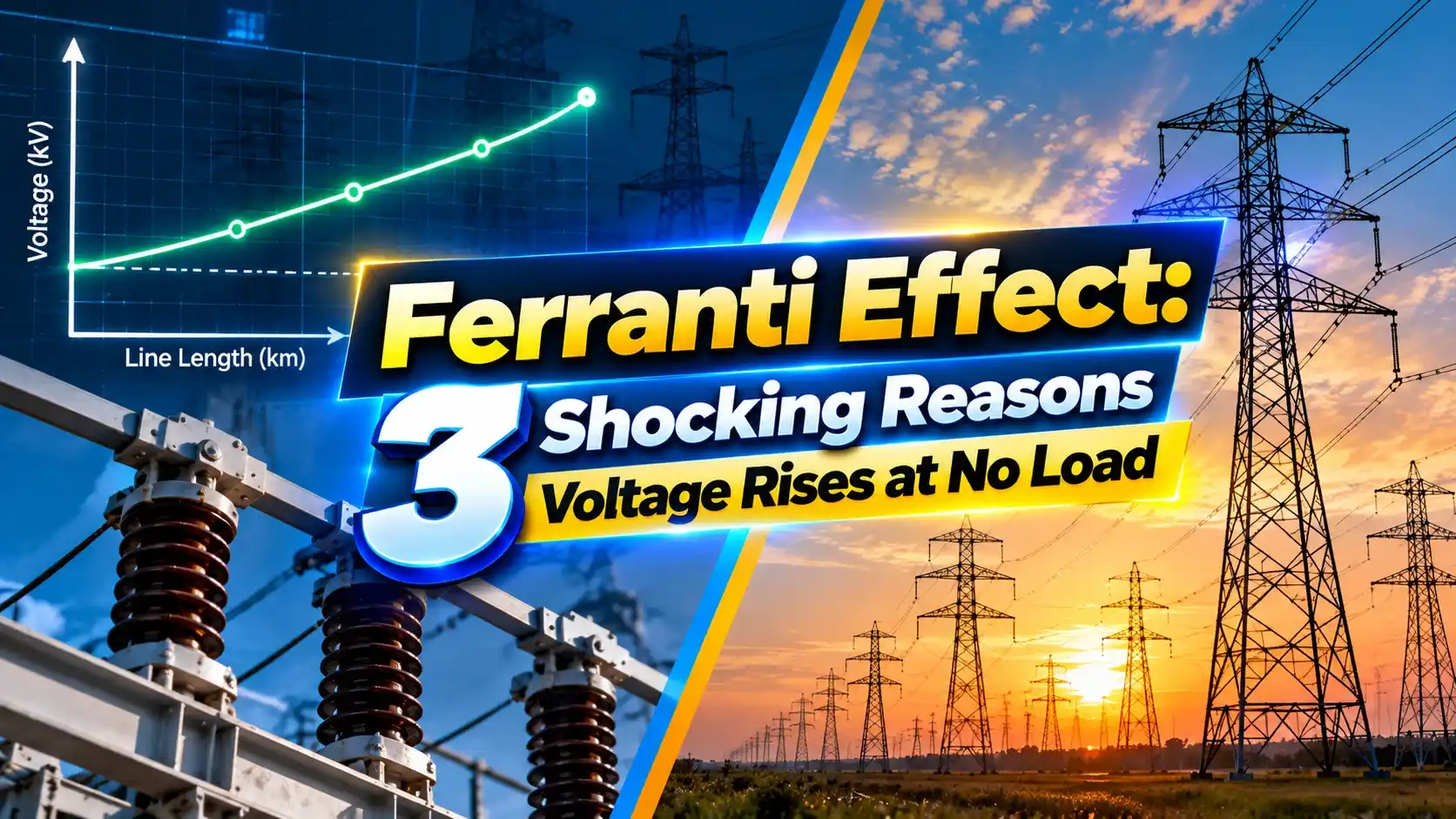
The Ferranti effect is the rise of receiving end voltage above sending end voltage on a long, lightly loaded line or cable. It is caused by line capacitance drawing charging current through the series inductance.
What Is the Ferranti Effect?
The Ferranti effect is a condition where the receiving end voltage of a long AC line becomes higher than the sending end voltage under light or no load. It was first observed by Sebastian de Ferranti in the 1880s on underground cables in London, and it follows from basic impedance and reactance behaviour.
Normally we expect voltage to fall along a line because of load current. At light load, however, the line itself behaves like a capacitor and draws leading current.
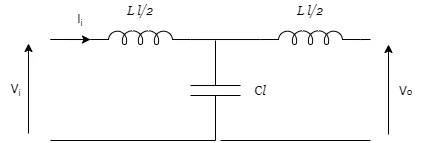
That leading charging current flows through the inductive reactance of the line. The resulting voltage drop is in phase with the source voltage and actually adds to it.
EEPower notes the effect is strongest on long lines and especially on cables, whose capacitance is far higher than that of overhead lines.
3 Shocking Reasons the Voltage Rises
Reason 1 depends on capacitance between conductors and to earth, which is distributed along every metre of the line.
Reason 2 is about phase angles, covered in phase angle in AC circuits. A leading current through an inductor produces a voltage that adds to the source rather than subtracting.
Put together, these three reasons explain why engineers watch voltage closely during light load hours, holidays and night time. Grid operators often see their highest system voltages at these times, not at peak demand.
Voltage Rise Formula With Example
Approximate rise ≈ ω² × L × C × ℓ² ÷ 2
Worked example, overhead line at 50 Hz:
L = 1 mH per km, C = 0.011 µF per km, ℓ = 300 km
β = 314 × √(1 × 10^(minus 3) × 1.1 × 10^(minus 8)) = 0.00104 rad per km
β × ℓ = 0.3125 rad, cos = 0.9516
Vr ≈ 1.051 × Vs, about 5 percent rise at no load
Doubling the length to 600 km raises the no load rise to roughly 22 percent. This is why very long lines always need compensation.
EEPower notes the theoretical limit is reached near one quarter wavelength, about 1500 km at 50 Hz, where voltage would rise without bound on a lossless line.
When the Ferranti Effect Appears
Energizing a long line from one end with the far end open is a classic case. Operators often close the far end breaker quickly or connect reactors first.
Long underground and submarine cables show the effect even at moderate lengths. Their high capacitance means large charging currents at every voltage level.
The same phenomenon links to reactive power flow, covered in active, reactive and apparent power. Lines at light load generate more reactive power than they absorb.
Methods to Control the Ferranti Effect
Shunt reactors are the most common remedy. EEPower suggests limiting uncompensated lines to about 600 to 700 km at 50 Hz, with reactors added beyond that.
Switching out capacitor banks at light load also helps, since they add to the leading current.
Ferranti Effect on Lines vs Cables
| Feature | Overhead Line | Underground Cable |
|---|---|---|
| Capacitance per km | Low | High, often 20 to 50 times higher |
| Length before significant rise | Hundreds of km | Tens of km |
| Typical remedy | Shunt reactors at ends | Reactors at both ends or mid route |
| Charging current | Moderate | Large |
Cable projects therefore study reactive compensation early. Long HVAC cable links often need reactors on both sides.
The resulting voltage profile is checked in voltage swell and insulation coordination studies.
No Load Voltage Rise Calculator
This lossless model slightly overestimates the rise on real lines with resistance. It is ideal for quick screening.
- Occurs at light or no load.
- Caused by charging current through inductance.
- Grows with the square of length.
- Controlled with shunt reactors.
- Overvoltage at remote substations.
- Stress on insulation and arresters.
- Equipment tripping on high voltage.
- Trouble energizing long cables.
Ferranti Effect Explained PDF
Voltage Rise Video Explanation
Ferranti Effect FAQ
Related Articles
- Impedance and Reactance in AC Circuits
- Active, Reactive and Apparent Power
- What Is Reactance
- Phase Angle in AC Circuits
- Capacitor Working Principle
External References
- Understanding Voltage Rise on Lines, EEPower
- Voltage Rise Technical Note, 3PhaseEE
- Power Systems Lecture on Line Voltage Rise, Engineering Devotion
- Transmission Line, Wikipedia
What We Learn Today
- Light load lets charging current dominate and raise far end voltage.
- The rise grows roughly with the square of line length.
- Shunt reactors and good switching practice keep voltage in limits.