
The tray you pick decides how well cables cool, how much they can weigh and how long the route survives the plant air. This guide compares every common tray and material, then shows how to check load, span and earthing.
Cable trays carry power, control and instrument cables across every plant, but the wrong tray overheats cables or rusts out in a few years. Learn each tray, each material, load classes, support spans and bonding rules.
What Are Cable Tray Types?
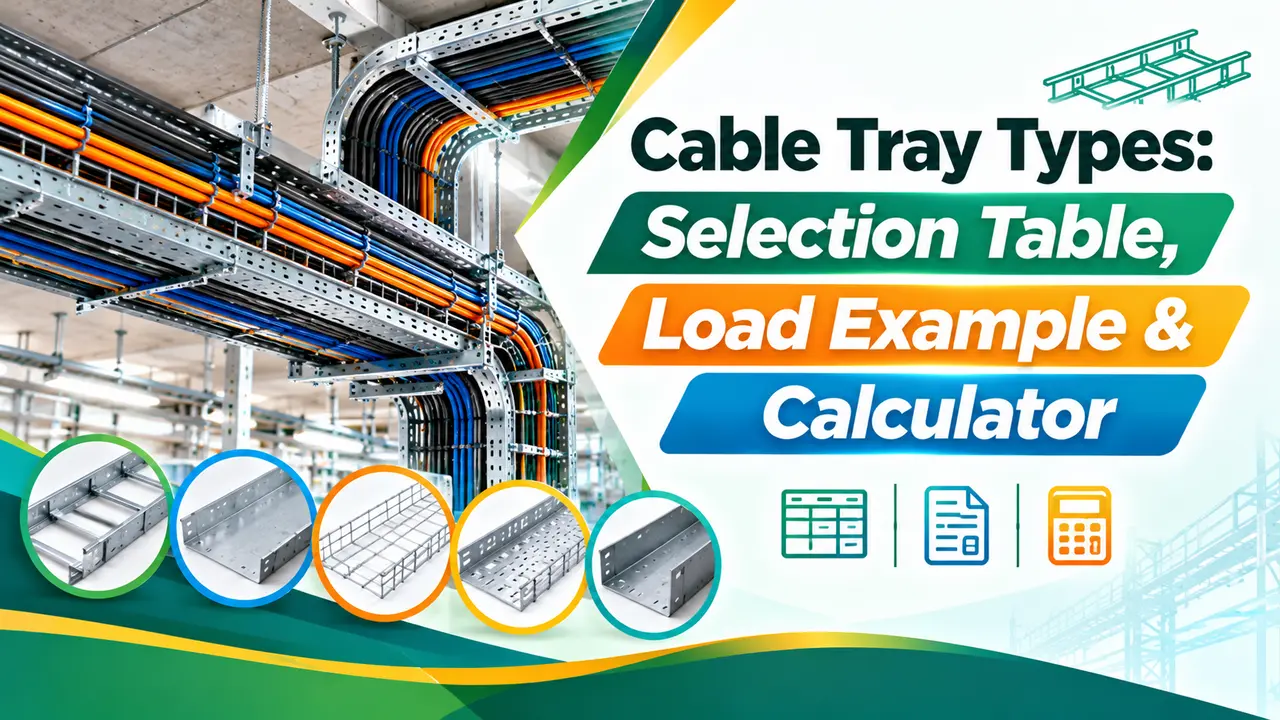
Cable tray types are the standard tray constructions used to support cables in plants and buildings, mainly ladder, perforated or ventilated, solid bottom, wire mesh, channel and trough trays. Each one balances cable cooling, mechanical protection, shielding and cost in a different way.
- Ladder tray suits heavy power cables and long spans with the best cooling
- Perforated tray suits mixed control and small power cables
- Solid bottom tray protects instrument cables and gives EMI shielding with a cover
- Wire mesh tray suits light power, data and fibre in buildings
- Channel tray suits drops and short runs with a few cables
A tray is only one part of the cable system, since the cable size, the derating factors and the route length all depend on how cables are laid. If you are sizing the tray width, use our cable tray fill calculation together with this guide.

Eaton rates its B Line KwikSplice aluminium tray for NEMA 12A and 12B load classes, for light industrial and data centre routes. The trapeze support shown above is the typical hanger for indoor runs from a ceiling or a steel structure.
Six Main Cable Tray Types Used in Plants
Most cable tray types used in Indian plants come from the six designs below. Each card shows where that tray fits best.
Two side rails joined by rungs, so cables are open to air and can leave the tray at any rung.
A ventilated bottom sheet with slots, giving more support than rungs while still letting heat escape.
A continuous bottom with no openings, often used with a solid cover.
Welded steel wire grid, light and easy to cut and bend on site.
A narrow tray of 3 to 6 inches wide, ventilated or solid.
A deep ventilated or solid tray with closely spaced support, like a ladder with a bottom.
ABB, in its cable tray technical guide, describes ladder tray as having welded rungs and side rails, and a ventilated version with rungs only 100 mm apart for small instrument cables. Eaton calls ladder tray the most widely used type because cables are anchored to rungs, airflow is maximised and dust builds up less.
ABB notes that a solid bottom tray with a solid cover can carry non plenum rated cables through air handling spaces. The same closed tray also traps heat, so cable ampacity must be checked again.
Ladder vs Perforated Cable Tray
| Point | Ladder Tray | Perforated Tray | Solid Bottom Tray |
|---|---|---|---|
| Cable cooling | Best | Good | Poor |
| Support for small cables | Weak between rungs | Good | Full |
| EMI shielding | None | Low | High with cover |
| Typical span | Long, 3 to 6 m | Short to medium | Short |
| Dust and water | Does not collect | Little | Can collect, needs weep holes |
| Typical use | Power cables on racks | Control and LV power | Instrument and signal cables |
The choice among cable tray types often comes down to this table. A ladder tray, the toughest of the cable tray types, carrying motor feeder cables stays cooler, while a perforated tray gives small control cables a flat bed so they do not sag between rungs.
Eaton advises rung spacing of 6 to 12 inches for small control cables and 9 inches or more for large power cables. If a solid bottom tray is used outdoors without a shielding need, Eaton suggests drilling quarter inch weep holes about every 3 feet so rain water can drain.
Never mix power cables and shielded instrument pairs in the same open tray without a metal divider. Separate trays or a barrier strip in a solid bottom tray keep induced noise out of your 4 to 20 mA loops.
Cable Tray Materials: GI, HDG, SS, Aluminium and FRP
| Material | Zinc or Base | Best Environment | Watch Out For |
|---|---|---|---|
| Pre galvanised steel (GI) | About 19 µm zinc per side | Dry indoor areas | Cut edges rust quickly |
| Hot dip galvanised steel (HDG) | About 65 µm zinc per side | Outdoor racks, general plant | Weight and cost |
| Stainless steel 316L | Molybdenum alloy | Chloride, coastal, food and pharma | Highest metal cost |
| Aluminium | 5000 or 6000 series alloy | Light structures, offshore with care | No bare copper contact |
| FRP | Polyester or vinyl ester | Chemical plants, acids, salt | UV and fire rating to confirm |
ABB gives the zinc coating of pre galvanised steel as about 19 µm per side and hot dip galvanised after fabrication as about 65 µm. The same guide states that hot dip galvanising can more than triple service life compared with pre galvanised steel, so most cable tray types used on outdoor racks are HDG.
For coastal or chlorine plants, ABB lists 316L stainless steel, where molybdenum improves resistance to chlorides. FRP is non conductive and non magnetic, which helps in chemical areas, but read the common types of corrosion first so you know what attacks each metal.
Selection Table by Cable Type and Environment
Use this table to shortlist cable tray types for a route before you check load and span.
| Application | Recommended Tray | Material |
|---|---|---|
| HV and LV power on outdoor pipe rack | Ladder, heavy duty | HDG steel |
| Control cables in a substation | Perforated with cover where needed | GI or HDG |
| Instrument and fieldbus cables | Solid bottom with cover | HDG or SS |
| Data centre or office data cables | Wire mesh | Zinc plated or SS wire |
| Drops to a transmitter or valve | Channel | SS or HDG |
| Acid or salt laden area | Ladder or perforated | FRP or SS 316L |
Match cable tray types to the most sensitive cable on the route. Instrument routes are usually planned in the instrument cable schedule, while power routes follow the cable ampacity study, as covered in this short guide to how cable sizing works.
- Best cable cooling
- Light and quick to install
- Easy to add or exit cables
- No water or dust traps
- Better EMI shielding
- Protects cables from falling objects and sun
- Holds heat, so derating may apply
- Can trap water without weep holes
NEMA VE 1 Load Classes and Support Span
In NEMA VE 1 the load class is written as a span in feet and a letter for load, so 12B means 75 lb per foot on a 12 foot span. Eaton lists A as 50 lb per foot, B as 75 and C as 100, which are about 75, 112 and 150 kg per metre.
| Class Letter | Load lb per ft | Load kg per m | Common Spans |
|---|---|---|---|
| A | 50 | 75 | 8, 12, 16, 20 ft |
| B | 75 | 112 | 8, 12, 16, 20 ft |
| C | 100 | 150 | 8, 12, 16, 20 ft |
Eaton explains that NEMA applies a safety factor of 1.5 to the failure load in a single span test, while IEC 61537 uses a continuous span test with a 1.7 factor. Place supports near the quarter point from a splice and keep only one splice between two supports, which also helps prevent cable tray sagging.
Power: 10 cables × 2.4 kg/m = 24 kg/m
Control: 20 cables × 0.45 kg/m = 9 kg/m
With 20 % future spare: 33 × 1.2 = 39.6 kg/m
Class B rating = 112 kg/m
Utilisation = 39.6 ÷ 112 × 100 = 35.4 %
Take cable weights from the cable maker datasheet and the rated load from the tray catalogue at your actual support span. This simple check compares cable tray types on load, but snow, wind and point loads from people walking on outdoor trays need extra margin.
Write the tray material, finish, load class and span on the cable route drawing itself. When cable tray types change along a route, mark the transition point so the site team orders the right splice plates.
Earthing and Bonding of Cable Trays
ABB states that metal tray must be grounded, and that tray bolted to a grounded structure is deemed bonded. Where it is not, the Canadian Electrical Code calls for grounding at intervals of no more than 50 feet, and bonding jumpers across expansion gaps and breaks.
Steel or aluminium tray can serve as an equipment grounding conductor under NEC 392.60 when it meets the area table, but ABB warns that bare copper must not touch aluminium tray because of galvanic corrosion. Follow the plant earthing design in earthing aspects in industrial process plants and our guide on equipotential bonding.
- Bonding jumper across every expansion splice and break
- Tray bonded to building steel or earth grid at both ends
- Earth continuity measured across splices
- No bare copper on aluminium tray
- Instrument trays kept apart from power trays
- Covers fitted where falling objects or sun are expected
- Weep holes in outdoor solid bottom trays
- Support span matches the load class used
During a site walkdown, our electrical safety audit checklist helps you note missing covers, broken bonding jumpers and overloaded trays. Also check the cable glands where each tray run enters a panel, and the voltage drop on long routes.
Eaton notes that aluminium cable tray is well suited as an equipment grounding conductor and is adequate for circuits with ground fault protection up to 2000 A. That is one reason aluminium ladder tray is popular in some power distribution routes.
The ABB technical guide below covers each tray, its finishes, splices, expansion joints and grounding. It is a good reference when you specify cable tray types for a project.
The video below compares different cable tray types with real product views. It is a quick visual recap of the cable tray types in the tables above.
Cable Tray Types FAQ
The main cable tray types are ladder, perforated or ventilated, solid bottom, wire mesh, channel and trough trays. Each one differs in cable cooling, support and protection.
Ladder tray is the most widely used for power cables on pipe racks. Solid bottom tray suits instrument cables, while wire mesh is common in data centres and offices.
A ladder tray has rungs between two side rails, so cables get the best airflow and can exit anywhere. It suits heavy power cables and longer support spans.
A perforated tray has a slotted bottom sheet that supports small cables along their whole length. It suits control and small power cables that would sag between rungs.
Hot dip galvanised steel ladder tray is the usual choice for outdoor racks, because its zinc layer is about three times thicker than pre galvanised sheet. ABB says this can more than triple service life.
For coastal or chemical sites, stainless steel 316L or FRP lasts longer. Add covers where sun or falling objects are a concern and drill weep holes in solid trays.
Support spacing depends on the load class of the tray, and NEMA VE 1 classes use spans of 8, 12, 16 and 20 feet. A tray rated 12B carries 75 lb per foot on a 12 foot span.
If you widen the span, the safe load drops, so check the maker catalogue. Place supports near the quarter point from a splice and use only one splice between supports.
Yes, metal cable tray must be earthed and kept electrically continuous along its whole length. Bonding jumpers are needed across expansion joints, firewall breaks and all other gaps in the run.
Tray bolted to earthed building steel is often treated as bonded already. Never connect bare copper directly to aluminium tray, since galvanic corrosion will weaken the joint.
A wire mesh or basket tray is made of welded steel wire and is light and easy to cut on site. It is used for data, fibre and light power cables in buildings.
It gives good airflow and makes it easy to add cables later. It is not normally chosen for heavy power cables or long spans on outdoor racks.
Related Articles
- Cable Tray Fill Calculation
- Cable Tray Sagging
- Cable Derating Factors
- Instrument Cable Schedule
- Cable Gland Types and Selection
External References
What We Learn Today
- The six main cable tray types are ladder, perforated, solid bottom, wire mesh, channel and trough, and each trades cooling against protection and shielding.
- Hot dip galvanised steel carries about three times the zinc of pre galvanised sheet, while 316L stainless steel and FRP suit coastal and chemical areas.
- Check NEMA load class at the real span, keep one splice between supports and bond every break so the metal tray stays continuous to earth.