
Every generator, transformer and magnetic flow meter depends on one simple idea, a changing magnetic flux creates a voltage.
Faradays law says that a voltage is induced in a coil whenever the magnetic flux through it changes. The faster the change and the more turns in the coil, the larger the induced voltage.
What Is Faradays Law?
Faraday's law of electromagnetic induction states that the EMF induced in a coil equals the rate of change of magnetic flux linking it, multiplied by the number of turns. Michael Faraday discovered this in 1831, and it remains the basis of almost all electrical power generation, including every alternator.
Magnetic flux is the amount of magnetic field passing through an area, measured in webers. A steady flux does nothing, but a changing flux pushes electrons and creates a voltage.

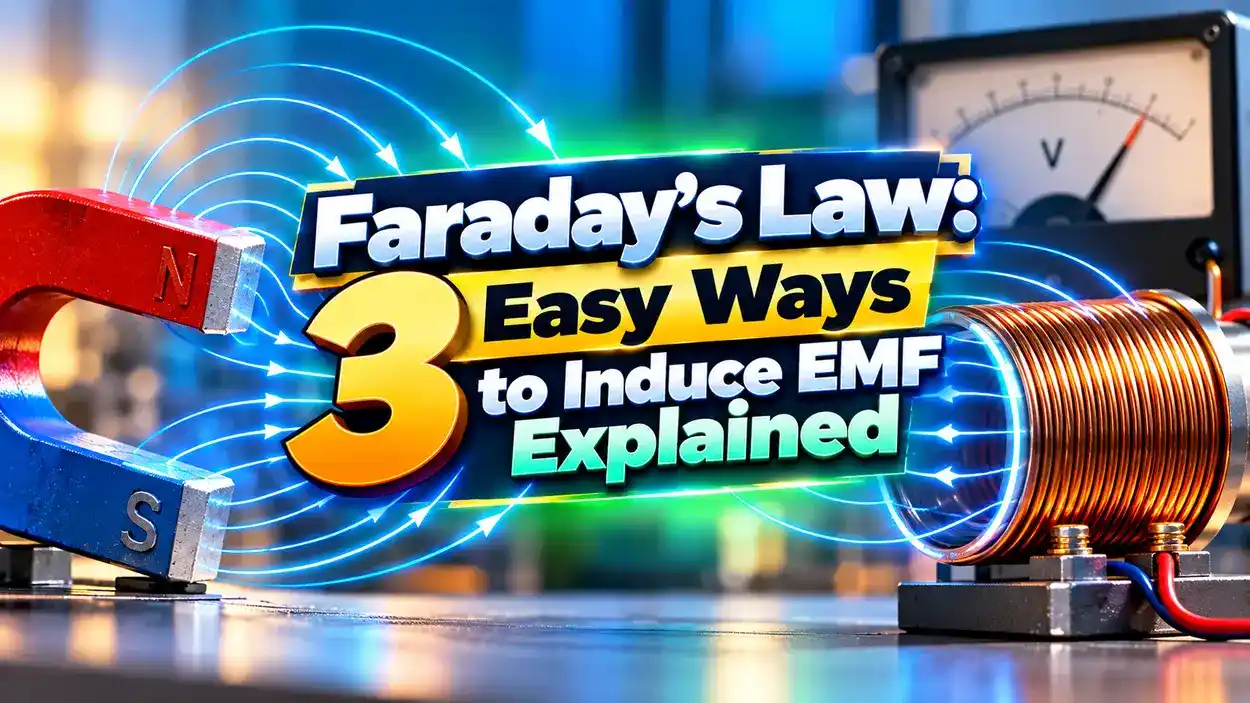
In the classic experiment, a magnet pushed into a coil makes a galvanometer needle swing one way. Pulling it out swings the needle the other way, and holding it still gives no reading at all.
This shows the key point of the law. Only change creates voltage, not the magnetic field itself.
Faraday's Law Formula With Worked Examples
Motional EMF = B × l × v
N = number of turns
ΔΦ = change in flux in webers
Δt = time for the change in seconds
B = flux density in tesla, l = conductor length, v = speed
Example 1: N = 200, ΔΦ = 0.05 Wb, Δt = 0.1 s
EMF = 200 × 0.05 ÷ 0.1 = 100 V
Example 2: B = 0.5 T, l = 0.2 m, v = 10 m/s
Motional EMF = 0.5 × 0.2 × 10 = 1 V
The full equation carries a negative sign, which represents Lenz's law. It tells us the direction of the induced EMF, while the formula above gives its size.
Doubling the number of turns doubles the voltage. Halving the time of the change also doubles it, which is why fast moving generators produce more voltage.
3 Easy Ways to Induce an EMF
Transformers use method 1, because the AC current in the primary makes the field rise and fall constantly. Our guide on transformer turns ratio shows how turns set the output voltage.
Generators use method 3 by rotating coils in a magnetic field. MIT course notes describe these same three mechanisms as the only ways flux can change.
Lenz's Law and the Direction of EMF
Lenz's law says the induced current always flows in a direction that opposes the change that caused it. This is simply energy conservation, because you must do work to push the magnet into the coil.
The same opposition appears as back EMF in motors, explained in our article on back EMF in motors and generators. As a motor speeds up, its back EMF rises and limits the current it draws.
Inductors store energy for the same reason. Our inductor working principle guide explains why current in a coil cannot change instantly.
Faraday's Law vs Lenz's Law
| Aspect | Faraday's Law | Lenz's Law |
|---|---|---|
| Tells you | Size of induced EMF | Direction of induced EMF |
| Main variable | Rate of flux change | Opposition to change |
| Formula part | N × ΔΦ ÷ Δt | Negative sign |
| Physical meaning | Change creates voltage | Energy conservation |
| Practical example | Generator voltage level | Eddy current braking |
The two laws always work together. Engineers often call the full equation Faraday's law, with Lenz's law included as the sign.
Eddy current brakes in trains and exercise bikes are a good example of Lenz in action. The induced currents create a field that resists motion without any contact.
Where Electromagnetic Induction Is Used
Instrument engineers meet this law daily in the electromagnetic flow meter. There, the liquid itself is the moving conductor, so E = B × l × v applies directly.
The current transformer and LVDT also rely on induced voltage to measure current and position.
Induction Effects Engineers Must Respect
Opening the secondary of a running current transformer is dangerous because the collapsing flux induces a very high voltage. Our article on CT secondary open circuit risks explains why the secondary must always stay shorted or loaded.
Switching off a relay coil or solenoid causes the same effect on a smaller scale. A flyback diode across the coil gives the stored energy a safe path and protects the transistor or PLC output.
Changing fields near cables also induce unwanted noise in instrument signals. Twisting and shielding, covered in shielded cable and twisted pair, cancels much of this induced voltage.
Induced EMF Calculator
The calculator gives the magnitude only. Use Lenz to decide the polarity based on whether flux is rising or falling.
- Only changing flux induces voltage.
- More turns give more voltage.
- Faster change gives more voltage.
- Induced current opposes the change.
- A strong steady magnet alone induces voltage.
- Induction needs physical contact.
- DC can drive a transformer continuously.
- Direction of EMF is random.
MIT Guide to Faraday Induction PDF
Induction Demonstration Video
Faraday's Law Questions Answered
Related Articles
- Inductor Working Principle
- Alternator Working Principle
- Current Transformer Working Principle
- How AC Induction Motor Works
- Difference Between AC and DC
External References
- Faraday's Law of Induction, Wikipedia
- Faraday Law Course Notes, MIT
- Faraday Law of Electromagnetic Induction, Electrical4U
- Lenz's Law, Wikipedia
What We Learn Today
- Only a changing magnetic flux induces voltage in a coil.
- EMF equals turns multiplied by the rate of flux change.
- Lenz's law sets the direction so the induced effect opposes the change.