
Run electricity into a coil sitting in a magnetic field and it spins as a motor. Spin that same coil by hand and it generates electricity instead. AC motors and generators are, at their core, the same machine running in opposite directions, connected by a phenomenon called back EMF.
A motor that is spinning is also, quietly, a generator. That second identity is not a coincidence, it is Lenz's law in action, and understanding it explains why a motor draws a small current when idling and a large current under load.
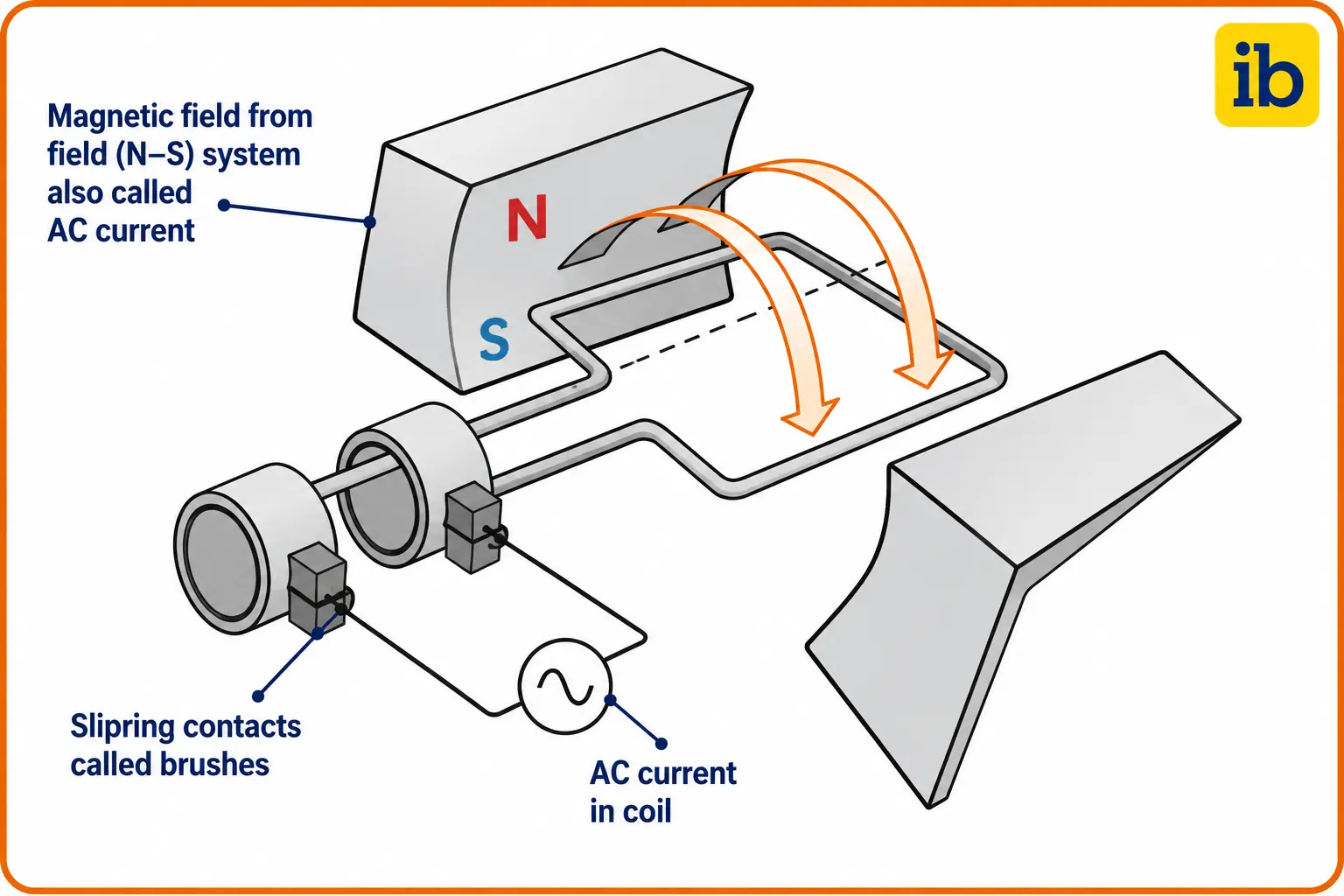
As in a DC motor, an AC motor passes current through a coil to generate torque. Because that current alternates, the motor only runs smoothly at the frequency of the sine wave feeding it, which is exactly why this type is called a synchronous motor. More common in practice is the induction motor, where current is induced in the rotating coils rather than supplied to them directly, avoiding the sparking and heating that high current through rotating contacts would otherwise cause.
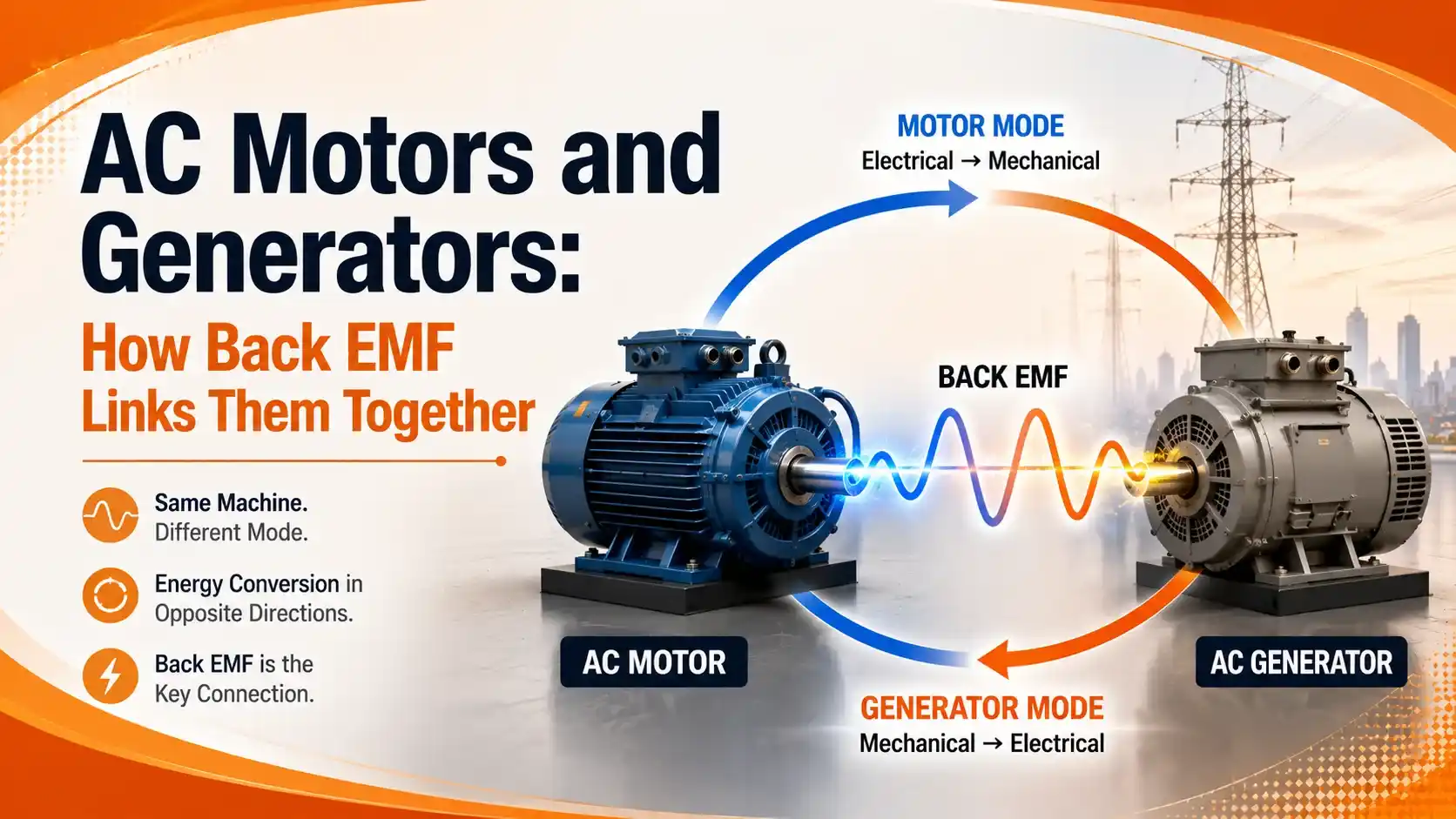
This guide covers how an AC motor and an AC generator actually work, the real formula behind the sinusoidal voltage a generator produces, and the back EMF relationship that links every motor to a generator hiding inside it.
How an AC Motor Works
In common AC motors, the magnetic field is produced by an electromagnet powered by the same AC voltage as the motor coil itself. The coils producing that magnetic field are called the stator, while the rotating coil and core assembly is called the armature. Since the field is sinusoidally varying, just like the current in the coil, the whole system stays synchronized to the supply frequency.
For the deeper mechanics of how synchronous and induction motors differ in practice, our guides on synchronous motor working principle and induction motor slip cover each type in full detail.
How an AC Generator Works
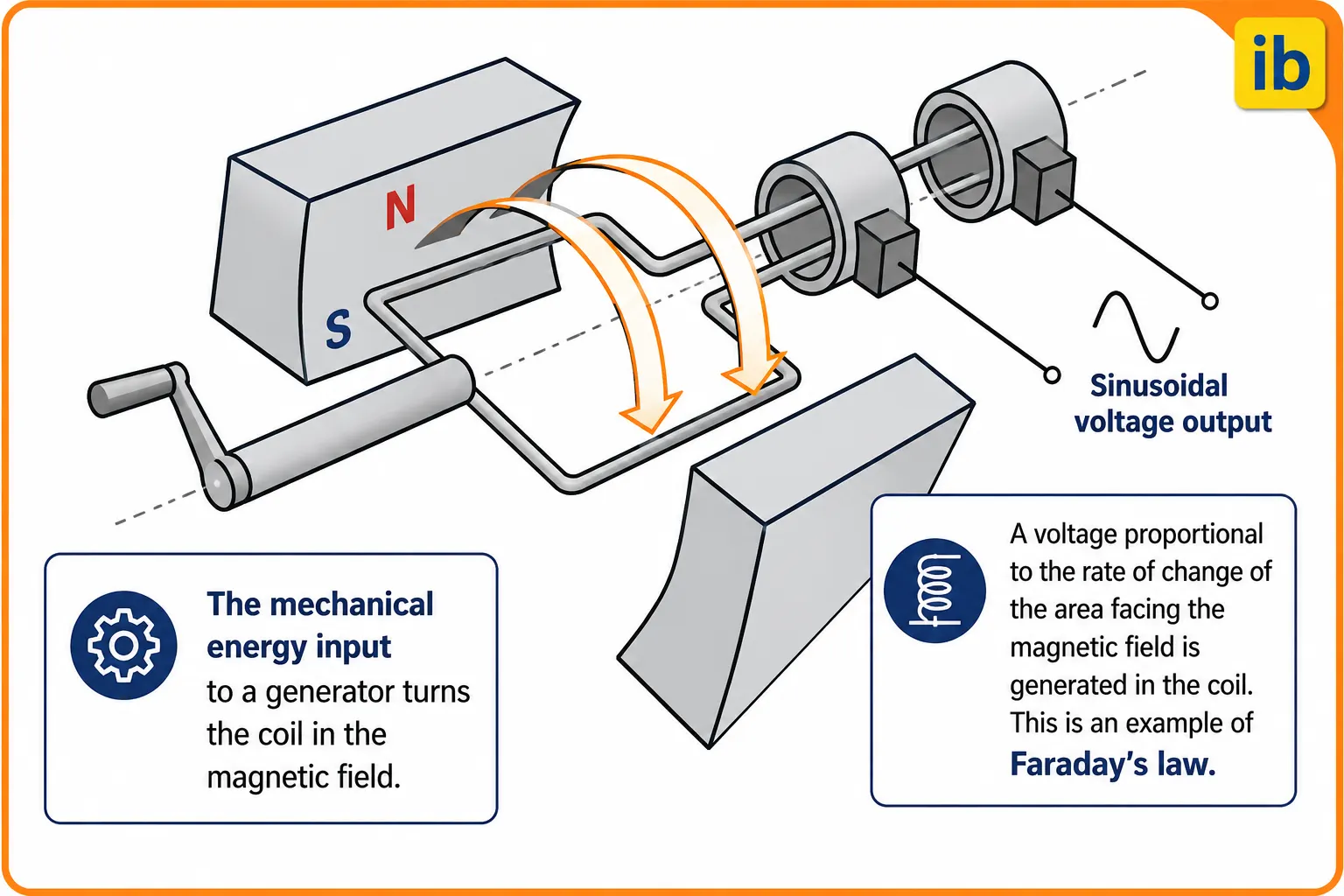
Turning a coil inside a magnetic field produces motional EMFs on both sides of the coil, which add together. Because the component of velocity perpendicular to the magnetic field changes sinusoidally as the coil rotates, the generated voltage comes out sinusoidal too, which is exactly what AC means.
This is Faraday's law in action: the coil's rotation continually changes the magnetic flux passing through it, and a changing flux is precisely what generates a voltage. The relationship has a clean mathematical form.
- e is the instantaneous generated EMF
- N is the number of turns in the coil
- B is the magnetic flux density
- A is the area of the coil
- ω is the angular velocity of rotation, in radians per second
- t is time
The peak EMF, N × B × A × ω, occurs when sin(ωt) equals 1, exactly when the coil's plane is parallel to the magnetic field and cutting through flux lines fastest.
🧮 Interactive AC Generator EMF Calculator
Enter the coil and rotation details to see the instantaneous and peak EMF generated.

The Generator Hiding Inside Every Motor: Back EMF
A hand cranked generator can turn a motor. That setup converts mechanical energy to electrical energy and then back to mechanical energy again, and it reveals something important: as a motor turns, it also acts as a generator, producing what is called a back EMF.
By Lenz's law, the EMF generated by the motor's own coil opposes the change that created it. This is not a side effect to engineer around, it is a built in, self limiting behavior every real motor has.
Motor Running Unloaded
The generated back EMF almost balances the input voltage, so very little current flows in the motor coil. The motor spins freely while drawing minimal current.
Motor Driving a Heavy Load
The back EMF is lower relative to supply voltage, so more current flows in the coil, and that extra electrical power is exactly what converts into mechanical power to drive the load.
A stalled motor has zero back EMF, since it is not turning and generating anything at all. That is precisely why a stalled motor draws its highest current, often enough to trip a breaker or burn a winding if it stays stalled too long.
Watch: AC Generators and Back EMF
This mini lecture walks through Faraday's law as it applies to AC generators and motors, including the back EMF relationship covered above.
Video: "AC Generators and Back EMF", via YouTube.
FAQs on AC Motors and Generators
You May Also Like
Synchronous Motor Working Principle: Stator, Rotor, and Synchronous Speed Explained
This guide covered the shared physics behind AC motors and generators. For the full picture of how a synchronous motor's rotor locks to the rotating field and why it needs help to start, this companion article covers it in depth.
Read Full Article →External References
- AC Motors and Generators, HyperPhysics, Georgia State University
- Faraday's Law of Induction, Wikipedia
- Counter Electromotive Force (Back EMF), Wikipedia
What we learn today
- AC motors and generators are fundamentally the same machine, a coil in a magnetic field, running in opposite energy directions.
- An AC generator's output follows e = N × B × A × ω × sin(ωt), producing a naturally sinusoidal voltage as the coil rotates.
- Every spinning motor also generates a back EMF through Lenz's law, which opposes the supply voltage and self limits current draw.
- An unloaded motor's back EMF nearly balances supply voltage, while a heavily loaded motor's back EMF drops and current rises to deliver more power.
- A stalled motor generates no back EMF at all, which is exactly why stall conditions draw dangerously high current.