
A clogged filter, a dry running pump or a stopped fan all show up first as a change in pressure difference. A simple two port switch can watch that difference and open or close a contact the moment it crosses a chosen value.
Instead of measuring pressure against atmosphere, this device compares two process pressures and acts on their difference. It needs no transmitter or controller logic to raise an alarm or stop equipment.
What Is a Differential Pressure Switch?
A differential pressure switch is a device with two pressure ports, high and low, that operates an electrical contact when the difference between them reaches a set value. It extends the basic idea explained in what is a pressure switch from one pressure to two.
Tameson explains that the sensing element can be a diaphragm, capsule, Bourdon tube or bellows, reacting to the pressure difference between the two connected points. The set point can be fixed at the factory or adjusted on site.
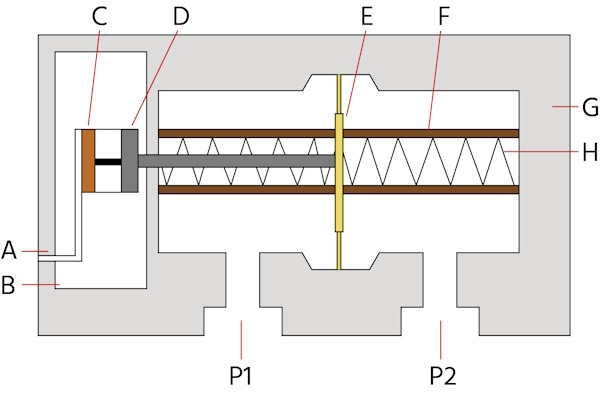
How the Two Port Mechanism Works
In a differential pressure switch, the diaphragm or piston separates the two chambers, so equal pressures cancel and only the difference produces force. When that force overcomes the range spring, a rod pushes the microswitch and the contact changes over.
Most units use a single pole double throw, SPDT, contact with common, normally open and normally closed terminals. The Dwyer Series 1900 manual rates its SPDT switch at 15 A from 120 to 480 VAC.
Diaphragm vs Piston Sensing
Soft elastomer for very low differentials.
Welded stainless for liquids and higher pressure.
Spring loaded piston, very robust.
Sensitive and linear, moderate pressure.
DwyerOmega notes that its low range switches cover differentials from 0.01 inch water column up to 50 psig, using diaphragms up to 7.75 inches in diameter. A larger diaphragm gives more force at tiny differentials.
Set Point, Deadband and Static Pressure
The set point is the differential at which the contact changes state on rising pressure. The switch resets at a lower value, and the gap between them is the deadband, explained in deadband in pressure switches.
DwyerOmega gives an example where a switch operating at 3.5 inches water column resets at about 2.4 inches, a deadband of 1.1 inches. Deadband stops the contact from chattering when the differential hovers near the set point.
Static or line pressure is the pressure present on both ports at once. A differential pressure switch rated for a tiny differential can still be damaged if its static rating is exceeded, so check both values on the datasheet.
5 Smart Uses in Plants and Buildings
Filter monitoring is the most common duty, both for air filters and the elements discussed in strainer and filter difference. Tameson lists volume control, duct pressure, room pressure and filter checks as typical HVAC system uses.
Flow proving by pressure difference is one of the methods compared in flow switch working principle.
Checking Set Point Against Range
Reset point = set point minus deadband, for a rising trip
Example:
Adjustable range 50 to 500 Pa, set point 250 Pa, deadband 20 Pa
Percent = (250 minus 50) ÷ 450 × 100 = 44.4 percent
Resets at 250 minus 20 = 230 Pa falling
A common selection rule is to keep the set point between about 25 and 75 percent of the adjustable range. Near the ends, repeatability suffers and the spring works outside its most linear region.
Set Point and Deadband Calculator
Installing and Setting a Differential Pressure Switch
On liquid service, fit a three valve valve manifold so the ports can be equalised during testing. The Dwyer 1900 manual states that turning the slotted screw clockwise raises the set point and counter clockwise lowers it.
Detailed field procedures are in pressure switch set point and deadband configuration.
- Simple, low cost and reliable.
- Direct contact output, no controller needed.
- Works without power for the sensing element.
- Handles very low differentials.
- On or off signal only, no trend.
- Mechanical drift needs periodic checks.
- Fixed deadband on many models.
- Static pressure limits must be respected.
When the actual value must be trended, a differential pressure transmitter is better, as compared in pressure switch vs pressure transmitter. For local indication alongside the switch, add a differential pressure gauge.
Dwyer Series 1900 Manual PDF
Danfoss Switch Setup Video
Differential Pressure Switch FAQ
It compares two process pressures and changes an electrical contact when their difference reaches a set value. It does not respond to the absolute pressure level on its own.
Typical uses are filter clog alarms, pump protection and air flow proving in ducts. The contact can drive an alarm lamp, a safety interlock or a PLC input.
The high port connects to the point with higher pressure, which is usually upstream of the equipment. The low port connects to the lower pressure point, usually downstream.
Reversing them makes the switch see a negative difference during normal running. Then it will never reach its set point and the protection is lost.
Deadband is the difference between the operating point and the reset point of the contact. It prevents contact chatter when the pressure difference hovers near the set value.
Some models have a fixed deadband, while others allow adjustment with a second screw. Choose a value that suits how quickly the process pressure changes.
It is the maximum pressure the body can safely see on both ports at the same time. It is usually far higher than the differential range printed on the scale.
Exceeding it can rupture the diaphragm, bend the linkage or cause leakage to atmosphere. Always check it carefully for pumps and other high pressure systems.
A common guideline is to keep it between about 25 and 75 percent of the adjustable range. Accuracy and repeatability are usually best in that middle region.
If the set point falls near either end, choose a switch with a different range instead. That keeps the range spring working in its most linear region.
First note the clean filter pressure drop and the recommended change value from the filter maker. Then set the switch to operate at that change value on rising difference.
Test the setting with a hand pump and a calibrated gauge connected to the high port. Record both the operate and reset points on the calibration sheet.
A switch is cheaper and simpler when only an alarm or trip is needed at one value. It gives a clear on or off signal without any configuration software.
A transmitter gives a continuous value for trending, diagnostics and early warning. Many critical services use both together for control and independent protection.
Related Articles
- What Is a Pressure Switch
- Deadband in Pressure Switches
- Differential Pressure Transmitter Working Principle
- Flow Switch Working Principle
- Pressure Switch vs Pressure Transmitter
External References
- Series 1900 Pressure Switch Manual, DwyerOmega
- DP Switches in HVAC Systems, Tameson
- Pressure Switch, Wikipedia
What We Learn Today
- A differential pressure switch compares high and low port pressures and flips an SPDT contact when their difference reaches the set point.
- Deadband sets the reset point, and static pressure rating must suit the line pressure present on both ports at once.
- Keep the set point between about 25 and 75 percent of the range for filter, pump, flow proving and HVAC duties.