
A flow switch detects the presence or absence of flow in a pipe and provides a discrete on/off output when flow crosses a preset threshold.
It does not measure flow rate continuously. It monitors whether flow is above or below a setpoint.
This guide covers the three main types, how each works, their setpoint ranges, and how to select the right type for your process.
A flow switch is not a flow meter. A flow meter measures flow rate continuously and outputs a proportional signal.
A flow switch only indicates whether flow is present or absent — a simple contact output. Use this device when you only need to know "is there flow?", not "how much?"
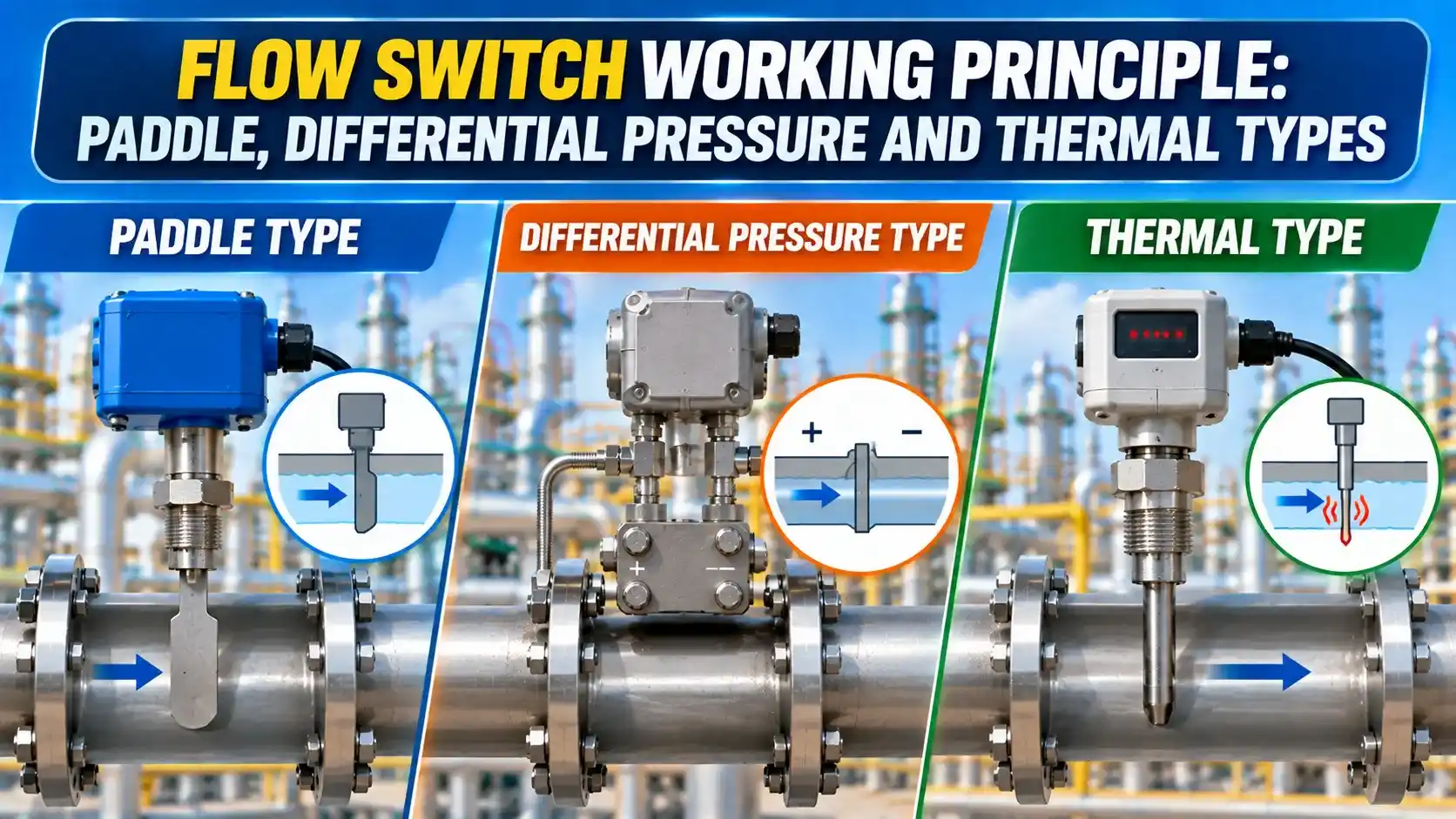
Flow Switch Working Principle and How It Differs from a Flow Meter
This device monitors a process line and triggers a relay or transistor output when flow crosses a threshold.
The output is a single-pole double-throw (SPDT) contact: one normally-open (NO) and one normally-closed (NC).
The contact changes state when flow crosses the trip point. The same device serves both high-flow and low-flow functions: the trip direction is set by wiring to the NO or NC terminal.
Before electronic transmitters, most pump protection systems used a simple paddle flow switch (see the pressure switch guide for the equivalent concept on pressure) on the pump discharge to confirm that the pump was actually moving fluid. If the pump ran but the paddle switch indicated no flow, the seal water or coolant was stopped automatically to protect the mechanical seal.
This basic application — protecting a pump mechanical seal from dry running — is still one of the most common uses of a paddle flow switch in modern process plants.
Flow Switch Types Explained
A paddle type has a flat vane inserted into the pipe. The flowing fluid exerts a drag force on the paddle and deflects it in the direction of flow.
This deflection is transmitted through the pipe wall to an external microswitch, which changes state at the setpoint deflection.
The setpoint is adjusted by changing the spring tension opposing the paddle deflection, or by repositioning the microswitch activation point relative to the lever arm.
Fluid types: Liquids primarily. Some paddle flow switches work on air and gas, but low gas density requires a larger paddle or longer arm for sufficient deflection force.
Flow direction sensitivity: The paddle deflects only in the flow direction. Reverse flow deflects it away from the setpoint. Bi-directional service requires two switches, one for each flow direction.
Wetted materials: Paddle and fitting material (316 SS, PVC, Hastelloy) must be compatible with the process fluid. The microswitch mechanism is outside the pipe and is not wetted.
A paddle that is too large for the pipe bore will cause excessive pressure drop and false trips on surge or slug flow. A paddle that is too small will not deflect enough to actuate the switch at the minimum required flow velocity.
Most manufacturers provide a paddle size chart (paddle width as a percentage of pipe bore) for different pipe sizes and fluid viscosities. Always cross-check this before ordering — the standard paddle size supplied with the device is often sized for water, not for viscous or light fluids.
In this orientation, gravity pulls the paddle to the deflected position even with zero fluid velocity — actuating the switch and indicating false flow.
Always install a paddle type with the paddle moving horizontally (not vertically) when flow is applied. The manufacturer's installation arrow on the body shows the correct orientation. Ignore it and the switch will misread every time the line is depressurised.
A differential pressure flow switch measures the pressure drop across a fixed restriction (orifice plate, pitot tube, or venturi insert).
The restriction creates a DP proportional to the square of the flow velocity. When DP crosses the setpoint, the switch actuates.
The DP sensing element (typically a piston or diaphragm) directly operates a microswitch through a sealed actuator.
No moving parts are inserted into the pipe bore. The restriction and pressure taps are the only wetted components.
Fluid types: Liquids, gases, and steam. The DP approach works on any fluid creating a measurable pressure differential.
See the pressure drop guide and the deadband guide for related switch concepts.
Setpoint: Factory-set based on the orifice sizing and the required DP at the trip flow rate.
The setpoint corresponds to a specific flow velocity. It cannot be freely adjusted in the field without changing the restriction geometry or the sensing capsule spring.
No moving parts in the flow: the DP type has no paddle in the flow path.
This makes it suitable for fluids where a paddle would erode, foul, or clog: slurries, steam, and viscous liquids.
if the switch setpoint is at 50% of maximum DP, the trip point corresponds to 70.7% of maximum velocity (not 50%) because flow is proportional to the square root of DP.
This is the same relationship as a DP flow transmitter in square root mode. Always verify the trip velocity against the actual process flow rate and pipe area, not against the DP setpoint percentage alone.
By measuring the DP across a filter element rather than an orifice, the same DP switch indicates both "is there flow?" (DP greater than zero) and "is the filter blocked?" (DP exceeds the high-fouling setpoint).
This dual function is used in lubricating oil filter systems, instrument air dryer installations, and HVAC air filter monitoring — a single DP switch providing both flow confirmation and maintenance alarm.
the thermal type uses two elements in the pipe: a heated element and a reference (unheated) element.
When fluid flows past the heated element, it carries heat away. The temperature difference between the two elements decreases as flow increases.
The electronic circuit compares the two temperatures. When the difference falls below the setpoint (sufficient flow present), the switch output changes state.
At zero flow, the heated element runs hot — maximum temperature difference. At the trip flow rate, the difference has dropped to the threshold.
Fluid types: Liquids and gases. Thermal flow switches excel at very low flow velocities where a paddle or DP element produces insufficient signal.
Minimum detectable velocity can be as low as 0.01 m/s in liquid service — 10 to 20 times more sensitive than a paddle type.
No moving parts: this thermal design has no moving parts in the flow stream. Highly reliable on clean fluids with no fouling or abrasion risk.
Limitation: This type is affected by changes in fluid temperature and thermal properties.
If process temperature fluctuates significantly, the apparent temperature difference changes without any flow change — causing false trips or missed trips unless the setpoint is temperature-compensated.
The heat transfer from the heated element to the fluid depends on the fluid's thermal conductivity and its flow velocity. A high-viscosity oil moves heat away very slowly even at higher velocities — making it hard for the electronics to distinguish no-flow from slow-flow.
For viscous fluids above about 100 cP, specify a paddle or DP switch instead. Thermal types are best suited to water, light process fluids, instrument air, and clean gas streams.
In CTA mode, the electronics actively maintain the heated element at a fixed temperature above the fluid temperature by adjusting the heating current. The required current is directly proportional to the heat removed by the flowing fluid, which is directly related to the mass flow rate.
This approach is much more sensitive and temperature-compensated than the simpler differential-temperature method, and is why modern thermal flow switches can detect extremely low flow velocities in gas service (below 0.01 m/s in some designs).
switch types: full comparison
| Parameter | Paddle (Vane) | Differential Pressure | Thermal (Calorimetric) |
|---|---|---|---|
| Working principle | Flow drag deflects paddle; deflection actuates microswitch | Flow creates DP across orifice; DP actuates piston or diaphragm switch | Flow carries heat from heated element; temperature difference actuates electronic switch |
| Moving parts in flow | Yes: paddle and lever arm | No (only fixed orifice restriction in pipe) | No (two probe elements, no moving parts) |
| Fluid types | Liquids; limited gas/air service | Liquids, gases, steam | Liquids and gases (clean, low viscosity) |
| Minimum detectable velocity | 0.1 to 0.3 m/s (liquid) | 0.05 to 0.5 m/s (depends on orifice ratio and fluid density) | 0.001 to 0.05 m/s (liquid); 0.01 to 0.3 m/s (gas) |
| Slurry and dirty fluid | Poor: paddle fouls and erodes | Moderate: orifice plates can plug on heavy slurry | Poor: probe fouling changes calibration |
| Gas and steam service | Limited: large paddle needed | Good: no paddle, suitable for steam with correct orifice sizing | Good for gas; avoid steam (condensation changes thermal reading) |
| Pressure drop introduced | Low to moderate (paddle obstruction) | Moderate (deliberate restriction is the sensing element) | Near zero (small probe cross-section) |
| Setpoint adjustment | Mechanical: spring tension or lever position | Factory-set orifice; some models have adjustable DP setpoint | Electronic: adjustable via potentiometer or DIP switches |
| Response time | Fast: direct mechanical actuation (under 1 second) | Fast: direct piston/diaphragm actuation (under 1 second) | Slower: thermal time constant typically 2 to 30 seconds |
| Typical applications | Pump seal protection, cooling water confirmation, HVAC chilled water | Filter element monitoring, steam service, general flow/no-flow on clean fluids and gases | Very low flow detection, clean gas flow confirmation, instrument air, laboratory equipment |
Flow Switch Type Selector
watch: types and working Principle
FAQ: Flow Switch Questions
External References
- Flow Switch Types: Paddle, Thermal and DP Compared | Gems Sensors (2025)
- Thermal Flow Switch Applications and Selection | IFM Electronic (2025)
What We Learn Today
- A flow switch gives a discrete on/off contact output when flow crosses a setpoint — not a continuous flow rate signal. Use it when "is there flow?" is the question, not "how much flow?"
- Paddle type: simplest, lowest cost, for clean liquid at normal velocity. DP type: no moving parts, good for steam and gas. Thermal type: best for very low flow and clean gas, slowest response time.
- Install a paddle flow switch with the paddle moving horizontally — not vertically — when flow is applied. Vertical installation causes gravity-induced false trips at zero flow.