
A ripple counter chains flip-flops so each one clocks the next. That single wiring choice is exactly why its delay compounds with every added bit, and exactly why the synchronous counter exists. Here is the full comparison, with real circuit diagrams and a live timing simulator you can try now.
What Is a Digital Counter?
A digital counter is a sequential circuit built from flip-flops that cycles through a fixed sequence of binary states, one state per clock pulse.
Every counter is really just a specialized register that increments itself, using logic that resembles the same binary addition covered in our half adder vs full adder guide, built from the same flip-flop types we covered previously.
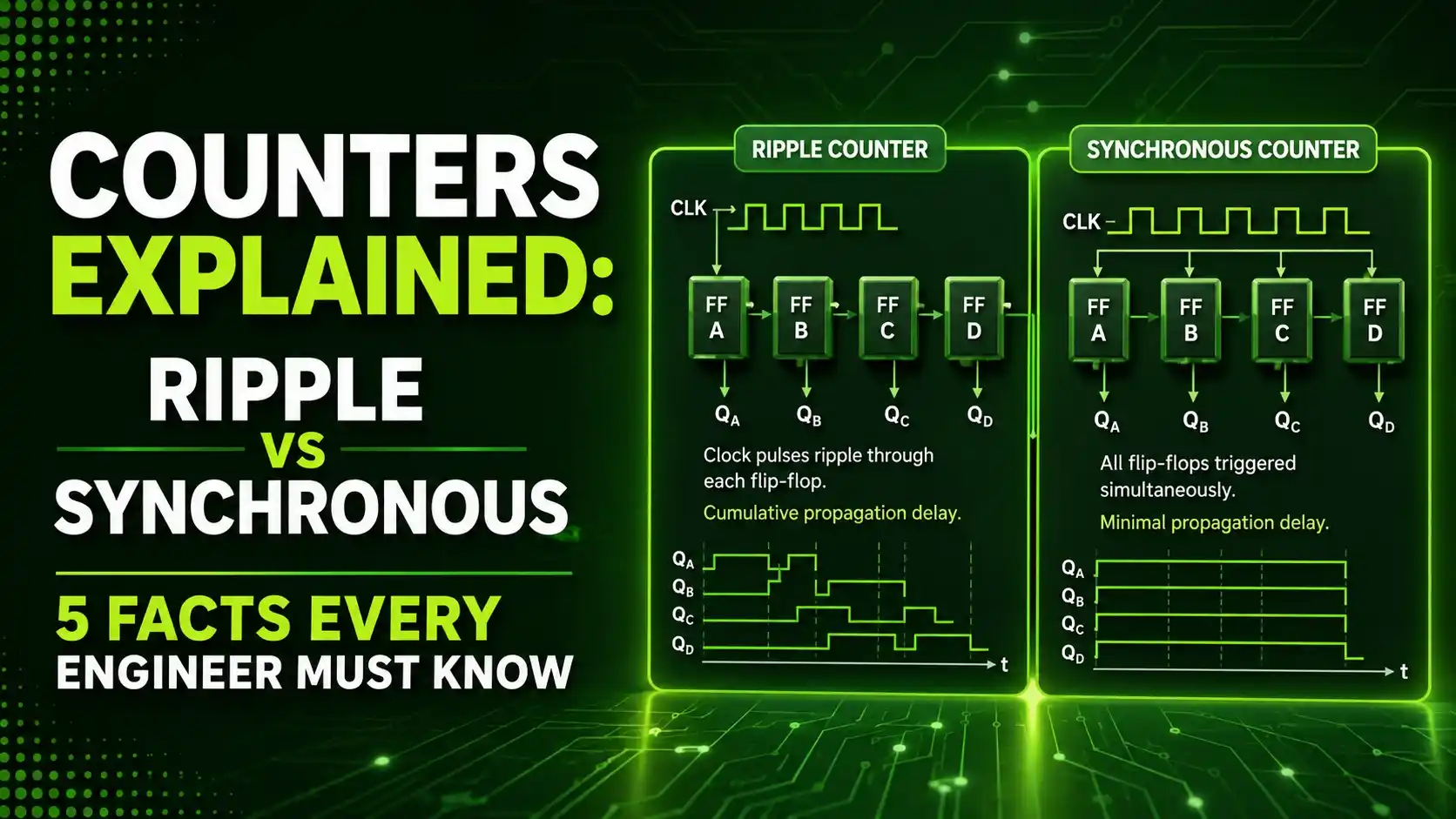
How those flip-flops are clocked splits counters into two very different families: ripple counters and synchronous counters. This guide covers the five essential facts behind that split, from wiring differences to real IC part numbers.
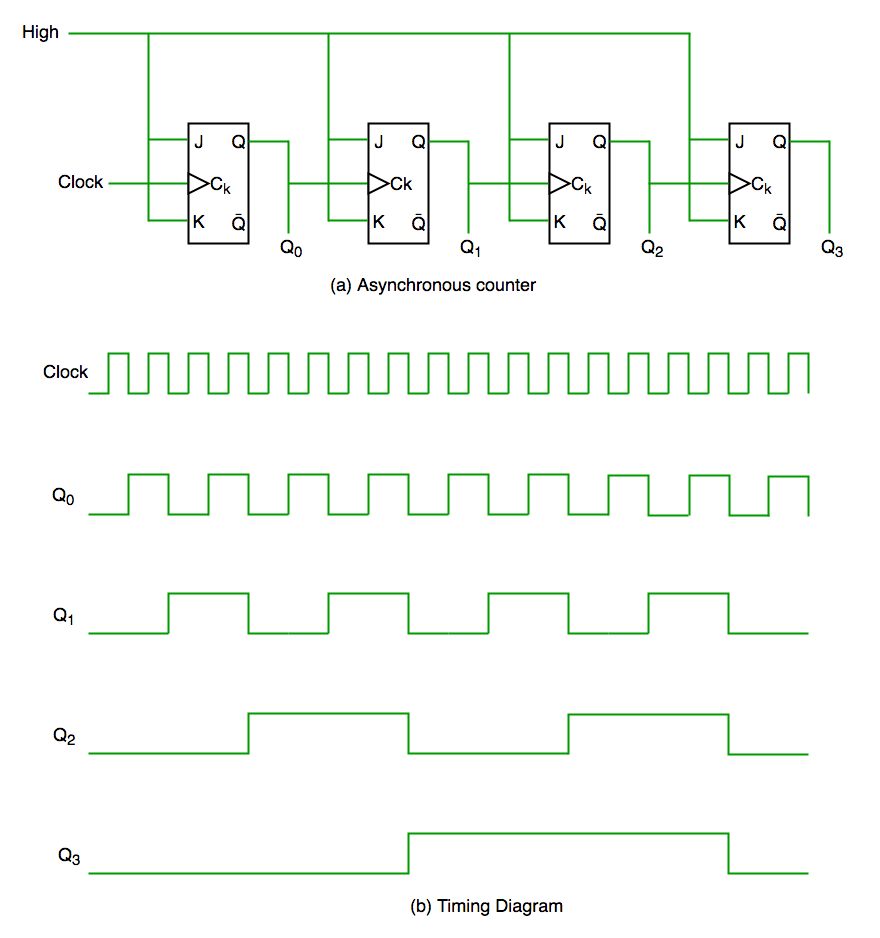
Ripple vs Synchronous Counters: Core Definitions
Before comparing the details of ripple vs synchronous counters, it helps to see each definition side by side.
Ripple Counter
Only the first flip-flop receives the external clock. Each following flip-flop is clocked by the output of the one before it, causing the count to ripple through the chain.
Best for: simple, low-cost frequency division where speed does not matter.
Synchronous Counter
Every flip-flop receives the same external clock at the same time. Combinational logic decides which flip-flops toggle on each pulse.
Best for: high-speed counting where predictable timing matters.
5 Facts Every Engineer Must Know About Counters
These five facts explain why both counter families still exist side by side, and when each one actually makes sense.
Ripple Counters Chain Flip-Flops in Series
Each flip-flop's output becomes the next flip-flop's clock input. Simple to wire, but it means every stage waits for the one before it to finish toggling first.
Synchronous Counters Clock Every Stage at Once
A single common clock line reaches every flip-flop simultaneously. Extra logic gates determine which flip-flops toggle, replacing wiring complexity with logic complexity.
Propagation Delay Compounds in Ripple Counters
A ripple counter's total delay is the sum of every flip-flop's individual delay. A synchronous counter's delay is just one flip-flop's delay, no matter how many bits wide it is.
Ripple Counters Are Cheaper but Glitch-Prone
Fewer gates mean lower cost and simpler design, but the sequential toggling can produce brief, incorrect intermediate states during transitions that a decoder downstream might briefly misread.
Real ICs Make the Trade-Off Concrete
The 7493 ripple counter and the 74163 synchronous counter solve the same basic problem with genuinely different internal wiring, cost, and maximum operating speed.
Synchronous Counter Circuit Diagram
Notice how every flip-flop connects to the same clock line, with logic gates feeding each J and K input instead.
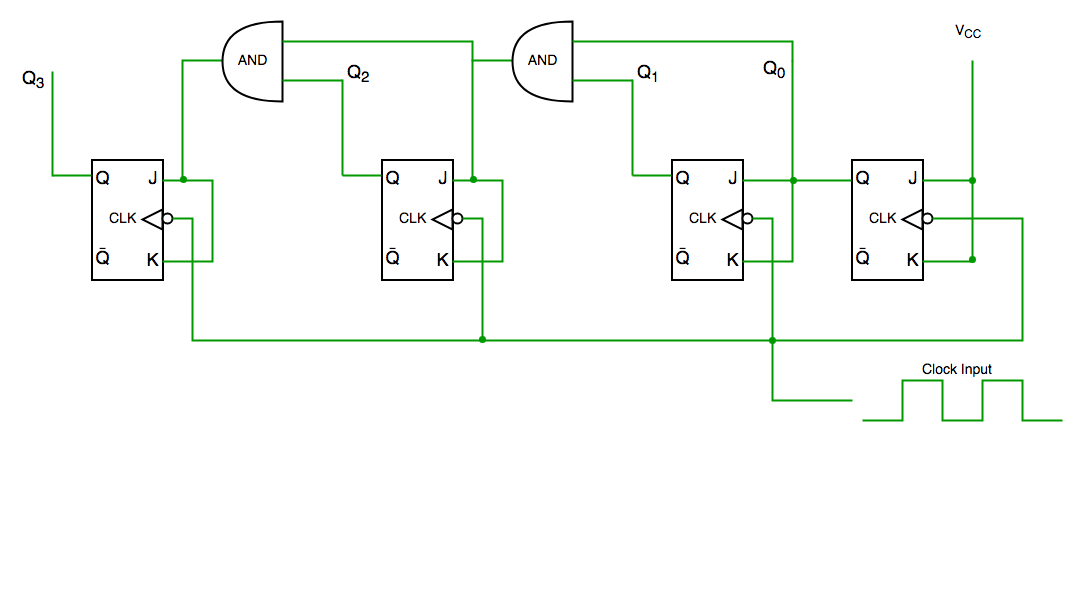
What is happening: Q0 toggles on every clock pulse, exactly like in a ripple counter. But Q1, Q2, and Q3 all also connect directly to that same clock line, with AND logic on their J and K inputs deciding whether they toggle this cycle.
A real example: Q1 only toggles when Q0 is already high, using an AND gate fed by Q0. Q2 only toggles when both Q1 and Q0 are high. This cascaded AND logic reproduces the exact same counting sequence as a ripple counter, just without the sequential delay.
Why it works: Since every flip-flop reacts to the same clock edge at the same instant, the maximum speed depends only on the slowest single flip-flop and its logic, not on how many bits the counter has.
Propagation Delay Compared
This is the single biggest practical difference between ripple vs synchronous counters, and it grows worse for ripple designs with every bit added.
Delay Formulas
Both relationships reduce to one simple rule each.
Ripple counter total delay: Td = n × tpd
Synchronous counter total delay: Td = tpd (constant)
Worked example: tpd = 10ns per flip-flop, n = 6 bits
Ripple: Td = 6 × 10 = 60ns
Synchronous: Td = 10ns, unchanged
Try It: Ripple vs Synchronous Counter Simulator
Click Clock Pulse repeatedly to compare ripple vs synchronous counters counting up, while the delay readout shows exactly why they behave differently.
Real Counter IC Comparison
Click each tab to see how these families show up as actual part numbers in real designs.
The 7493 is a classic 4-bit ripple counter, internally split into a divide-by-2 and a divide-by-8 section that can be wired together for a full divide-by-16 count. Inexpensive and simple, widely used purely as a frequency divider.
The 74163 is a synchronous 4-bit binary counter with parallel load and internal carry lookahead, letting multiple 74163 chips be cascaded for wide, fast counting without accumulating ripple delay.
The 4020 is a 14-stage CMOS ripple counter, commonly used purely for frequency division in low-power clock circuits where its cumulative delay across 14 stages is simply irrelevant to the application.
The 74190 is a synchronous up/down decade counter, adding direction control on top of standard synchronous counting, common in digital displays and control sequencing.
Ripple vs Synchronous Counters Comparison Table
| Feature | Ripple Counter | Synchronous Counter |
|---|---|---|
| Clocking | Only first flip-flop, others chained | All flip-flops, same clock line |
| Propagation Delay | Sum of all flip-flop delays | One flip-flop delay, constant |
| Gate Count | Low | Higher, needs extra logic per stage |
| Glitches | Possible during transitions | Rare, clean transitions |
| Best For | Simple frequency division | High-speed, precise counting |
Applications of Counters
Frequency Dividers
Ripple counters cheaply divide a clock frequency down by powers of two.
Digital Clocks
Cascaded counters track seconds, minutes, and hours from a stable time base.
Event Counters
Production lines and sensors use counters to tally discrete events over time.
Address Sequencing
Memory and instruction addresses often step through a synchronous counter.
Frequency Synthesizers
Synchronous counters divide a reference clock precisely inside PLL circuits.
Instrumentation Timing
Test equipment relies on accurate counters for precise timing measurements.
Advantages and Limitations of Each Counter Type
Why Synchronous Counters Win at High Speed
Where Ripple Counters Still Make Sense
Download Counter References
These two references go deeper into real counter circuit design using actual ICs.
PHYS 432 Lab 4: Counters
University of Oregon lab guide building a real ripple counter with 7474 ICs
MOD 11 Synchronous Binary Counter Using IC 74163
Real project report designing a custom-modulus synchronous counter
Watch: Propagation Delay in Ripple Counters Explained
This video explains exactly how propagation delay limits ripple counter performance.
FAQs on Ripple vs Synchronous Counters
These questions about ripple vs synchronous counters come up constantly in digital logic coursework and real design work.
External References
- University of Oregon, PHYS 432 Lab 4: Counters
- MOD 11 Synchronous Binary Counter Using IC 74163
- GeeksforGeeks, Counters in Digital Logic
- YouTube, Effect of Propagation Delay on Asynchronous Counter Explained
What we learn today
- Ripple counters chain flip-flops so each one clocks the next, causing delay to compound with every bit added.
- Synchronous counters clock every flip-flop from the same line simultaneously, using logic to decide which ones toggle.
- Ripple counter delay equals the sum of all flip-flop delays, while synchronous counter delay stays roughly constant.
- Real ICs like the 7493 and 74163 make the cost, speed, and complexity trade-off between these families concrete.
- Ripple counters remain the simpler, cheaper choice wherever exact timing genuinely does not matter.