
The plug, seat and cage inside a valve decide its capacity, characteristic, noise level, shutoff and service life.
Control valve trim is the set of internal parts that touch the flowing fluid and actually throttle it. Choosing the right trim often matters more than choosing the valve body itself.

What Is Control Valve Trim?
Control valve trim is the group of internal wetted parts that regulate flow, mainly the plug, seat ring, cage, stem and guide bushings. The body only holds pressure, while the trim does the real throttling work described in our guide on basic parts of a control valve.
Because the trim sees the highest velocities in the whole piping system, it also takes the most erosion, cavitation and vibration. That is why trim is often upgraded while the same body stays in the line for decades.
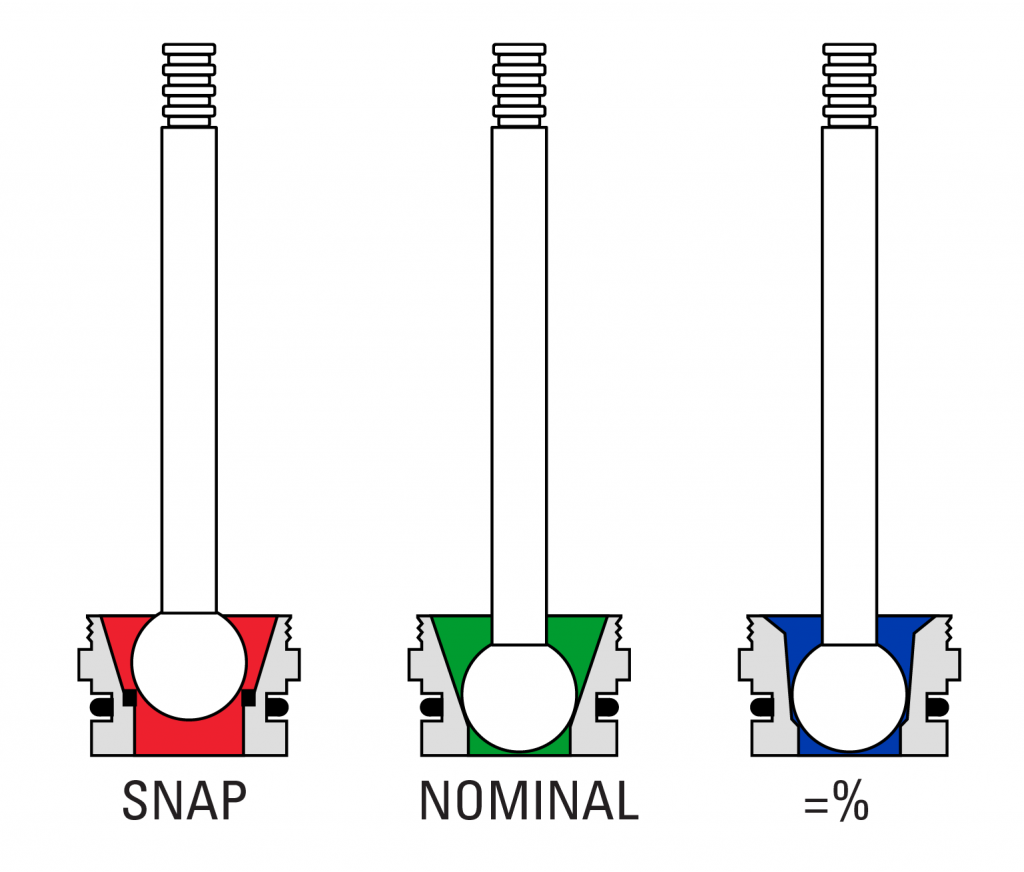
In a sliding stem valve, the plug moves up and down relative to the seat. The shape of the plug or the openings in the cage decide how much flow passes at each position.
Trim also sets the rated flow coefficient and the shutoff class. Changing only the trim can therefore resize a valve without replacing the body.
Main Parts of Valve Trim
Not every valve has all five parts. A top guided valve has no cage, while a cage guided valve uses the cage both for guiding and for flow shaping.
The seat ring and plug together decide the seat leakage class. Metal seats usually reach Class IV or V, while soft seats can reach Class VI.
6 Common Types of Control Valve Trim
A shaped plug in a top or post guided valve without a cage.
A cylindrical cage guides the plug and its windows set the characteristic.
Holes through the plug equalize pressure above and below it.
Window shapes give quick opening, linear or equal percentage flow.
Stages the pressure drop through several paths or cascading orifices.
Many small drilled holes break the jet into small streams.
Balanced trims need a seal between the plug and the cage, which can limit temperature or shutoff. Unbalanced trims give tighter shutoff but need a larger actuator at high pressure.
Special trims such as anti cavitation and low noise are almost always cage guided. The cage provides the space to machine many small flow paths.
How Trim Shapes the Flow Characteristic
Equal percentage: f = R^(x minus 1)
f = fraction of rated Cv
x = fraction of valve travel
R = rangeability, often 50
Worked example at 50 percent travel, R = 50:
Linear: f = 0.5, so 50 percent of rated Cv
Equal percentage: f = 50^(0.5 minus 1) = 50^(minus 0.5)
f = 1 ÷ √50 = 1 ÷ 7.07 = 0.141
Equal percentage gives 14.1 percent of rated Cv
So at half travel, an equal percentage trim passes far less flow than a linear one. Our article on flow characteristics of control valves explains when each shape suits the process.
Rated capacity itself is expressed as Cv, covered in control valve flow coefficient. A reduced trim uses a smaller seat to lower Cv for oversized bodies.
5 Steps to Select the Right Trim
Step 3 is where most trim failures begin. Read our guide on control valve cavitation and flashing before you finalize any high drop liquid valve.
The sizing data from control valve sizing basics feeds every step. Without correct process data, even the best trim will struggle.
Anti Cavitation and Low Noise Trim Design
Cavitation happens when local pressure falls below vapour pressure and the bubbles later collapse on metal surfaces. Anti cavitation trim splits the total drop into several smaller stages so pressure never dips that low.
If the drop is high enough, flow may also become choked, which limits capacity no matter how far the valve opens. Multistage trim helps delay this point.
For gas and steam, noise comes from the high velocity jet leaving the trim. Drilled hole cages create many small jets that shift noise to higher frequencies, which the pipe wall blocks more easily.
These special trims have small passages, so they need clean fluid. Adding a strainer upstream protects them from plugging.
Control Valve Trim Comparison Matrix
| Trim Type | Cavitation Control | Noise Control | Plugging Risk | Relative Cost |
|---|---|---|---|---|
| Contoured plug | Low | Low | Low | Low |
| Cage guided | Low to medium | Medium | Medium | Medium |
| Balanced plug | Low | Medium | Medium | Medium |
| Anti cavitation | High | Medium | High | High |
| Low noise drilled cage | Medium | High | High | High |
The matrix shows the usual trade off. Every gain in cavitation or noise control narrows the flow paths and raises cost and plugging risk.
For dirty service, a contoured plug or a rotary or angle body is often a better choice than a fine cage.
Trim Materials by Service
Kimray reports that zirconia trim outperformed Stellite by about 10 times in ASTM G65 abrasion testing. Hard materials cost more but can save repeated shutdowns.
Worn trim is a leading reason for internal leakage. Our article on control valve passing causes shows how to diagnose it in the field.
Valve Characteristic Calculator
Note that the equal percentage formula gives a small flow even at zero travel. Real valves shut off fully, so the theoretical curve differs near the seat.
- Stable loop gain across the operating range.
- Longer life in erosive or cavitating service.
- Lower noise near the valve.
- Tight shutoff where required.
- Cavitation damage and frequent overhauls.
- Hunting loops and poor control.
- Excessive noise and vibration.
- Seat leakage and wasted product.
FCI Trim Description Tech Sheet
Globe Valve Trim Types on Video
Control Valve Trim Questions and Answers
Related Articles
- Basic Parts of a Control Valve
- Flow Characteristics of Control Valves
- Control Valve Cavitation and Flashing
- Control Valve Seat Leakage Classes
- Control Valve Selection Key Factors
External References
- Control Valve Trim Descriptions, Fluid Controls Institute
- Snap, Nominal and Equal Percentage Trim, Kimray
- Trim, Seats and Springs, Kimray
- Globe Valve Basics, Emerson
- Control Valve, Wikipedia
What We Learn Today
- Trim is the plug, seat, cage and stem that actually throttle the flow.
- Cage window or plug shape decides the linear, equal percentage or quick opening characteristic.
- Anti cavitation and low noise trims stage the pressure drop but need clean fluid.