
Control Valve Cavitation and Flashing Explained: Sigma Factor and Anti-Cavitation Trim
Cavitation sounds like gravel rattling through the pipe. Flashing sounds more like a hiss. Both start the same way, a pressure drop that pushes liquid below its own vapor pressure, but only one of them lets the bubbles collapse violently enough to eat away steel.
Cavitation and flashing both begin when a control valve drops liquid pressure below its vapor pressure, but only cavitation lets the resulting bubbles collapse violently enough to destroy valve trim. This guide explains the difference, the sigma cavitation index, the FL pressure recovery factor, and anti-cavitation trim design.
What is Control Valve Cavitation?
As liquid accelerates through a control valve's restriction, its pressure drops sharply at the narrowest point, called the vena contracta. If that local pressure falls below the fluid's vapor pressure, the liquid flashes into vapor bubbles right at that point. What happens next determines whether this becomes cavitation or flashing.
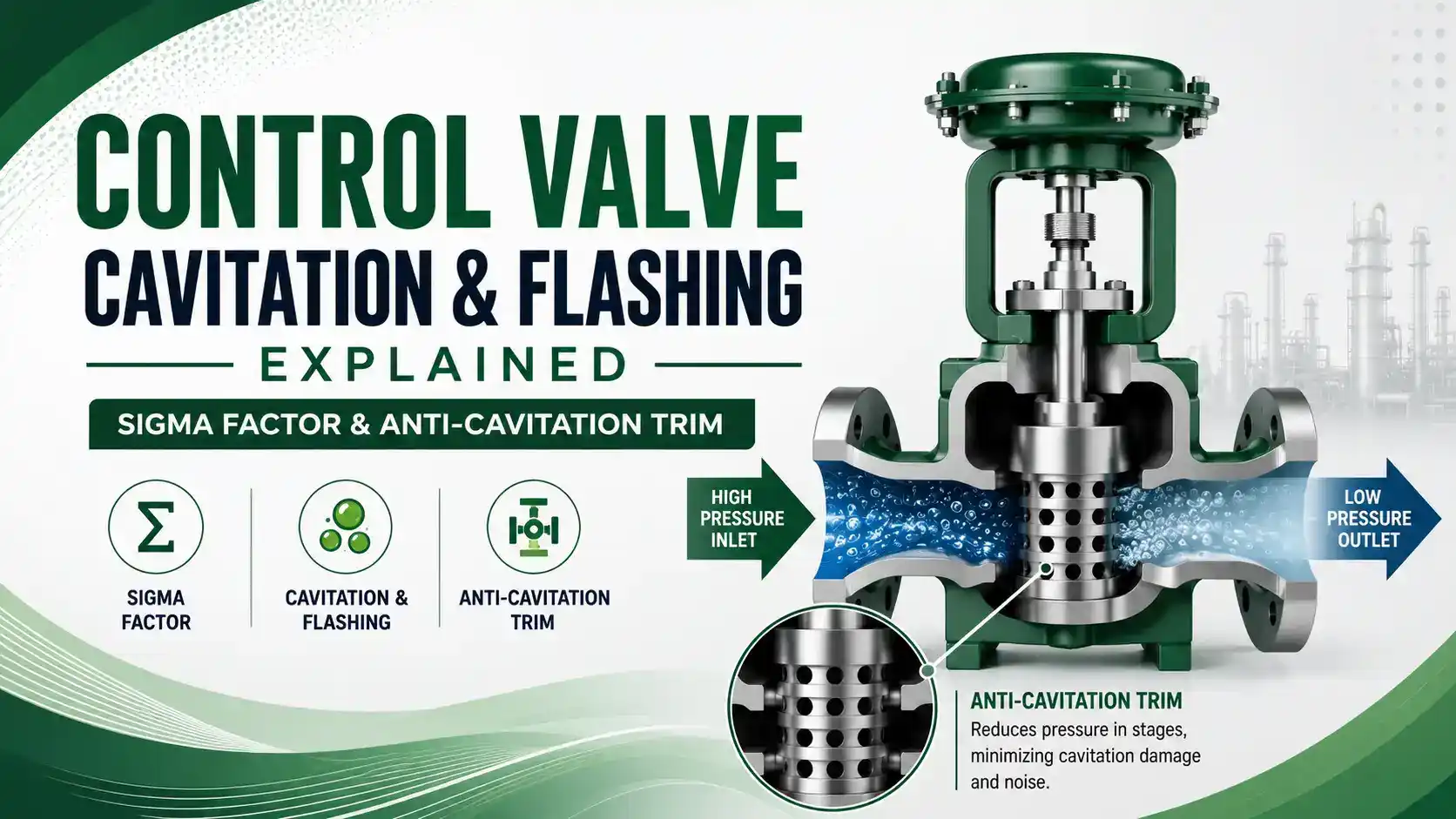
If downstream pressure recovers above the vapor pressure, those bubbles collapse violently, a two-stage process called cavitation. Each collapse creates an intense, localized shockwave, and enough of these implosions striking the same surface will pit and erode valve trim, seats, and downstream piping, sometimes destroying a valve within 24 hours under severe conditions. If downstream pressure never recovers above vapor pressure, the bubbles simply persist as a two-phase vapor-liquid mixture, a phenomenon called flashing, which causes erosive wear rather than the violent implosion damage of cavitation.
Real Life Example
Think of squeezing a garden hose almost shut. Right at the pinch point, water speeds up and its pressure momentarily drops. If you let go and the hose widens back out immediately after, the water settles back to normal, calm flow, roughly like cavitation's bubble collapse. But if the hose stays pinched all the way to the end, the water sprays out chaotically the whole time, never fully recovering, more like flashing's persistent two-phase condition all the way to the outlet.
Cavitation vs Flashing
| Aspect | Cavitation | Flashing |
|---|---|---|
| Downstream Pressure | Recovers above vapor pressure | Stays below vapor pressure |
| Bubble Behavior | Collapses violently | Persists as two-phase flow |
| Damage Type | Pitting from implosion shockwaves | Erosive wear from high-velocity droplets |
| Sound | Gravel or popping rocks | Hissing or sandblasting |
| Prevented By | Anti-cavitation, multi-stage trim | Not preventable by trim; requires hardened materials |
| Damage Speed | Can destroy trim in under 24 hours if severe | Usually slower, more gradual erosion |
Sigma Cavitation Index
Each valve style and trim design has its own published σi and σc values from testing. If the calculated operating sigma for an application falls below the trim's σc, anti-cavitation trim becomes necessary, not just a recommendation.
How Anti-Cavitation Trim Works
Anti-cavitation trim prevents cavitation by breaking one large pressure drop into a series of smaller stages, so the local pressure at any single stage never actually drops below the fluid's vapor pressure. Disc-stack designs, cage trims with tortuous internal flow paths, and multi-stage labyrinth trims all accomplish this the same way: dividing the total energy loss the valve must impose into small, manageable steps rather than one violent drop.
Anti-cavitation trim cannot help with flashing. Since flashing is determined by whether downstream system pressure itself, not just the valve's internal geometry, stays below vapor pressure, no amount of internal valve trim redesign can fix it. Flash service instead requires hardened trim materials, generously sized downstream piping, and careful selection of body materials to tolerate ongoing two-phase erosive wear.
Applications and Risk Areas
High Pressure Letdown
Boiler feedwater and high-pressure letdown stations are classic cavitation risk points.
Hot Condensate Service
High temperature raises vapor pressure, increasing cavitation risk at modest pressure drops.
Pump Recirculation Valves
Minimum flow recirculation valves frequently operate under severe pressure drop conditions.
Refinery Process Units
Flashing crude and hydrocarbon services often require hardened, erosion-resistant trim.
Ball and Butterfly Valve Service
Their low FL factor makes these valve styles especially cavitation-prone at high pressure drop.
Control Valve Retrofits
Retrofitting anti-cavitation trim is a common fix for chronically noisy or damaged valves.
Common Cavitation Assessment Mistakes
✅ Do This
- Check the cavitation index at minimum flow, not just normal operating flow
- Account for the valve's actual FL factor, not just the pressure drop across it
- Confirm whether the condition is cavitation or flashing before selecting a fix
- Specify anti-cavitation trim when operating sigma falls below the trim's σc
❌ Avoid This
- Assuming anti-cavitation trim will also solve a flashing problem
- Using ball or butterfly valves in high pressure drop service without checking FL
- Judging severity purely by ear without confirming downstream pressure vs vapor pressure
- Ignoring vendor-published sigma values in favor of trim velocity estimates alone
Cavitation, Flashing, and Choked Flow: Video Walkthrough
Frequently Asked Questions
- Control Engineering, Control Valve Cavitation
- Valin, Control Valve Liquid Flow, Choked Flow, Cavitation, Flashing
- Trimteck, Cavitation Guide for Control Valves
What We Learn Today
- Cavitation and flashing both start when local pressure drops below the fluid's vapor pressure
- Cavitation lets bubbles collapse violently when downstream pressure recovers, causing pitting damage
- Flashing keeps bubbles persisting as a two-phase mixture, causing erosive rather than implosive wear
- The sigma cavitation index and FL pressure recovery factor determine whether anti-cavitation trim is needed
- Anti-cavitation trim solves cavitation but cannot fix flashing, which requires hardened materials instead