A magmeter with a drained or half filled tube can still show flow, because its open electrodes pick up noise and the totalizer keeps counting. A well tuned empty pipe alarm forces the output to zero and tells the operator exactly why.
Electromagnetic flowmeters only measure correctly when the tube is full of conductive liquid. Empty pipe detection watches the electrode circuit, stops false totals and flags installation problems before they reach the billing report.

What Is Empty Pipe Detection?
Empty pipe detection is a diagnostic function in an electromagnetic flowmeter that checks whether the measuring tube is filled with liquid and, when it is not, drives the flow output to zero and raises an alarm. Without it, a drained meter can report flow that never happened, as described in magnetic flow meter troubleshooting.
A magmeter works on Faraday law: a conductive liquid moving through a magnetic field generates a small voltage between two electrodes. The voltage is only a few millivolts, so the meter is very sensitive to anything that disturbs the electrode circuit, as explained in electromagnetic flow meter working principle.
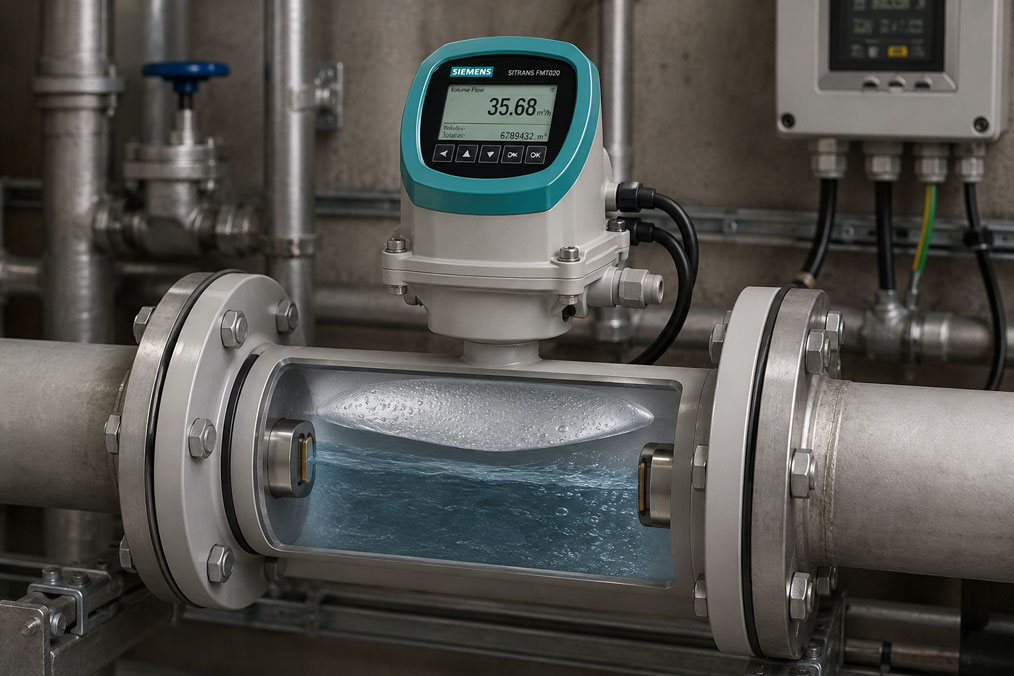
When the tube drains, the electrodes are no longer connected through liquid. They float at a high impedance and act like small antennas, picking up electrical noise that the converter may treat as a real flow signal.
How a Magmeter Knows Its Tube Is Empty
SA Instrumentation and Control explains that an empty measuring tube leaves the electrode circuit open, so it has a high impedance and becomes vulnerable to interference that causes wrong flow readings and totals. The transmitter therefore measures the electrical condition of the electrodes and compares it with a stored limit.
The size of the jump depends on the liquid. High electrical conductivity gives a large and clean difference between full and empty, while poorly conducting liquids make the two states look similar.
Emerson describes the Rosemount Empty Pipe value as a unitless, read only number. It depends on sensor type, line size, process fluid and wiring, so there is no universal value that means empty.
4 Proven Empty Pipe Detection Methods
The measuring electrodes are checked for resistance to earth. No extra hardware is needed.
An extra electrode at the top of the tube senses the first air at the crown.
The converter checks the symmetry of the flow profile across the tube.
Pump or valve status forces the output to zero and stops the counter.
SA Instrumentation and Control notes a weakness of the plain electrode resistance method: it switches only when the liquid level falls below the electrode axis. It also becomes unreliable with coatings and in long or vertical pipes.
The separate full pipe electrode sits at the top of the bore and gives an early warning of partial filling in horizontal pipes, even with only a little gas at the crown. Its switching point must be set below the lowest conductivity expected in the process, and it can respond slowly in viscous liquids, sludge and incrustation.
For the flow profile method, the same source describes the KROHNE IFC 300 test, which detects incomplete filling regardless of conductivity, viscosity or coating. The test generally responds only once the liquid level has fallen to about 75 percent, so the normal empty pipe detector must stay active as well.
External control signals are described as the simplest and most reliable method, because a pump or valve signal sets the outputs to zero whatever the fluid condition. The drawback is that any volume passing while the pump is off goes unmeasured, a point worth checking against the pump type and its coast down.
Why Partially Filled Pipes Give False Totals
A magmeter calculates volume flow as average velocity times the full bore area. If the tube is only half full, the velocity signal is distorted and the area assumption is wrong, so the reading can be badly high or low, one of the issues covered in flow meter reading stability factors.
SA Instrumentation and Control adds that the flow profile in a partially filled tube becomes asymmetrical, with less liquid in the upper part. A level that wanders above and below the electrode axis can make the reading jump between real flow and noise.
Before you blame empty pipe detection for random totals at night, trend the flow against pump status. Phantom flow appearing only when the pump stops almost always means the tube drains or the electrodes see air.
Tuning the Empty Pipe Trigger Level
Emerson describes three parameters for Rosemount empty pipe detection. The EP Value is calculated by the transmitter, the EP Trigger Level is the limit, and EP Counts is the number of consecutive readings above the limit needed to raise the alert.
In the Emerson field guide example, the sensor reads 0.2 when full and 80.0 when empty. A trigger level of 25.0 and EP counts of 10 give a reliable alarm with good margin on both sides.
k = position between full and empty, as a fraction
Example:
EP full = 0.2, EP empty = 80.0, k = 30 percent
Span = 80.0 minus 0.2 = 79.8
Trigger = 0.2 + 0.30 × 79.8 = 0.2 + 23.94
Trigger = 24.14
Margin above full = 23.94, margin below empty = 55.86
A small k gives sensitive empty pipe detection for clean liquids, while a larger k avoids nuisance trips when the full value drifts with conductivity or coating.
Empty Pipe Trigger Level Calculator
Second Worked Example: Cost of Phantom Flow
Suppose a 100 mm effluent meter has no working alarm and its drained tube shows a noisy 3.5 m³/h each night. Over a 10 hour pump stop, the totalizer adds 3.5 × 10 = 35 m³ that never flowed.
Over 30 nights that becomes 1050 m³, enough to spoil a water balance or an effluent charge. The same meter with a correctly tuned trigger level would hold zero flow and log the empty event, a good reason to review alarms under ISA 18.2 alarm management.
Low Conductivity, Coating and Grounding Problems
Most magmeters need a minimum liquid conductivity, often around 5 µS/cm, though the exact figure is in each datasheet. ICS Schneider points out that demineralised water, some solvents and weakly ionised liquids can be critical, while normal water and wastewater usually meet the requirement.
When conductivity is low, the full pipe EP value rises toward the empty value and the alarm may trip on a full tube. Emerson lists raising the process conductivity above 50 µS/cm as one remedy for unexpected empty pipe alerts.
Insulating deposits such as limescale, grease or sludge act the same way, because they separate the electrode from the liquid. Choosing the right liner and electrode for wastewater reduces this risk.
Grounding matters too. A metal pipe section replaced by plastic, or a loose earth strap, changes the reference that the diagnostic relies on, so review the grounding techniques before changing any setting.
ICS Schneider stresses that an empty pipe alarm means insufficient plausible electrode contact at the measuring point. It does not always mean the whole line is empty.
Installation Rules to Keep the Tube Full
The best empty pipe detection alarm is one that never needs to trip. Good layout keeps the sensor flooded at all flows, following the magnetic flow meter sizing and installation guidance from the supplier.
During commissioning, record the full and empty EP values on the loop sheet. The next technician can then retune the trigger level in minutes instead of guessing.
Empty Pipe Detection Alarm Handling
When the alarm sets, the transmitter normally forces the flow reading to zero, freezes the totalizer and flags a status bit. On a 4 to 20 mA loop this usually means 4 mA, so the DCS must read the digital status to tell zero flow from an empty tube.
Troubleshooting Unexpected Empty Pipe Alarms
- Confirm the sensor is really full at the moment of the alarm.
- Check for air or gas, especially at pump start.
- Measure process conductivity under real conditions.
- Inspect electrodes for coating, insulation or damage.
- Verify earthing rings, straps and pipe material.
- Inspect remote cable shielding, moisture and terminal numbers.
- Only then adjust the trigger level or EP counts.
This order follows the ICS Schneider checklist, which advises against lowering empty pipe detection sensitivity until the real cause is found.
- Stops false totals when the line drains.
- Built into most converters at no extra cost.
- Warns of air, coating and grounding faults.
- Adjustable trigger and counts for each process.
- Less reliable in very low conductivity liquids.
- Plain electrode method reacts only below the axis.
- Coating can mask the empty condition.
- Needs tuning after a liquid or wiring change.
Where Empty Pipe Detection Matters Most
Empty pipe detection is essential wherever pumps start and stop or lines drain between batches. Typical cases include borewell and booster pumping, effluent transfer, tanker unloading and dosing skids, where magnetic and ultrasonic meters are both common.
Rosemount Tunable Empty Pipe Field Guide
Promag Empty Pipe Setup Video
Empty Pipe Detection FAQ
It is a built in diagnostic that checks whether the measuring tube is full of liquid. When the tube is empty, it forces the flow output to zero and raises an alarm.
Without it, open electrodes pick up noise and the converter may show flow. The totalizer would then keep adding volume that never passed through the line.
The converter measures the electrical impedance between the electrodes and earth. A full tube gives a low value, while air between the electrodes gives a much higher one.
Rosemount converts this reading into a unitless EP value and compares it with a trigger level. The alarm sets only after several consecutive readings exceed that limit.
Record the EP value with the pipe full and again with it empty. Then set the trigger level between the two, closer to the full value for higher sensitivity.
Emerson shows a full reading of 0.2 and an empty reading of 80. A trigger of 25 with counts of 10 works well in that example.
Common causes are entrained air, coating on the electrodes, low conductivity and poor grounding. The electrode may also be wrongly placed at the top of the pipe.
Check these causes in order before changing any setting. Raising the counts or the trigger level should come last, only after the real cause has been found and fixed.
The plain electrode method reacts only when the level drops below the electrode axis. A full pipe electrode at the crown gives earlier warning in horizontal lines.
A flow profile test, as in the KROHNE IFC 300, also detects partial filling. It generally responds only once the level in the tube falls to about 75 percent.
Yes, because a poorly conducting liquid makes the full and empty values look similar. The alarm may then trip on a full tube or fail to trip on an empty one.
Emerson lists raising conductivity above 50 µS/cm as one remedy. Always check the minimum conductivity in the meter datasheet before you change any setting.
Mount it where the tube stays flooded, ideally in a vertical line with upward flow or at a low point. Keep the electrodes on the horizontal axis, never at the crown.
Avoid downward lines that end in an open discharge. Also keep the meter away from pipe high points and pump suctions where air pockets gather.
Related Articles
- Magnetic Flow Meter Troubleshooting
- Electromagnetic Flow Meter Working Principle
- Magnetic Flow Meter Sizing and Installation
- Liner and Electrode for Wastewater Type
- Ultrasonic vs Magnetic Flow Meter, 7 Differences
External References
- Tunable Empty Pipe Field Guide, Emerson
- Empty Pipe and Partial Filling Detection in EMF Meters, SA Instrumentation and Control
- Magnetic Flow Meter, Wikipedia
What We Learn Today
- Empty pipe detection watches the electrode impedance of a magmeter and forces the output to zero when air replaces the liquid, stopping false totals.
- Tune the trigger level between the recorded full and empty EP values, and raise EP counts where air slugs or entrained gas are likely.
- Low conductivity, electrode coating and poor grounding cause most nuisance alarms, so fix those before lowering sensitivity or disabling the function.