
Flow meter readings that jump around are almost never random. They trace back to one or more of a fairly small, well understood set of factors, spanning hardware, installation, configuration, calibration, and the process itself.
An unstable flow meter reading is rarely a mystery once you know where to look. It is almost always one of a handful of well documented culprits, and most of them are fixable without replacing the meter.
Flow meter reading stability depends on far more than the meter itself. Fluid behavior, pipe installation geometry, electrical grounding, calibration status, and even upstream process equipment all shape whether a reading holds steady or drifts and jumps.
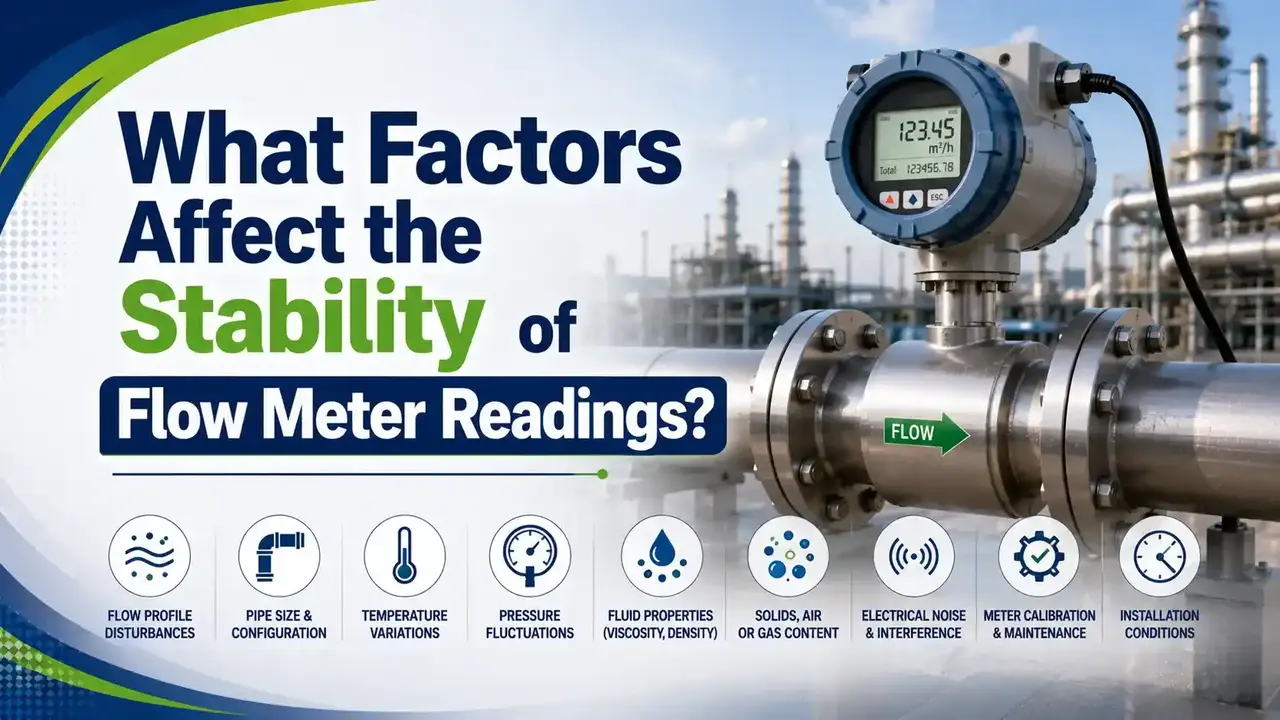
This guide covers all 15 factors that commonly destabilize flow meter readings, the 10 practical solutions to address them, and the straight pipe run requirements that prevent turbulence related instability before it ever starts.
15 Factors That Cause Unstable Flow Meter Readings
1. Fluid Characteristics
Changes in viscosity or density affect different flow meter types differently.
2. Air Bubbles
Entrained air or gas in the fluid causes fluctuating readings.
3. Pipe Vibration
Mechanical vibration interferes with the meter's sensing elements directly.
4. Pulsating Flow
Diaphragm or piston pumps can produce pulsatile rather than smooth flow.
5. Improper Installation
Mounting too close to a bend, pump, or valve creates turbulent flow.
6. Temperature Fluctuations
Rapid fluid temperature changes cause transient reading shifts.
7. Electrical Interference
Noise from nearby equipment can corrupt the meter's signal.
8. Wear and Tear
Mechanical wear degrades internal components over time, the same aging pattern covered in our guide to field sensor installation precautions.
9. Calibration Drift
An improperly calibrated meter gives unstable or inaccurate readings.
10. Pressure Fluctuations
Variability in line pressure also destabilizes the reading, similar to the pressure transmitter installation factors that shape a stable measurement.
11. Blockages
Partial blockages or fouling create unpredictable flow profiles.
12. Software Glitches
Firmware or software issues in digital meters cause instability too.
13. Scaling and Fouling
Material buildup on internal surfaces degrades readings over time, much like the fouling concerns covered in our level sensor selection guide.
14. Manual Interference
Tampering with settings or manual adjustments introduces instability.
15. Instrumentation Issues
Signal processing faults, bad wiring, or a poorly designed isolation and grounding scheme in the control system all contribute.
If you experience unstable flow meter readings, a systematic diagnosis is essential to identify the actual root cause rather than guessing, especially since several of these factors, like electrical interference and calibration drift, produce very similar looking symptoms on the display.

Straight Pipe Run Requirements by Meter Type
Improper installation, specifically mounting a meter too close to a bend, pump, or valve, is one of the most common and most preventable causes of unstable flow meter readings. Every meter technology needs a certain length of undisturbed, straight pipe both upstream and downstream to let a proper flow profile develop before measurement.
| Meter Type | Typical Upstream Run | Typical Downstream Run |
|---|---|---|
| Orifice plate (DP) | 10 to 30 diameters | 5 diameters |
| Magnetic flow meter | 5 diameters | 3 diameters |
| Turbine flow meter | 10 to 20 diameters | 5 diameters |
| Vortex flow meter | 15 to 20 diameters | 5 diameters |
| Ultrasonic (clamp on) | 10 to 20 diameters | 5 diameters |
| Coriolis | Minimal, largely insensitive | Minimal |
These figures are general guidance, and actual requirements can shift based on beta ratio, the specific upstream fitting, and manufacturer recommendations, similar to the flow related sizing considerations covered in our guide to selecting the right sensor for an application.
📏 Interactive Straight Pipe Run Calculator
Select your meter type and enter your pipe diameter to get the recommended straight run lengths.
How to Solve Flow Meter Stability Issues
The table below maps each factor to a concrete solution, the same practical, factor by factor approach used in our guide to pressure transmitter installation.
| Factor | Solution |
|---|---|
| Fluid Properties | Adopt flow meters with built in compensation for density or viscosity variation, and calibrate regularly against actual fluid properties |
| Air Bubbles | Incorporate air eliminators or air traps to remove entrained air before the fluid reaches the meter |
| Pipe Vibration | Employ vibration isolation techniques, or reposition the meter away from the vibration source entirely |
| Pulsating Flow | Introduce a flow smoother or flow conditioner upstream to equalize the flow before it reaches the meter |
| Installation Errors | Follow manufacturer guidelines, with sufficient straight pipe length both upstream and downstream |
| Temperature Fluctuations | Use meters with temperature compensation, or stabilize the temperature around the meter itself |
| Electrical Interference | Install shielded cabling and proper grounding, isolating power supplies where possible |
| Wear and Tear | Schedule regular maintenance and inspections to catch and replace worn components early |
| Calibration Issues | Follow a strict calibration schedule per manufacturer guidelines or industry norms |
| Pressure Changes | Employ pressure compensating flow meters, or stabilize line pressure through control valves |
Most flow meter troubleshooting fails not because the fix is hard, but because the wrong factor got blamed first. A grounding problem and a calibration problem can look identical on the display, and only a systematic check tells them apart.
Watch: Straight Piping Requirement for Flow Meters
This video explains why a specified length of straight pipe is required both before and after a flow meter across several different technologies.
Video: "Straight Piping Requirement for Flow Meters", Measurement In A Minute, via YouTube.
FAQs on Flow Meter Reading Stability
You May Also Like
What is Electromagnetic Interference (EMI)?
Electrical interference is one of the 15 factors covered above, and it deserves a closer look on its own. This guide covers what EMI actually is, how it couples into sensitive instrumentation signals, and the shielding and grounding practices that keep it under control.
Read Full Article →External References
What we learn today
- Fifteen distinct factors, spanning fluid behavior, installation, electrical noise, calibration, and mechanical wear, can destabilize a flow meter reading.
- Improper installation, specifically insufficient straight pipe run, is one of the most common and most preventable causes.
- Straight pipe run requirements vary significantly by meter technology, from around 30 diameters for some orifice configurations to nearly none for Coriolis meters.
- Electrical interference and calibration drift can look identical on a display, which is why systematic diagnosis beats guessing.
- Most stability issues have a specific, documented solution, from air eliminators to shielded cabling to pressure compensating meter designs.